




Blue Glass Fruit Bowl
A blue glass fruit bowl brings rich colour and light to a table, moving effortlessly from Victorian opulence to clean Art Deco geometry.
Blue Glass Fruit Bowl
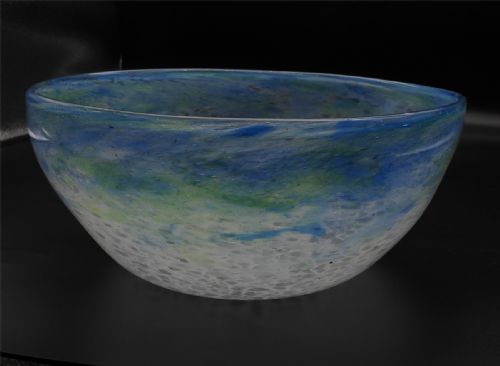
A blue glass fruit bowl is a decorative vessel intended for display or service, drawing the eye through deep cobalt shades, milky opalescence, and luminous iridescence. The selection on this page spans from the late Victorian and Edwardian eras into the roaring heights of the 1920s and 1930s.
Forms range from simple footed bowls and open coupes to grand centrepieces fitted with silver mounts. Makers represented here crossed Britain, France, Germany, Belgium, and Bohemia, working in distinct regional idioms.
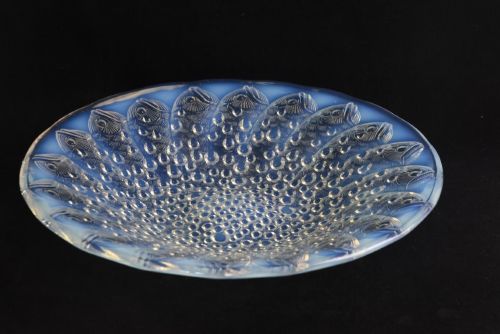
The most prevalent examples on this page date to the Art Deco period, showcasing press-moulded techniques and stylised floral motifs that defined interwar interiors. Alongside these sit earlier Bohemian cobalt pieces and iridescent Austrian vessels.
How they were made
Makers shaped these bowls through free-blowing, press-moulding, and casing layers of molten metal, often combining lead crystal with coloured glass. Techniques such as acid-etching, enamelling, and fire-polishing created textured surfaces that caught the light from every angle.
Several pieces incorporate metalwork, notably German 800 silver frames and mounts fitted securely around the blown or moulded glass bodies. Opalescent effects were achieved by adding bone ash or other agents to the glass batch, causing the cooled object to scatter blue light in direct illumination and amber tones by transmitted light.
Listings on this page span the Edwardian era through the 1930s, uniting pressed opalescent glass, heavy cobalt vessels, and silver-mounted centrepieces.
What varies in quality
Quality rests upon the crispness of the moulding and the depth of the glass body, distinguishing mass production from master craftsmanship. Sharp relief work in floral designs and clean finishing along the rim reveal the hand of skilled workshops.
The integration of materials also dictates standing, where silver mounts fit snugly to the glass and iridescent or opalescent treatments show an even, controlled play of colour across the surface.
Rene Lalique·Val St Lambert·Jobling Opalique·Loetz
The Blue Glass Fruit Bowl Glossary
- Opalescent Glass
- Glass that diffuses light so that it appears milky-blue when viewed by reflected light and warm amber by transmitted light. This effect was particularly favoured by interwar French makers.
- Cobalt Glass
- Deep blue glass coloured by the addition of cobalt oxide to the batch during melting. It produces a rich, dark tone seen frequently in nineteenth-century Bohemian wares.
- Iridescent Glass
- Glass treated with metallic salts while hot to create a shimmering, rainbow-like sheen on the surface. Austrian makers mastered this technique during the Art Nouveau period.
- Comport
- A raised bowl standing on a stem and foot, traditionally used for serving fruit or sweetmeats at the table. They elevate the display above the surface level.
- Press-Moulded Glass
- Glass formed by pressing molten metal into a metal mould using a plunger, allowing for complex repeating patterns and three-dimensional motifs.
Blue Glass Fruit Bowl: Frequently Asked Questions
How do I clean an antique glass bowl?
Wash the vessel gently by hand in lukewarm water using a mild, non-abrasive detergent. Avoid soaking pieces with silver mounts or enamel decoration to protect the metal and applied details.
Dry the glass immediately with a lint-free cloth to prevent water spots and maintain its natural lustre.
Can I use these bowls for actual fruit?
These bowls can certainly hold fruit, though many collectors prefer to display them empty to appreciate the colour, form, and surface texture without obstruction.
If you do use them for fruit, line the base with a soft cloth if the fruit is heavy or acidic, protecting the interior glass from potential scratching.
How do I tell Art Deco bowls from earlier pieces?
Art Deco bowls, generally dating to the 1920s and 1930s, lean towards geometric lines, stylised floral motifs, and press-moulded opalescent finishes. They often bear maker marks or registry numbers.
Earlier Victorian and Edwardian pieces tend to feature heavy cobalt glass, sometimes paired with detailed silver mounts or traditional cut patterns rather than moulded relief.
What makes opalescent glass change colour?
Opalescent glass contains chemical agents that scatter shorter light wavelengths. This optical property makes the glass appear milky-blue when light bounces off the surface.
When you hold the same piece up to a light source, the transmitted light passes through as a warm amber or orange tone.