




Blue Frosted Art Glass
Blue frosted art glass brings together tactile texture and colour, offering collectors vessels and lamps from the Victorian era to the Art Deco period.
Blue Frosted Art Glass
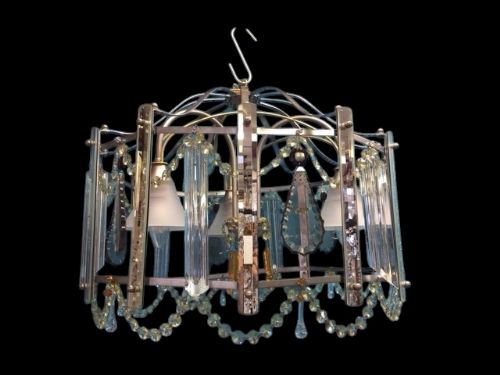
When you search for blue frosted art glass, you encounter decorative objects designed to catch light through matte surfaces and coloured tints. The selections span vases, perfume bottles, powder boxes, and table lamps originating from French and English makers.
Vessels and figures dominate the current selection, featuring moulded and pressed forms from the early twentieth century. Art Nouveau and Art Deco designs appear frequently, alongside Victorian satin glass pieces.
How they were made
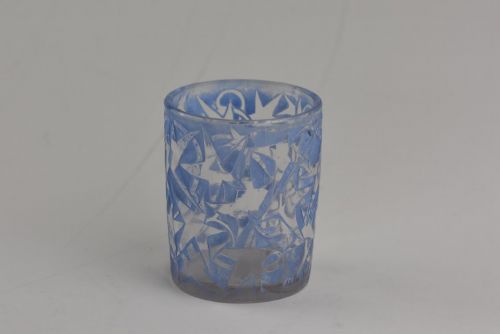
Makers utilised moulded glass, pressed glass, and cameo glass techniques to achieve dimensional depth. Acid etching and enamel applications often supplemented the frosted finish to define floral and geometric motifs.
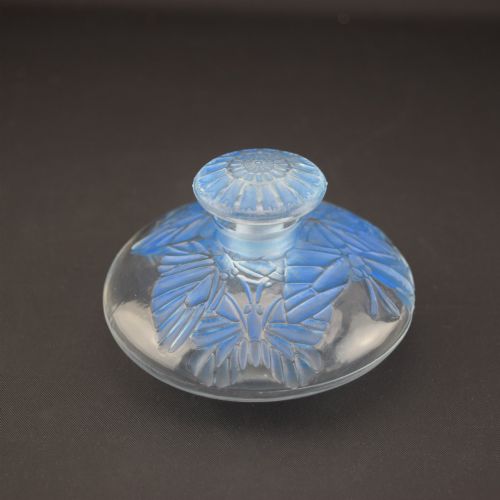
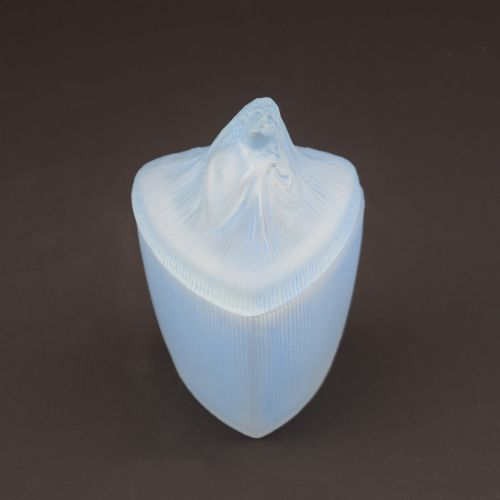
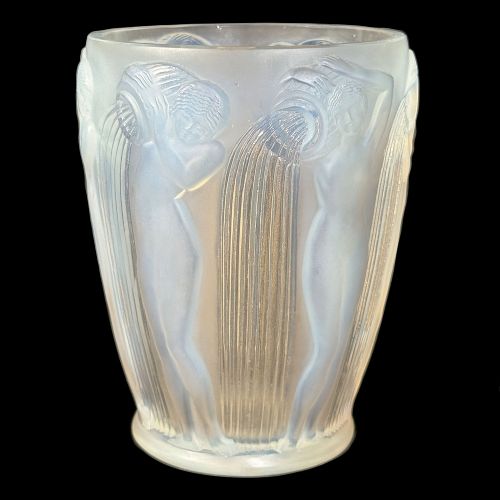
Opalescent and stained effects interact with the frosted ground, shifting tone depending on the light source. Skilled pressing allowed intricate details like butterflies, naiads, and foliage to emerge from the matrix.
Some beetles and butterflies found a permanent home behind glass, captured forever in the delicate frosted wings of perfume stoppers and paperweights.
What varies in quality
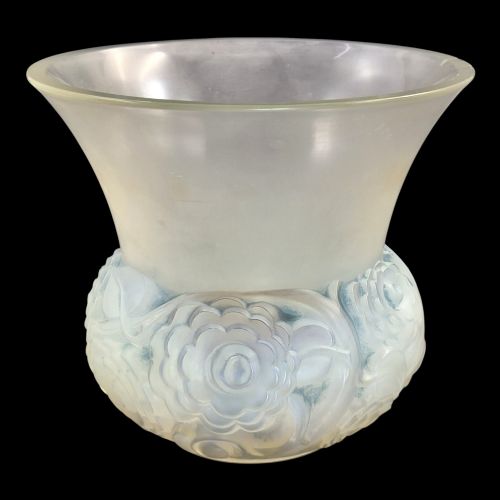
The degree of crispness in the moulded relief determines how sharply defined the design appears against the matte background. Finer examples retain precise detailing in hair, feathers, and floral petals without blurring at the edges.
The depth and consistency of the blue colouration influence visual impact, ranging from subtle tinting to dense saturation. The integration of staining within recessed areas requires expert hand-finishing.
Rene Lalique·Emile Galle·Marius Ernest Sabino·Baccarat·Jobling
The Blue Frosted Art Glass Glossary
- Frosted glass
- Glass treated to achieve a matte, non-reflective surface by acid etching or sandblasting. This texture diffuses light softly across the object.
- Cameo glass
- Glass vessels created with multiple fused layers of different colours, then carved or acid-etched to produce a raised design. The process demands immense patience and skill.
- Opalescent glass
- Glass that displays a milky translucency with varying hues, often appearing blue in transmitted light and warm amber in reflected light. It creates an ethereal glow.
- Plafonnier
- A ceiling-mounted bowl light fixture popular during the Art Deco period. These fixtures diffuse illumination evenly across decorated glass surfaces.
Blue Frosted Art Glass: Frequently Asked Questions
How do I clean blue frosted art glass?
Wash the glass gently in lukewarm water using a mild, non-abrasive soap. Avoid harsh scrubbers that can damage the delicate matte texture of the frosted surface.
Dry the piece thoroughly with a soft, lint-free cloth to prevent water spots from forming on the textured areas.
How do I tell Art Nouveau from Art Deco pieces?
Art Nouveau items feature organic, flowing lines inspired by natural forms like flowers, vines, and female figures. The overall aesthetic feels fluid and asymmetrical.
Art Deco objects rely on symmetry, geometric patterns, and stylised motifs such as sunbursts and angular steps, reflecting industrial modernity.
What is the difference between frosted and satin glass?
Frosted glass describes a matte finish achieved mechanically or chemically, scattering light uniformly across the piece. It appeared extensively in twentieth-century French production.
Satin glass typically refers to Victorian pieces treated with acid to produce a velvety sheen that resembles fabric, often with shaded colouration.
Where were most of these glass objects made?
A significant proportion of these decorative items originated in France, particularly during the height of the Art Nouveau and Art Deco movements. Major workshops operated in Paris and the regions.
English makers also produced notable examples, especially during the Victorian period, contributing distinct styles of moulded and satin glass.