
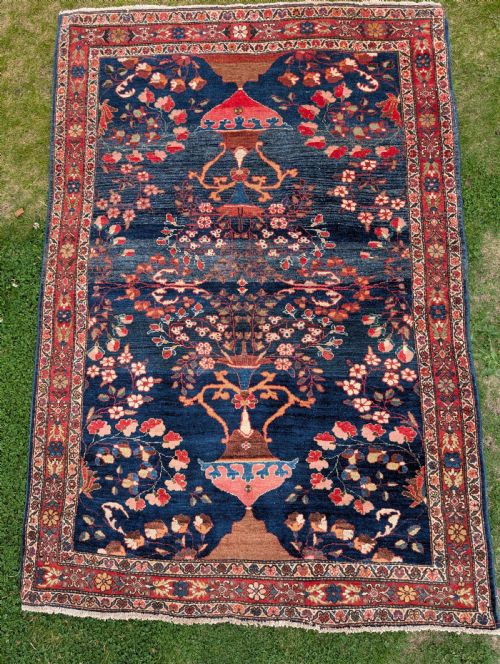
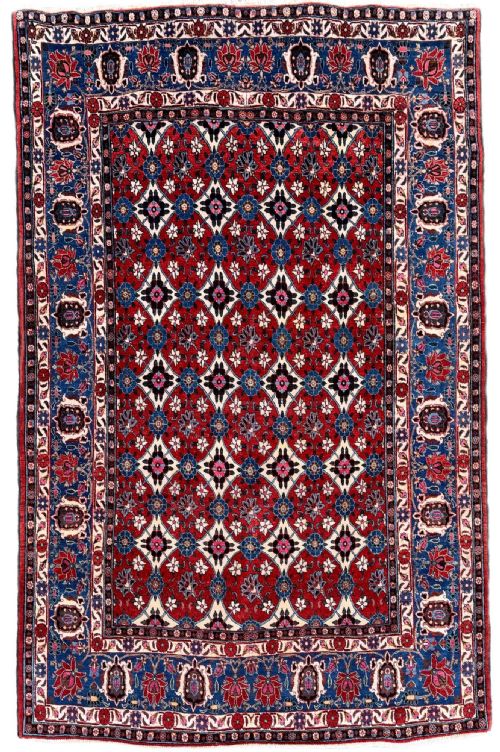
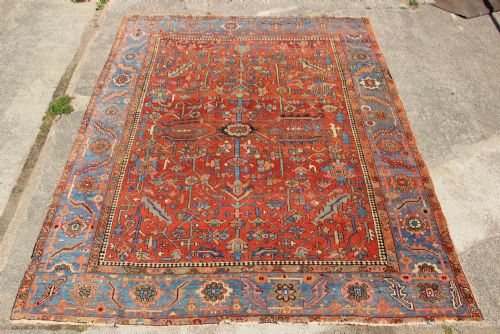
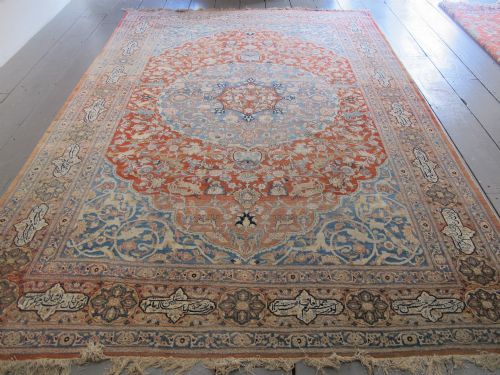


Blue Border Persian Carpet
A blue border persian carpet brings centuries of regional weaving traditions, rich wool piles and distinct graphic framing directly into a room.
Blue Border Persian Carpet
When you search for a blue border persian carpet, you are looking at floor coverings woven across towns, villages and tribal regions of Persia during the nineteenth and early twentieth centuries. These textiles span specific urban centres like Tabriz, Kashan and Isfahan alongside rural weaving districts such as Heriz, Veramin, and Sultanabad.
The pieces listed on this page represent a diverse array of room-sized carpets, long gallery runners and smaller area rugs. Most examples date from the late nineteenth century up through the nineteen-thirties, reflecting traditional weaving methods passed down through generations.
Buyers will encounter various regional designs, from the grand medallion layouts of city workshops to the geometric tribal motifs of Khamseh and Qashqai weavers. These carpets bring historical depth and structural framing to domestic interiors through their characteristic blue borders.
How they were made
The construction of these carpets relies on durable natural materials, predominantly wool for the soft pile coupled with cotton foundations for warp andOccasionally silk threads in finer urban pieces. Artisans tied hand-knotted piles onto supportive warp and weft grids using traditional upright looms.
Weavers utilised natural dyestuffs extracted from plants, roots and minerals to achieve deep indigo blues alongside madder reds and earthy tones. These organic dyes allow the wool to age gracefully, developing rich patinas across the field and border over decades of use.
Blue Border Persian Carpet Retail Price Guide 2026
Typical asking prices for blue border persian carpet among the pieces listed under this phrase on Sellingantiques today, from the lower quarter to the upper quarter. They describe what is for sale here now, not the wider market.
Some tribal carpets secretly hide small hand-woven animal motifs and wandering peacocks inside their borders.
What varies in quality
Quality in these carpets rests upon the fineness of the knot density and the precision of the underlying wool preparation. Finer urban workshops achieved intricate curves and detailed floral motifs, whereas rural and tribal pieces relied on bolder, geometric interpretations.
The depth and saturation of the natural dyes, particularly within the contrasting border work, dictate visual balance and longevity. Preservation of the original outer edges and fringe integrity also define the upper tier of surviving examples.
Ziegler and Co
The Blue Border Persian Carpet Glossary
- Warp
- The vertical threads stretched tightly on the loom that form the structural skeleton of the carpet. Fringes are typically the exposed ends of these foundation threads.
- Weft
- The horizontal threads passed back and forth between the warp threads to lock the rows of knots in place. They stabilise the body of the textile.
- Pile
- The upright cut or looped wool, cotton or silk fibres that form the soft upper surface of the carpet. This is the part that receives foot traffic and displays the colour.
- Medallion
- A large central ornamental design motif placed in the middle of the carpet field. It serves as the primary focal point for many regional Persian weaving styles.
- Kelleh
- A long, narrow format rug traditionally used in Persian domestic interiors as a side carpet. These proportions suit hallways or specific room layouts.
Blue Border Persian Carpet: Frequently Asked Questions
How do I clean a vintage carpet?
Professional specialist cleaning is essential for antique wool and cotton textiles to prevent dye bleeding or structural damage.
Regular gentle vacuuming without a rotating power brush helps remove embedded dust and maintains the pile.
Can I place these under heavy furniture?
Distributing weight using furniture cups helps prevent permanent crushing of the delicate hand-knotted wool pile over time.
Rotating the rug every year ensures even exposure to natural light and foot traffic across the room.
Are these carpets suitable for high traffic?
Traditional wool and cotton construction provides remarkable durability for everyday domestic living areas and hallways.
Using a quality underlay prevents slipping and cushions the foundation against hard flooring surfaces.
How do I identify a regional style?
Examining the specific geometry, border patterns and palette reveals whether a piece originated from city workshops or tribal areas.
Heriz carpets show bold geometric medallions, whereas Kashan and Tabriz feature finer floral curves.