
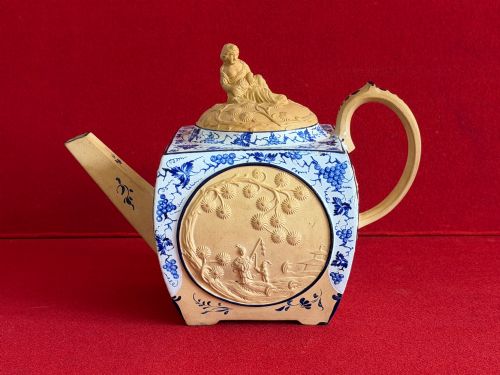
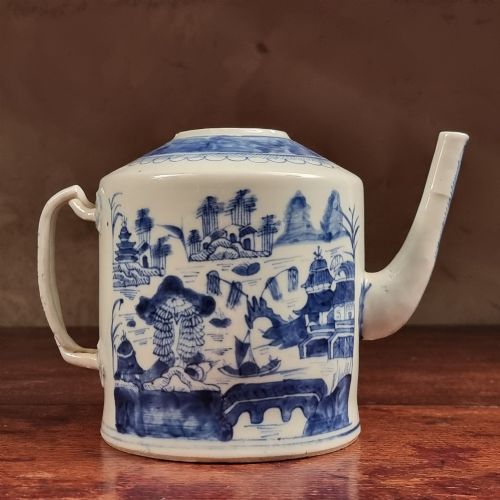
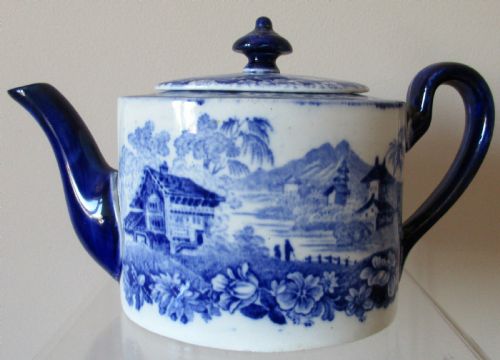
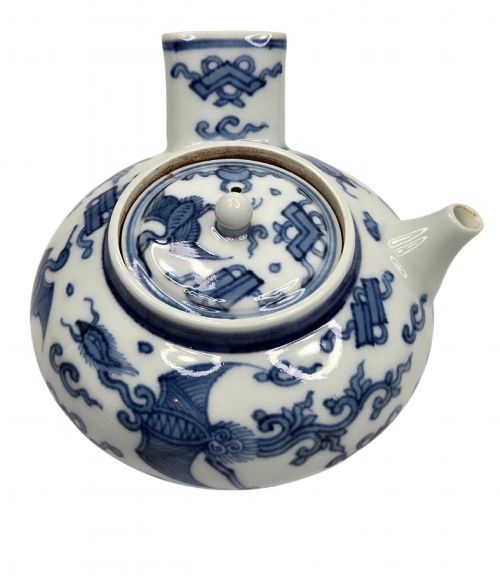


Blue and White Teapot
A blue and white teapot brings centuries of cobalt painting and ceramic tradition straight to the table.
Blue and White Teapot
A blue and white teapot is a vessel designed for brewing tea, decorated in contrasting cobalt pigments across ceramic surfaces. When searching this phrase, a buyer encounters forms ranging from compact English Victorian solitaire pots to large eighteenth-century Chinese export vessels.
The pieces on this page span the seventeenth to the early twentieth century, incorporating English factories, Japanese kilns, and Chinese dynasties. Earthenware, porcelain, and soft-paste porcelain provide the physical body for these historic designs.
Domestic English productions sit alongside East Asian exports influenced by Chinese Ming styles and Japanese Meiji aesthetics. Buyers frequently meet transfer-printed Victorian patterns as well as hand-painted eighteenth-century porcelain.
Materials and production
Potters shaped these vessels from clay bodies including earthenware, porcelain, and soft-paste porcelain before applying cobalt pigment to the surface. Cobalt underglaze painting required precise brushwork directly on the raw clay body prior to the application of a clear glaze.
Transfer printing emerged in the nineteenth century, allowing factories to apply intricate patterns such as Genevese and Native Scenery from engraved copper plates onto earthenware and porcelain. Firing took place in high-temperature kilns to fuse the cobalt pigment permanently beneath or within the glassy coating.
Listings feature ceramics spanning the seventeenth to the twentieth century, combining English earthenware with Chinese porcelain and Japanese stoneware.
Assessing quality and execution
Quality rests upon the crispness of the cobalt decoration, whether hand-painted with fine brush strokes or cleanly transferred from detailed copper plates. Softer, blurred pigment under thick glaze indicates less refined control in the kiln.
The delicacy of the ceramic body and the precision of the potting, from octagonal angles to balanced spouts and handles, distinguish finer examples. Earlier soft-paste porcelain and carefully potted eighteenth-century porcelains display superior translucency and thinness.
Mintons·Copeland·Enoch Wood and Sons·F and R Pratt of Fenton
The Blue and White Teapot Glossary
- Cobalt Underglaze
- Pigment applied to a ceramic body beneath a clear glaze before firing. This technique protects the blue decoration from wear over centuries of use.
- Transfer Printing
- A method of applying engraved designs to pottery using paper tissue inked from a copper plate. It enabled factories to produce complex pictorial scenes consistently.
- Soft-paste Porcelain
- A ceramic material made from clay and ground glass fired at lower temperatures than hard paste. It possesses a warm tone and distinct translucency.
- Sometsuke
- Japanese term for underglaze cobalt blue ceramics. The style draws inspiration from Chinese traditions adapted by Japanese kilns.
- Flow Blue
- A nineteenth-century earthenware style where cobalt pigment blurred slightly during firing. This chemical reaction created a soft, atmospheric haze around the printed design.
Blue and White Teapot: Frequently Asked Questions
Can I use an antique teapot for daily tea?
Many antique teapots remain structurally sound for brewing tea, provided they possess no hairline cracks or major structural repairs.
Earthenware and porous bodies benefit from gentle handling and hand washing rather than immersion in modern dishwashers.
How do I identify eighteenth-century pieces?
Eighteenth-century teapots often feature hand-painted cobalt decoration on soft-paste porcelain or early hard-paste bodies, sometimes marked with blue crescents or factory ciphers.
The weight, potting thickness, and iron-spurred foot rims provide further clues to their age.
What is the difference between Chinese export and English wares?
Chinese export pieces were made in Asian kilns for Western markets, often featuring hand-painted foliate motifs, octagonal shapes, or Kangxi period characteristics.
English wares utilised local earthenware or porcelain bodies, frequently decorated with transfer-printed nineteenth-century scenic patterns.
How should I display a blue and white teapot?
Display these vessels away from direct sunlight and sudden temperature shifts to protect the glaze and any delicate applied gilding.
Secure shelving with adequate depth ensures stability for pieces featuring extended spouts and delicate handles.