
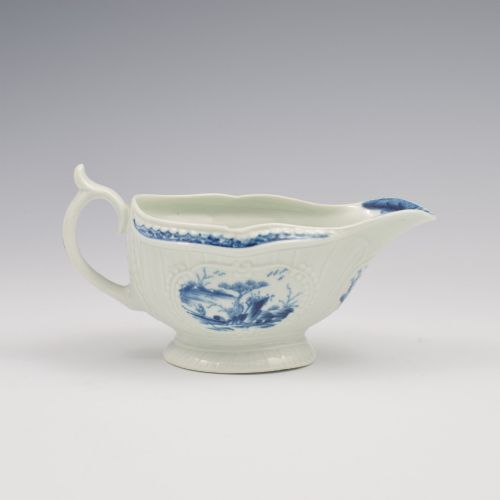
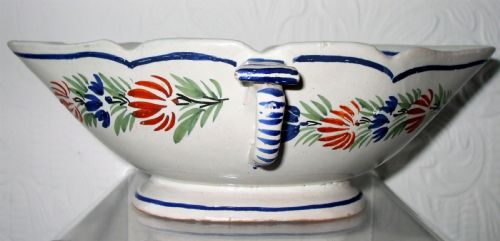


Blue and White Gravy Boat
A blue and white gravy boat brings classic cobalt patternwork to the table, offering centuries of ceramic artistry for daily use or display.
Blue and White Gravy Boat
A blue and white gravy boat is primarily found in forms such as sauce boats, sauceboats, and sauce tureens dating from the eighteenth and nineteenth centuries. These vessels served the dining table during Georgian and Victorian meals, holding sauces and gravies with practical elegance.
The pieces available span various regional traditions, including English porcelain from Worcester and Bow, French faience from Quimper, and robust ironstone from makers like Masons and Rogers. English soft-paste porcelain and earthenware predominate, reflecting the favoured materials of early ceramic production.
Stylistic influences range from Georgian Chinoiserie and Rococo to French Country and Victorian designs. Buyers will encounter both single boats and paired tureens complete with matching bases and ladles.
Materials and construction
Potters shaped these pieces from soft-paste porcelain, earthenware, ceramic, and faience, applying cobalt glaze either by hand-painting or transfer printing. The cobalt colour fused into the glaze during high-temperature firing, producing deep blue imagery against a white ceramic body.
Early porcelain examples utilise delicate soft-paste bodies with moulded or triangular platform shapes, whereas later nineteenth-century pieces employ durable ironstone and earthenware to suit heavier domestic service.
Listings feature pieces from the 18th Century and 19th Century, utilising soft-paste porcelain, earthenware, faience, and cobalt glaze.
Judging quality in blue and white ceramics
Quality rests upon the crispness of the cobalt glaze application and the fineness of the potting, distinguishing delicate soft-paste porcelain vessels from utilitarian earthenware. Early hand-painted patterns such as The Fisherman or Chinese Figures demonstrate superior artistic execution compared to standard transfer prints.
Completeness dictates value and desirability, particularly when pieces retain their original matching bases, lion head covers, or ladles as seen in larger sauce tureens.
Dr Wall Worcester·Masons·Rogers
The Blue and White Gravy Boat Glossary
- Soft-paste porcelain
- An early ceramic composition fired at lower temperatures than hard-paste porcelain, creating a warm, slightly creamy body ideal for eighteenth-century sauce boats.
- Cobalt glaze
- A metallic oxide pigment used to produce deep blue decoration on ceramics under or over the transparent glaze.
- Faience
- European tin-glazed earthenware, notably produced in French regions such as Quimper with hand-painted regional designs.
- Ironstone
- A dense, durable type of earthenware patented in the nineteenth century to rival porcelain in strength and utility.
- Sauce tureen
- A covered serving vessel designed for gravies and sauces, often accompanied by a fixed or detached matching base.
Blue and White Gravy Boat: Frequently Asked Questions
How were antique sauce boats used?
Antique sauce boats and sauce tureens held warm gravies and liquid accompaniments at formal Georgian and Victorian dining tables.
Many included matching bases to catch drips and dedicated ladles for serving.
How do I date an old sauce boat?
Dating relies on identifying the ceramic body, such as eighteenth-century soft-paste porcelain versus nineteenth-century ironstone, alongside stylistic markers like Rococo moulding or transfer-printed motifs.
Maker attribution and named patterns further narrow the period of manufacture.
Can I use an antique gravy boat today?
While many eighteenth and nineteenth-century pieces remain structurally sound, soft-paste porcelain and faience are porous and delicate compared to modern dinnerware.
Gentle hand washing preserves the cobalt glaze and prevents thermal shock.