


Black Wood Mantel Clock
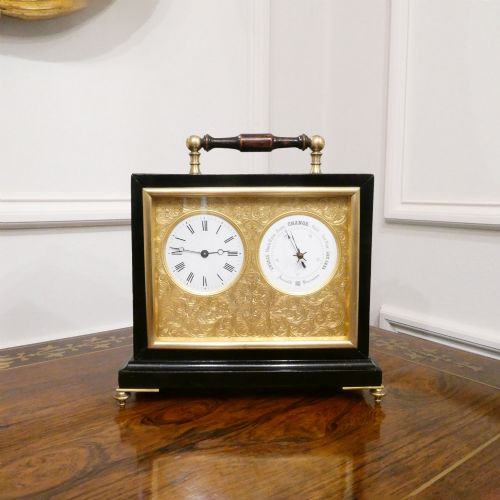
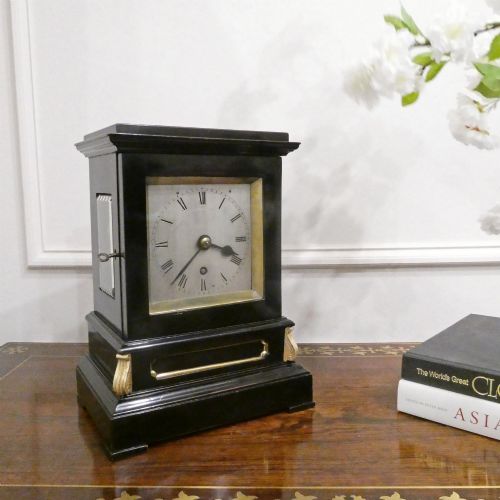
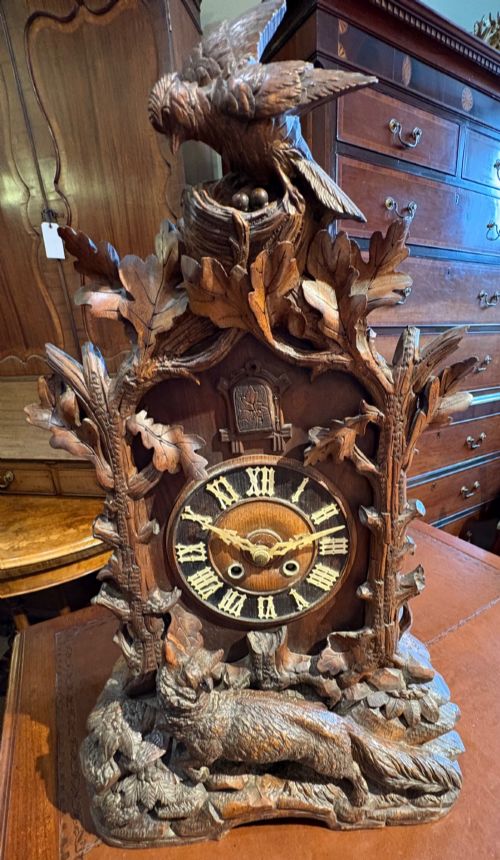
These black wood mantel clocks bring heavy Victorian drama and intricate Black Forest carving to a room.
Black Wood Mantel Clock
When you search for a black wood mantel clock, you are looking at timepieces housed in ebonised timber, dark walnut, or carved linden wood. The examples found here span the eighteenth century through to the Edwardian period, encompassing British library clocks and Swiss chalet forms.
You are most likely to meet nineteenth century Victorian and Black Forest variations on this page. These range from restrained ebonised single fusee library clocks to monumental carved wooden architectural cases featuring cuckoo mechanisms and swinging pendulum automata.
How they were made
The construction relies heavily on ebonised wood or carved linden wood, often accented with brass, gilt bronze or ormolu mounts. Makers shaped solid timbers into architectural cases or naturalistic foliage.
Delicate glass domes protect certain sensitive mechanisms or displays, whilst enamel dials provide a stark contrast against the dark timber housings.
Materials across these listings include traditional brass, glass, enamel, and carved linden wood alongside ebonised wood.
What varies in quality
The distinction between ordinary and exceptional pieces lies in the crispness of the timber carving and the sophistication of the movement. Hand-carved Black Forest details display a depth and life that machine-roughed foliage misses.
Material quality also dictates worth, separating simple ebonised pine cases from those adorned with fire-gilded ormolu, solid walnut, and complex fusee or chiming movements by known makers.
Bergen & Co·Des Granges·John Taylor·D Robertson of Perth·Beha·Henry Marc·Junghans
The Black Wood Mantel Clock Glossary
- Ebonised wood
- Timber stained or painted to imitate true ebony, a technique widely used during the Victorian and Aesthetic Movement periods to achieve a dense, uniform black finish.
- Fusee
- A conical pulley used in better quality clocks to equalise the declining power of the mainspring as it unwinds, ensuring more accurate timekeeping.
- Linden wood
- A pale, close-grained timber favoured by Black Forest carvers for its ability to hold intricate, deep undercut details without splintering.
- Ormolu
- Finely ground high-carat gold applied to a bronze base, adding metallic lustre and bright contrast to dark wooden clock cases.
- Verge escapement
- An early type of escapement mechanism that controls the release of the gear train, found in older bracket and mantel clocks.
Black Wood Mantel Clock: Frequently Asked Questions
Are Black Forest clocks loud?
Many traditional Black Forest models feature striking mechanisms, gongs, or cuckoo calls that sound on the hour and half-hour. The acoustic resonance depends largely on the wooden or metal housing enclosing the movement.
If the noise level concerns you, examine the interior configuration to see if a silencing lever or toggle is present before placing the clock in a bedroom or quiet study.
How do I spot ebonised wood?
Inspect areas of minor wear, such as edges or corners, where the underlying lighter timber or grain might show through the dark surface coating. True ebony remains dark throughout, whereas ebonised pieces rely on a surface stain or paint layer.
Look closely at the weight and grain structure, as lighter fruitwoods or pines were frequently chosen as the base for ebonising during the nineteenth century.
Where should I place my clock?
Position the mantel clock on a sturdy, level surface away from direct sunlight, dampness, and active heat sources. Temperature fluctuations can cause timber cases to warp and delicate metal oils to gum up.
Ensure there is enough clearance behind the case for pendulum swing and key rotation, giving the clock a stable footing to maintain an even beat.