
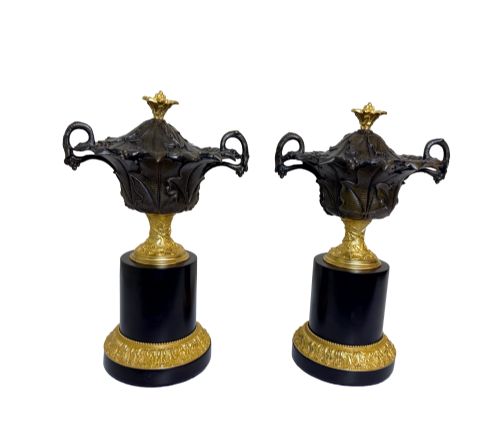
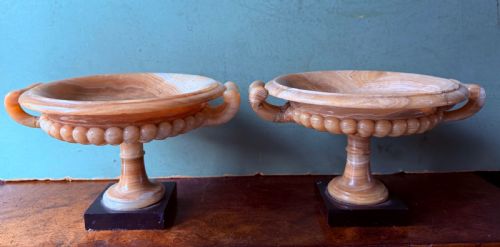
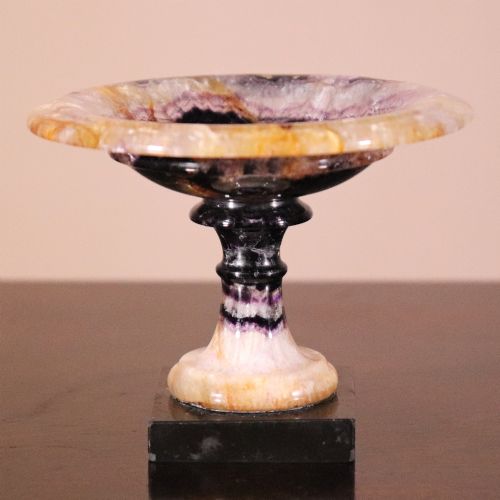
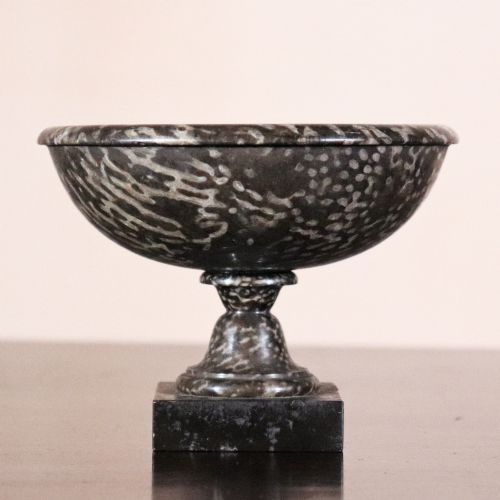


Black Marble Pedestal Urns
These black marble pedestal urns and related tazze and plant stands bring nineteenth-century Neoclassical gravitas to a room.
Black Marble Pedestal Urns
When you search for black marble pedestal urns, you are looking at nineteenth-century ornamental vessels, tazze, and plant stands rooted in Neoclassical design. These pieces often draw upon Grand Tour souvenirs, French Empire aesthetics, and Italian carving traditions. While the exact forms vary from bronze-mounted coupes to alabaster-accented tazze, the dominant materials lean heavily on dark stone and classical proportions.
The versions most commonly met on this page include nineteenth-century tazze on black marble block bases and paired ornamental urns. You will encounter pieces incorporating bronze, ormolu, and contrasting minerals like Blue John or Ashford coral marble alongside the foundational black marble. They serve primarily as decorative centerpieces or architectural plant stands rather than functional vessels.
How they were made
The construction relies on the careful turning, carving, and polishing of stone, paired with metalwork cast in bronze or ormolu. Artisans shaped the dense black marble on lathes or worked it by hand to create smooth columns, bases, and shallow bowls. Mineral specimens such as Blue John and alabaster were selected for their natural figuring and inset into the primary stone structure.
Metal mounts, handles, and plinths were produced through traditional bronze casting and fire gilding techniques. These bronze elements were then fitted meticulously to the stone bodies, often secured with threaded rods or pins concealed within the pedestals. The combination of patinated bronze and polished marble demanded precision fitting between disparate materials.
Listings feature nineteenth-century materials including black marble, bronze, alabaster, Blue John, and Ashford coral marble.
What varies in quality
Quality in these pieces rests upon the crispness of the stone carving and the fidelity of the classical proportions. Superior examples display tightly turned profiles, uniform polish across the black marble, and seamless joins where stone meets bronze or ormolu. Lesser pieces exhibit sluggish detailing in cast mounts and dullness in the stone finish.
The selection of secondary minerals further distinguishes the work. Exceptional items utilise highly figured alabastro egiziano or vibrant Blue John with dramatic natural banding, whereas standard pieces rely on plain monochromatic stone. The weight, stability, and integrity of the composite base structure dictate the overall sculptural presence.
The Black Marble Pedestal Urns Glossary
- Tazza
- A shallow cup or bowl set upon a stem and foot, frequently utilised in the nineteenth century as a decorative display object. These are often carved from decorative stones and mounted on square marble bases.
- Grand Tour
- A cultural journey undertaken by wealthy young Europeans in the eighteenth and nineteenth centuries to collect classical antiquities and souvenirs. Items of this genre emulate ancient Roman and Greek sculpture and architecture.
- Ormolu
- Finely ground high-carat gold applied to a bronze base using a mercury amalgamation technique, common in French Empire and Neoclassical decorative arts. It provides a bright, lasting golden finish alongside patinated bronze.
- Athenienne
- A tripod-supported neoclassical stand or small urn-like piece derived from ancient Greek furniture forms. These items typically combine bronze framework with stone or marble bowls.
Black Marble Pedestal Urns: Frequently Asked Questions
How were these stone urns used historically?
Historically, they functioned purely as decorative showpieces placed on side tables, mantelpieces, or pedestals within formal reception rooms. Their primary role was to display wealth, classical taste, and an appreciation for European travel.
Some variations, such as plant stands and jardiniere tables, accommodated indoor greenery, while smaller tazze served to exhibit prized mineral specimens.
How do I style them in a modern interior?
You can place a single tazza or a matched pair upon a sideboard or console table to anchor a room with architectural weight. Their dark stone surfaces pair effectively against neutral walls or timber furniture.
Because they command visual attention through their classical silhouette, they require minimal surrounding decoration to make an impact.
How can I tell a nineteenth-century piece apart?
Nineteenth-century examples are distinguished by traditional hand-finishing marks on the stone, patinated bronze components, and period-appropriate assembly methods such as threaded iron or brass fixings. The materials often reflect specific regional mineral sources popular during the Victorian period.
Examining the depth of the carving and the quality of the ormolu or bronze casting helps confirm the nineteenth-century manufacturing context.