

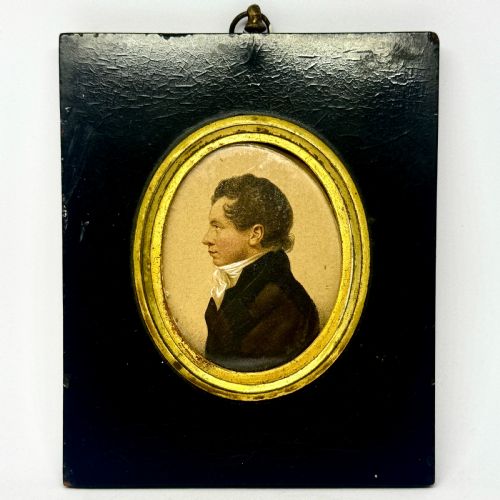


Black Ebonised Profile Portrait
A black ebonised profile portrait captures a subject in sharp outline, offering an intimate glimpse into the past.
Black Ebonised Profile Portrait
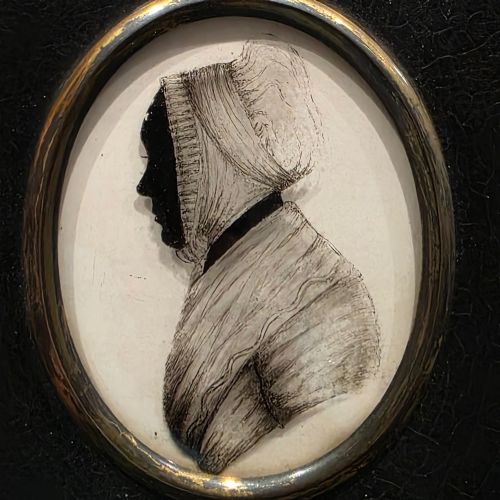
A black ebonised profile portrait distils a likeness down to shadow and contour, drawing the eye directly to the set of a chin or the slope of a nose. When searching for a black ebonised profile portrait, buyers encounter framed silhouettes and miniature paintings originating from the Georgian, Regency, and nineteenth-century periods.
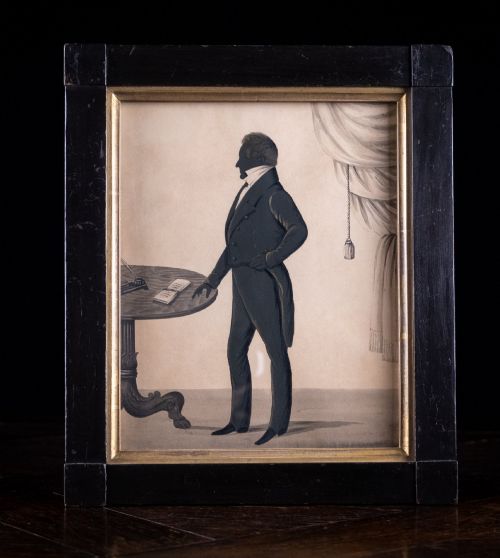
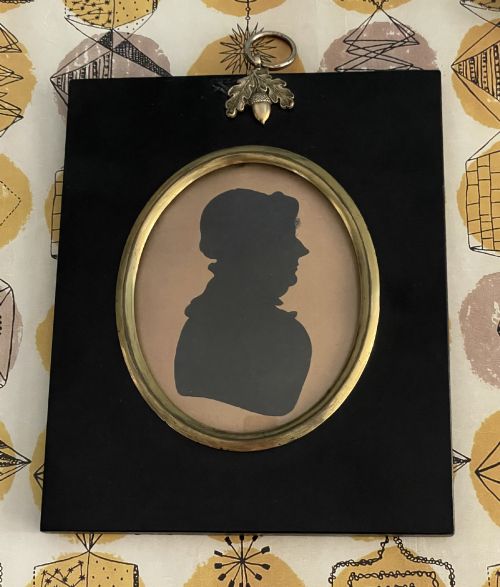
The pieces on this page take several distinct forms, ranging from cut paper silhouettes to delicate work painted directly on glass or card. Many examples retain their original brass-fitted frames and ebonised wood surrounds, preserving the stark monochrome contrast intended by the maker.
Georgian and Regency practitioners dominate the selection, offering meticulous records of sitters whose names sometimes survive on the reverse. These works function as miniature biographies, distilling status, fashion, and personal identity into a compact, dark-framed format.
Materials and construction
Makers utilised dark pigments, watercolour, and ink upon paper, card, or glass, often applying fine lines of gold leaf to pick out buttons, lace, and hair ornaments. Reverse painting on glass required immense steady skill, as any error could not be corrected once applied to the transparent pane.
The characteristic dark frames rely on ebonised wood, a technique where timber is treated or stained to imitate costly ebony. Glazing protected the delicate paper or painted surface from dust and moisture, held in place by narrow brass bezels and hanging loops.
One gentleman manages to look sternly through time despite having his likeness permanently fixed behind convex glass.
Factors of quality
Quality rests upon the precision of the cutting or the sureness of the brush, separating rapid commercial output from masterwork portraiture. A superior silhouette captures the distinct psychology and anatomical quirks of the sitter with minimal strokes.
The preservation of the mounting matters greatly, including the survival of original convex glass, backing papers, and handwritten identifiers. Pieces signed by known practitioners command higher regard for their documented origin and technical mastery.
James Gillespie·Thomas London·George Atkinson·Archibald Skirving·John Miers
The Black Ebonised Profile Portrait Glossary
- Ebonised
- Wood treated with a dark stain or finish to resemble ebony. This dark surround provides the classic contrasting border for monochrome profiles.
- Silhouette
- A portrait represented as a solid shape of a single colour, usually black, showing the profile of the subject. The form gained immense popularity before the widespread adoption of photography.
- Reverse painted
- An image applied to the back side of a glass panel so that it is viewed correctly through the front. This technique protects the pigment and yields a smooth, reflective surface finish.
- Miniature portrait
- A small-scale painting or likeness executed with fine detail. These works were often designed to be held in the hand or worn as personal mementoes.
- Cameo
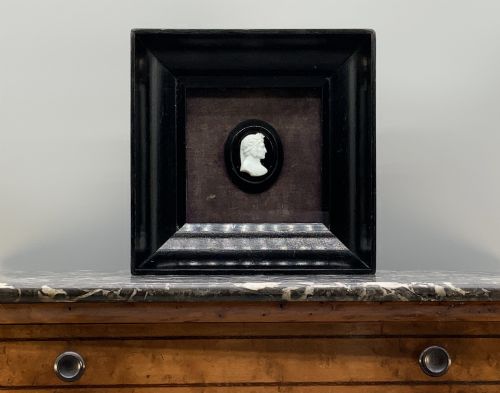
- A method of carving or moulding an object to create a raised relief image against a contrasting background. Pressed white glass paste examples mimic classical carved stone.
Black Ebonised Profile Portrait: Frequently Asked Questions
How do I date a silhouette?
Dating relies heavily on the clothing styles, hairstyles, and framing materials visible in the piece. Regency and Georgian examples often feature distinct collar shapes and bonnet designs that anchor them to specific decades.
Backing papers, trade labels pasted to the reverse, and handwriting styles also help establish a reliable chronology for unsigned works.
Were these portraits painted or cut?
Makers used both methods, sometimes combining them by cutting paper and mounting it against a contrasting background before adding ink details. Other practitioners painted directly onto card, paper, or the reverse of a glass sheet.
Examining the surface under magnification reveals whether the edge of the profile is formed by a sharp paper cut or a fine brushstroke.
Why are some painted on glass?
Painting on the reverse of glass created a glossy, deep finish that protected the delicate lamp-black or watercolour pigments from fading and atmospheric dirt. This technique required the artist to paint the highlights and foreground details before the background layers.
Such pieces demand careful handling to prevent the glass from cracking within its original housing.
How should I hang these portraits?
These pieces require placement away from direct sunlight to prevent the fading of dark pigments, paper grounds, and watercolour details. Wall placement should also avoid damp exterior walls and areas subject to sudden temperature fluctuations.
Using the original brass hanging rings or secure picture hooks ensures the weight distributes evenly across the antique frame.