



Black Papier Mache Portrait
These black papier mache portrait pieces capture the intense intimacy of Georgian and Regency likenesses through hand-painted silhouettes and miniature boxes.
Black Papier Mache Portrait
A black papier mache portrait brings together small-scale likenesses and dark lacquer or ebonised grounds, ranging from framed silhouettes to decorative boxes. When you search for black papier mache portrait, you encounter items shaped by Georgian and Regency craft traditions alongside later continental examples.
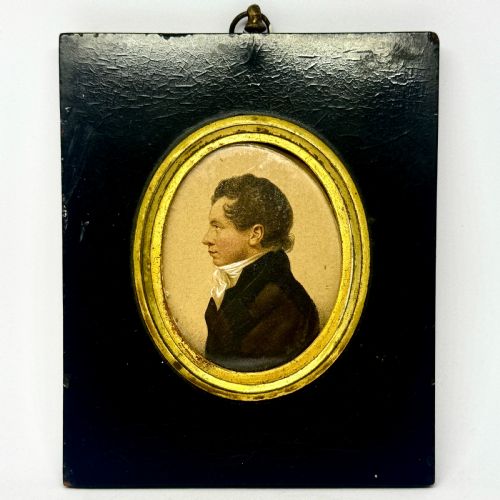
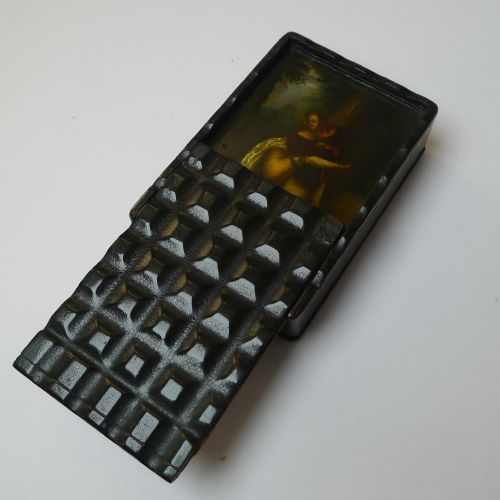
The objects on this page fall largely into two distinct forms: framed silhouette portraits and small lidded receptacles such as snuff or trinket boxes. Portrait miniatures and wall art sit alongside Stobwasser-style boxes featuring hand-painted figures set into dark surfaces.
Most pieces date from the nineteenth century, with strong representation from the Regency and Georgian eras. Makers such as George Atkinson, Thomas London, and J. Deacon appear among the framed silhouettes, while Stobwasser boxes represent the pinnacle of lacquered portrait containers.
Materials and construction methods
Makers built these pieces using compressed paper pulp or layered paper sheets treated with varnishes and dark lacquers to create a smooth, durable base. Ebonised wood and brass frames frequently house silhouette portraits painted on paper or glass.
Hand-painting and precise cutting define the visual impact, with artists using fine brushes to apply paint or gold leaf over dark grounds. Glass panels protect delicate paper silhouettes, while lacquer finishes provide a deep, polished sheen on boxes.
German workshops occasionally tucked cheeky surprises inside, hiding concealed erotic paintings beneath the lids of otherwise respectable snuff boxes.
Assessing quality and execution
The fineness of the brushwork and the clarity of the profile separate standard production from superior examples. Master silhouette artists capture subtle details of expression and costume within miniature formats.
The depth and integrity of the lacquer finish on boxes influence the overall merit of a piece. Well-preserved surfaces retain their original sheen without extensive modern intervention, while brass mounts and frames show crisp casting and secure fit.
George Atkinson·Thomas London·J. Deacon·Stobwasser
The Black Papier Mache Portrait Glossary
- Papier-mache
- A sturdy composite material formed from paper pulp or layered sheets mixed with glue, then moulded and dried. It provides a lightweight yet durable base for lacquer and paint.
- Silhouette
- A solid dark profile portrait, typically cut from paper or painted against a contrasting light background. These likenesses gained widespread popularity during the Georgian and Regency periods.
- Ebonised wood
- Timber treated with a dark finish to imitate expensive ebony. This dark framing material enhances the contrast of light profiles.
- Snuff box
- A small lidded container designed to hold powdered tobacco. Many surviving examples feature detailed portrait miniatures or lacquered lids.
- Portrait miniature
- A small, highly detailed painting on paper, vellum, or glass. These portable likenesses required immense skill due to their restricted scale.
Black Papier Mache Portrait: Frequently Asked Questions
What is a black papier mache portrait?
These items are small-scale likenesses created during the Georgian and Regency eras, combining dark paper, lacquer, and painted silhouettes. They typically take the form of framed wall art or lidded pocket containers.
The category encompasses both delicate paper cutouts mounted behind glass and finely painted miniatures set into lacquered surfaces, reflecting the portraiture tastes of the nineteenth century.
How were snuff boxes used?
Snuff boxes served as functional personal accessories for holding powdered tobacco consumed through the nose. Owners carried them daily as fashionable items that displayed their social standing. Some boxes featured concealed inner lids or erotic paintings beneath the primary lid, serving as private diversions for the owner and selected companions.
How do I date a silhouette?
Dating relies on costume details, hair styling, and the framing materials used around the portrait. Regency items often display high-waisted dresses, turbans, or specific neckwear popular in the early nineteenth century. Frame construction and backing papers also offer chronological clues. Georgian examples frequently use simple wooden frames with oval apertures, while later Victorian pieces adopted heavier, more ornate surrounds.
Where should I display these pieces?
Framed silhouettes work well grouped on panelled or neutral walls where their stark contrast stands out clearly. Small boxes sit comfortably on desks, mantelpieces, or inside glass-fronted cabinets. Because paper and lacquer are sensitive to light and moisture, placement away from direct sunlight and damp environments helps preserve the original pigments and finishes.