
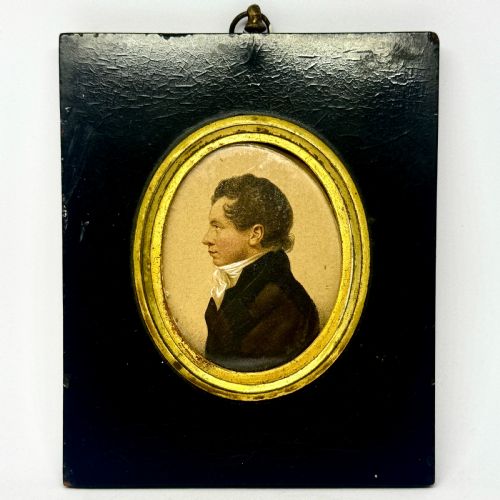
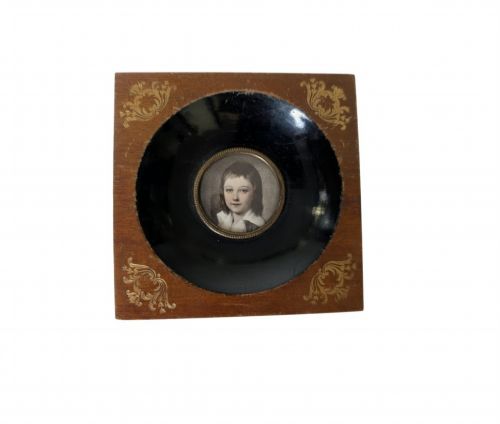


Georgian Papier Mache Frame
A georgian papier mache frame offers a distinct profile for holding miniature portraits and silhouettes, prized for its dark, lustrous finish.
Georgian Papier Mache Frame
When you search for a georgian papier mache frame, you encounter delicate enclosures designed primarily for silhouette portraits and miniature paintings. The items listed here span the Georgian, Regency, and nineteenth-century periods, showcasing the compact formats popular during these eras.
Most examples house painted watercolours on glass, silhouettes of gentlemen and ladies, or portrait miniatures. These pieces often feature contrasting brass accents and ebonised wood borders that complement the dark core material.
The prevailing form on this page is the framed artwork or wall art, frequently housing profile likenesses such as the silhouette of Mary Watts-Russell or individual portraits of ladies in turban caps. Pairs also appear among the offerings, providing matching setups for portrait displays.
Materials and Construction
Makers built these frames using reinforced paper pulp known as papier-mache, which allowed them to be moulded into smooth, durable shapes before receiving a dark, often ebonised finish. Artisans combined this paper base with wood elements and glass panes to protect the delicate watercolours and silhouettes within.
Bright brass fittings frequently appear as hanging loops, bezels, or decorative mounts, providing a sharp metallic contrast to the matte black papier-mache surface. Inside the frame, artists painted directly onto glass or paper, utilising fine watercolours and silhouettes to capture minute facial details.
E. Sutton was nine years old in 1816 when J. Deacon painted the gilded silhouette that preserves her likeness today.
Distinctions in Quality
The fineness of the inner brass work and the crispness of the moulded edge separate standard items from superior examples. Better pieces retain their original glass and feature finely detailed silhouette painting, such as gilded highlights on a lady's cap or attire.
The depth of the ebonised finish and the integrity of the papier-mache structure dictate the overall presence of the frame. Superior items maintain a smooth, deep lustre without significant chipping to the delicate moulded surfaces.
George Atkinson·Thomas London·J Deacon
The Georgian Papier Mache Frame Glossary
- Papier-mache
- A composite material made from paper pulp or layers of paper mixed with glue, moulded and baked to form a sturdy body.
- Silhouette
- A portrait profile filled in with a solid dark colour, typically cut from paper or painted on card or glass.
- Ebonised wood
- Timber treated with a dark stain or finish to imitate the appearance of heavy ebony.
- Portrait miniature
- A small, highly detailed painting, usually executed on ivory, card, or glass during the eighteenth and nineteenth centuries.
- Regency
- An English stylistic period spanning the early nineteenth century, noted for classical restraint and elegant proportions.
Georgian Papier Mache Frame: Frequently Asked Questions
What fits inside a georgian papier mache frame?
These frames were made to house small works on paper or glass, specifically portrait miniatures and black-profile silhouettes.
The listings show them holding watercolours, silhouettes of gentlemen and ladies, and printed miniatures from the Georgian and Regency periods.
How do I hang a georgian papier mache frame?
Most of these small pieces feature a small brass ring or loop fitted to the top edge for wall hanging.
Because of their lightweight papier-mache construction, they require only a modest hook or pin to support them securely.
Are these frames usually found as pairs?
Pairs do occur within the selection, often containing matching portraits or silhouettes of couples from the period.
Single frames remain much more common, housing individual likenesses of sitters like Mrs Hanbury or anonymous gentlemen.
How do I distinguish Regency frames from later ones?
Regency examples often incorporate distinct brass bezels and convex glass to cover the portrait miniature inside.
They share materials with nineteenth-century versions, but lean towards sharper moulding and specific portrait styles like the turban caps seen in the evidence.