







Black Bronze Table Clock
A black bronze table clock brings architectural presence and precision engineering to a room, combining dark metal with warm gilt or marble details.
Black Bronze Table Clock
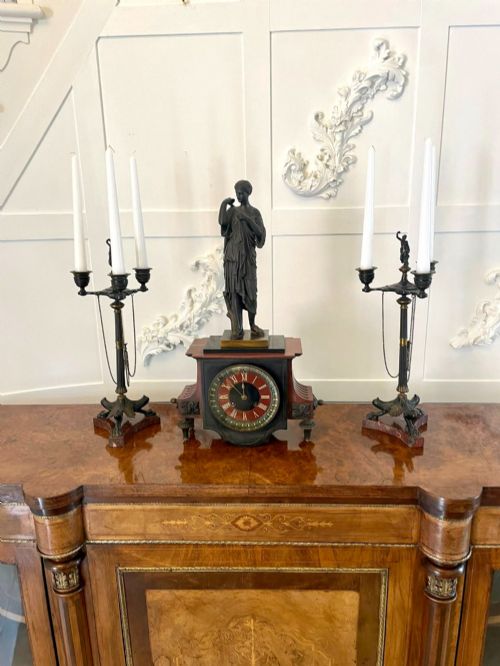
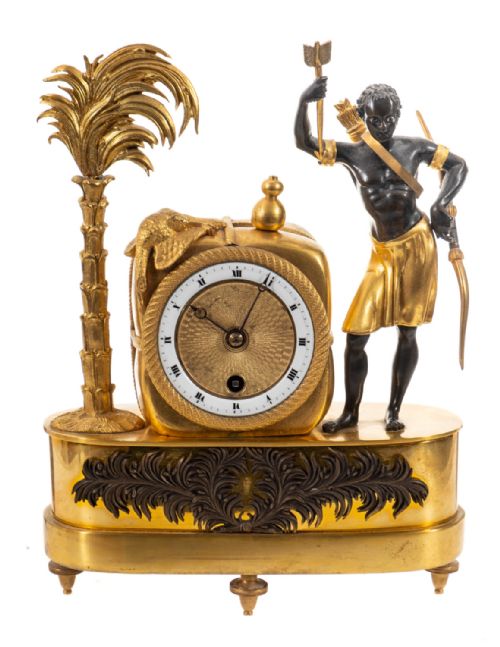
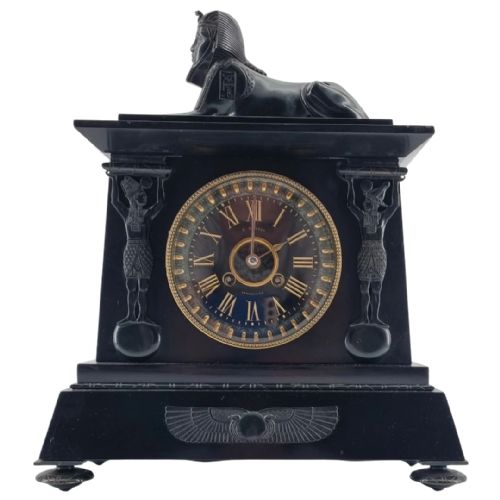
A black bronze table clock is a mantel timepiece or striking clock built around a dark patinated metal or slate body, frequently accompanied by matched garniture sets or figural elements. These pieces emerge across the nineteenth century, spanning Regency, Victorian, and French Empire aesthetics.
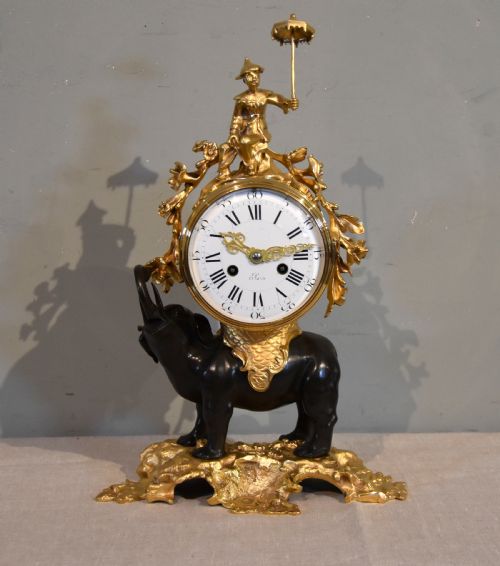
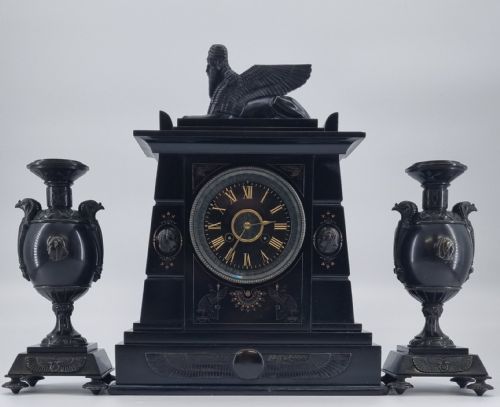
The format ranges from portico designs and architectural marble cases to figural compositions featuring elephants, lions, or Egyptian Revival motifs. Most examples encountered here originate from French workshops or English makers active during the 1800s and subsequent decades.
Buyers select these clocks for their substantial weight and contrasting metallic finishes, which unite patinated bronze, gilt ormolu, and pale marble. They function as both decorative centrepieces and working mechanical timekeepers driven by fusee or anchor escapement movements.
Materials and construction methods
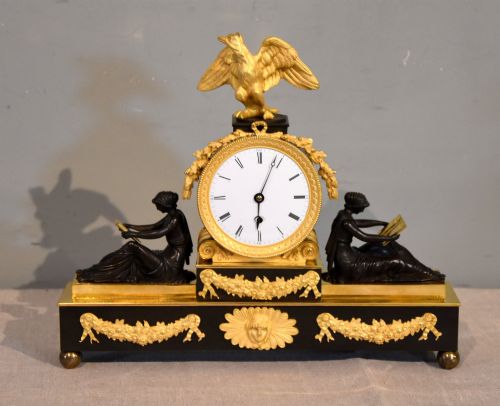
Cases combine patinated bronze, black slate, and marble, providing a dense, dark structural foundation that highlights brighter metallic highlights. Gilt bronze and ormolu mounts are applied to corners, dials, and figural components to create visual contrast against the dark body.
Dial faces incorporate enamel numerals and fine brass bezels, protected beneath glass panels that shield the hands and escapement. Movements rely on brass gear trains, driven either by weighted chains or spring-powered fusee cylinders housed within the stone or metal enclosure.
Black Bronze Table Clock Retail Price Guide 2026
Typical asking prices for black bronze table clock among the pieces listed under this phrase on Sellingantiques today, from the lower quarter to the upper quarter. They describe what is for sale here now, not the wider market.
Some nineteenth-century French clockmakers could not resist adding a touch of the jungle, placing life-sized bronze elephants and lounging lions directly atop the ticking machinery.
Determinants of quality
The standard of a black bronze table clock rests upon the crispness of the bronze casting and the depth of the patination. Superior examples display sharply chiselled ormolu mounts and finely articulated figural sculpture rather than soft, mass-produced detailing.
Movement complexity further distinguishes individual pieces, with single chain fusee mechanisms and striking trains demonstrating higher precision than basic timepieces. The integration of stone, such as high-grade black marble or slate fitted cleanly with brass bezels, indicates superior workshop execution.
Baetens London·Philippes Paris·D. Munsey of Cambridge·Payne & Co. London·Pons de Paul·Barraud & Lund London·Henry Berkeley Square London
The Black Bronze Table Clock Glossary
- Garniture
- A set comprising a central clock flanked by matching decorative objects such as urns or vases. These matched groups create a balanced arrangement on a mantelpiece.
- Ormolu
- Gilded bronze produced by applying a mercury and gold amalgam to a bronze base and firing it to drive off the mercury. This technique yields a durable, rich golden surface.
- Fusee
- A conical pulley connected to the mainspring by a cord or chain that equalises the driving force as the spring unwinds. It ensures consistent timekeeping accuracy across the power reserve.
- Portico clock
- A timepiece housed within a architectural frame supported by four columns, often taking inspiration from classical Greek or Roman temples. The pendulum typically swings visibly between the front pillars.
- Patinated bronze
- Metal treated with chemical solutions to produce a controlled dark surface oxide layer. This finish protects the underlying bronze while offering a sombre visual tone.
Black Bronze Table Clock: Frequently Asked Questions
How do I wind a fusee movement?
Wind the clock using the appropriate key inserted into the dial aperture, turning it slowly until resistance indicates full tension. Take care not to overwind antique mechanisms, as excessive force can snap the internal chain or spring.
Ensure you turn the key in the correct direction specified for that particular movement. Regular, gentle winding preserves the tension balance within the brass gear train.
What is a clock garniture?
A garniture is a decorative set consisting of a central clock accompanied by two matching side pieces, such as urns or vases. Designed to be displayed together on a mantelpiece, they create a unified decorative scheme.
These matching elements share the same materials, such as black marble or patinated bronze, repeating the motifs found on the main clock case.
How do I care for marble and bronze cases?
Dust marble and slate surfaces gently with a dry, soft cloth to prevent abrasion. Avoid chemical cleaners or excessive moisture, which can degrade the patinated bronze or stain the stone.
Keep the clock away from direct sunlight and heat sources to protect the delicate enamel dials and prevent the internal lubricants from drying out prematurely.
Are these clocks suitable for daily use?
These clocks are precision mechanical instruments that require stable placement and occasional professional servicing to run accurately. When properly maintained, they function reliably for daily timekeeping.
Position the clock on a level, sturdy surface to ensure the pendulum beats evenly and the escapement mechanism operates without interference.