


Birmingham Silver Spoons
Birmingham silver spoons bring together centuries of West Midlands assay craftsmanship, ranging from Georgian caddy spoons to vibrant Art Deco enamel sets.
Birmingham Silver Spoons
Birmingham silver spoons encompass a diverse array of flatware, caddy spoons, and condiment sets produced through the city's prominent assay office. Buyers exploring birmingham silver spoons encounter everything from single Georgian botanical pieces to cased coffee sets from the twentieth century.
The selection frequently includes specialised forms such as salt spoons, mustard spoons, and novelty designs incorporating jockey caps or animal motifs. Cased sets of coffee bean spoons with guilloche enamel represent another major category commonly found within this grouping.
How they were made
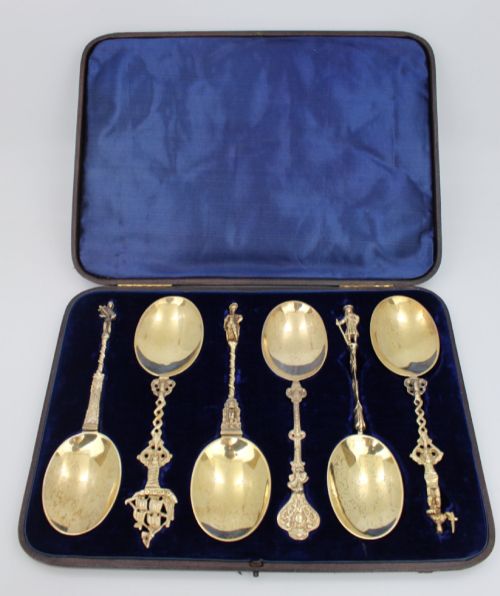
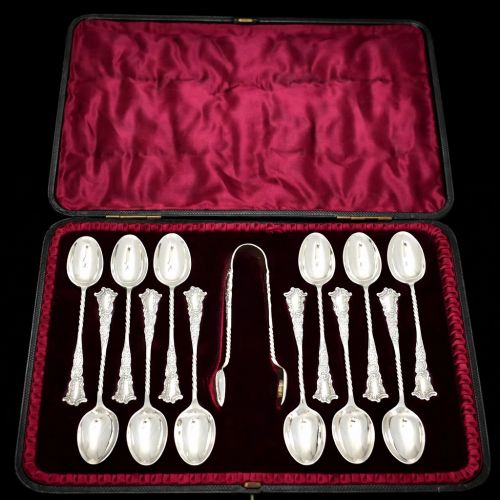
Silversmiths utilised sterling silver alongside silver gilt and coloured enamel to produce these items, often housing finished pieces in velvet or leatherette lined cases. Many spoons combine traditional casting and hand-finishing techniques with decorative enamel work applied to the bowls or handles.
Makers employed stamping, piercing, and engraving methods, particularly visible on novelty items like vine leaf caddy spoons and figural pieces. Hallmarks stamped directly into the metal record the assay year and the specific workshop responsible for the creation.
Some Edwardian silversmiths decided that stirring tea required a tiny silver golf club instead of a normal handle.
What varies in quality
The distinction between standard production items and exceptional examples often lies in the complexity of the design and the presence of specialist decorative techniques. Intricate hand-engraving, high-fired guilloche enamel, and unusual figural forms elevate certain spoons above standard utility flatware.
Completeness also dictates standing, with original fitted cases housing matching sets commanding greater interest than dispersed individual items. The reputation of the silversmithing firm, from early makers like Joseph Willmore to later houses like Turner and Simpson, further defines the tier of the piece.
Joseph Willmore·George Unite·Wilmot Manufacturing Co·Thomas Harwood and Co·Vale Brothers and Sermon·Elkington and Company·Henry Clifford Davis·Walker and Hall·Turner and Simpson·Levi and Salaman·Arthur Price and Co·Barker Ellis Silver Co·Joseph Gloster·William Suckling Ltd·Liberty and Co
The Birmingham Silver Spoons Glossary
- Caddy spoon
- A short-handled spoon specifically designed for measuring loose tea from a caddy. These examples often feature whimsical bowls shaped like leaves or jockey caps.
- Guilloche enamel
- A decorative technique where a geometric pattern is engraved beneath a translucent layer of enamel. This finish frequently appears on twentieth-century coffee spoon handles.
- Silver gilt
- Sterling silver that has been coated with a thin layer of gold on the surface. This treatment creates a rich, two-tone golden appearance inside spoon bowls.
- Assay office
- An official body that tests the purity of precious metals and stamps them with hallmarks. The Birmingham office uses an anchor symbol.
Birmingham Silver Spoons: Frequently Asked Questions
What is a caddy spoon used for?
A caddy spoon is a small scoop traditionally utilised for measuring tea leaves from a storage container into a teapot.
Collectors prize them for their imaginative bowl shapes, which range from simple shells to elaborate vine leaves and cap designs.
How do I date Birmingham silver spoons?
Dating relies primarily on the series of stamped hallmarks found on the reverse of the stem or bowl.
An anchor symbol confirms the Birmingham assay origin, accompanied by a specific date letter corresponding to the year of manufacture.
Were these spoons made in sets?
Many smaller spoons, particularly coffee bean and enamel designs, were produced as matched sets housed in fitted presentation boxes.
Salt and mustard spoons, however, typically accompanied larger tableware items like cellar pots or cruet frames.
How should I display cased silver spoons?
Cased sets are best preserved within their original velvet or leatherette presentation boxes away from direct sunlight.
Displaying them closed protects the delicate enamel and silver surfaces from tarnish while maintaining the integrity of the pairing.