



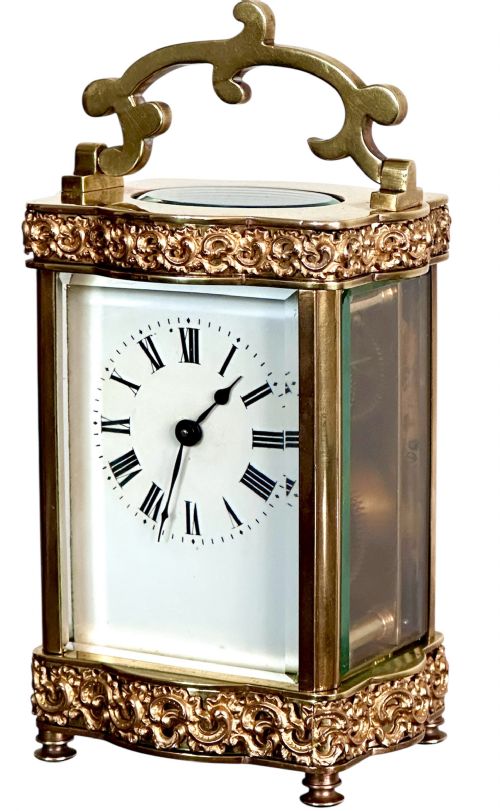


Bevelled Glass Timepiece
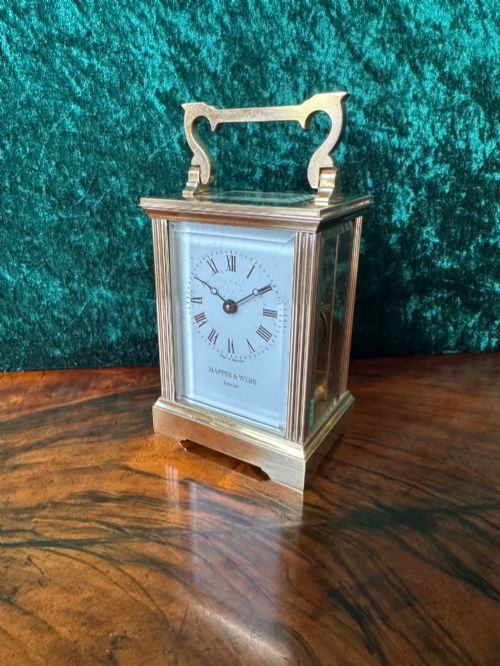
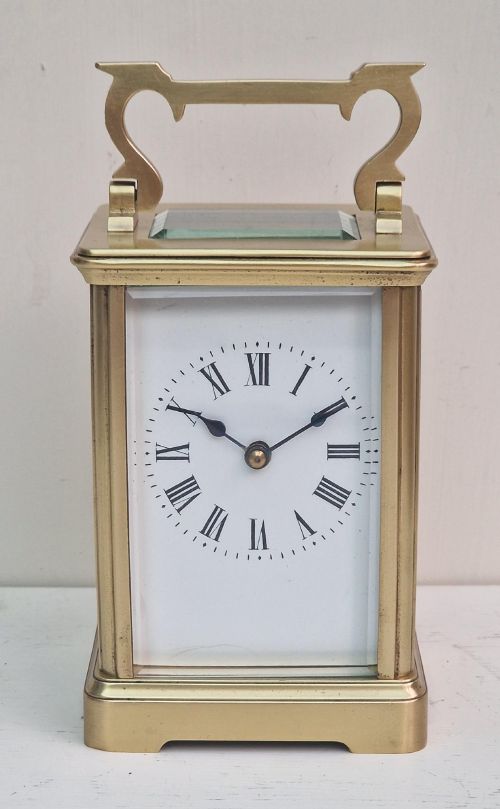
A bevelled glass timepiece combines heavy brass framing with thick, polished panes to house a portable mechanical movement.
Bevelled Glass Timepiece
When you search for a bevelled glass timepiece, you encounter portable carriage clocks and static four-glass mantel clocks dating from the late nineteenth century and the early twentieth century. Most pieces originate from French workshops or English makers, spanning the Victorian period through to nineteen fifty.
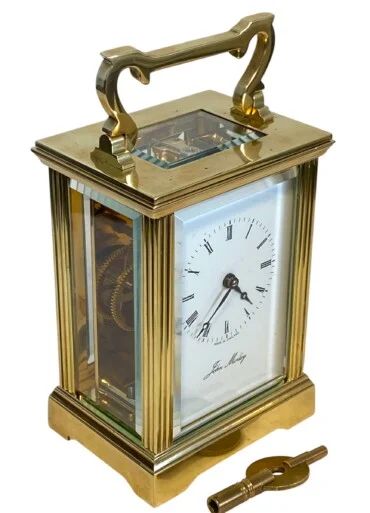
The predominant form on this page is the carriage clock, built with a rectangular brass case and glazed panels that reveal the escapement and gear train within. Mantel clocks also appear, offering larger four-glass designs that sit heavier on a shelf and sometimes incorporate striking mechanisms, alarm functions or moon-phase dials.
Makers and retailers such as Mappin and Web, John Morley, Tiffany, Drocourt and AD Mougin shaped this market. Their work demonstrates how portable timekeeping evolved from a practical travel necessity into a decorative domestic object.
Materials and construction methods
Makers constructed these timepieces primarily using brass and gilt brass frames to support thick panes of bevelled glass, allowing a clear view of the internal mechanics from multiple angles. Steel components govern the gear trains and escapements, while white enamel dials feature painted Roman or Arabic numerals.
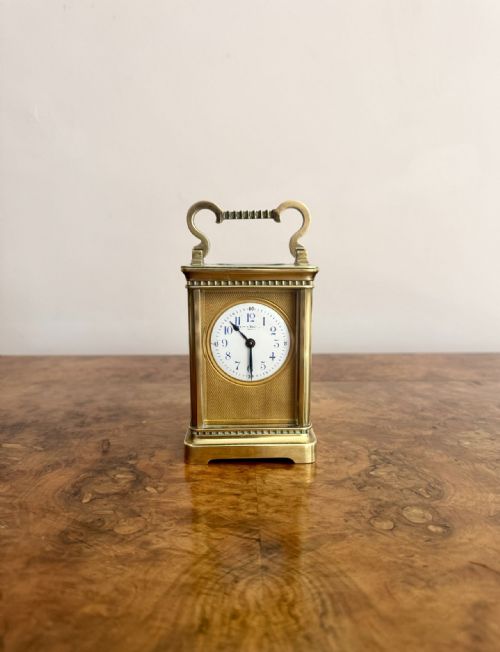
Side panels and dial masks frequently display chased or engraved brass ornamentation, adding texture to the polished metal framework. Leather travel cases occasionally accompany the portable carriage clocks to protect the brass and glass exterior during transit.
Listings feature Victorian, Edwardian and mid-century periods, spanning brass, gilt brass, steel, enamel and bevelled glass materials.
Assessing quality in construction and detail
Quality rests in the weight and precision of the brass casting, alongside the crispness of any hand-engraving on the mask or gorge panels. Finer examples feature substantial bevelled glass panes that fit snugly into robust metal rebates without movement.
The movement itself dictates distinction, separating standard timepieces from complicated repeat striking clocks, bell alarms and platform escapements by known makers. Better proportioned miniature and giant carriage clocks demand greater skill from the horologist than standard mid-sized models.
Mappin and Web·John Morley·Tiffany·Duverdrey and Bloquel·AD Mougin·Delépine·Drocourt·Goldsmiths·Dent
The Bevelled Glass Timepiece Glossary
- Bevelled glass
- Glass with an angled edge ground and polished to a specific slope. This technique catches the light and adds a decorative border to each window of the clock case.
- Four glass clock
- A mantel clock featuring glass panes on the front, back and both sides. This style exposes the pendulum and movement entirely to view.
- Gorge case
- A distinct carriage clock case style characterised by stepped mouldings on the top and base. It represents a refined standard of nineteenth-century French metalwork.
- Platform escapement
- The small horizontal sub-assembly containing the balance wheel and hairspring. It replaced the pendulum in portable clocks, allowing them to keep time while moving.
Bevelled Glass Timepiece: Frequently Asked Questions
How do carriage clocks work?
Carriage clocks utilise a mainspring barrel to store power, regulated by a balance wheel and hairspring on a platform escapement. This mechanical setup allows the clock to measure time accurately without relying on a stationary pendulum.
Energy transfers through a train of gears to move the hands across the enamelled dial. Many examples include a key-wind mechanism for the time and striking trains.
What is a four glass mantel clock?
A four glass mantel clock is a stationary timepiece housed in a brass and bevelled glass case designed for domestic interiors. Unlike portable carriage clocks, these models usually rest on a fixed surface and often feature a visible mercury or pendulum regulated movement.
They emerged strongly during the late nineteenth century in France and England. Their transparent construction allows light to pass entirely through the clock.
Where were most bevelled glass clocks made?
The majority of nineteenth-century carriage clocks and glass mantel clocks originated in French horological centres such as Paris and Saint-Nicolas-d'Aliermont. Makers exported these pieces across Europe, where British retailers frequently added their own signatures to the dials.
English workshops also produced notable carriage clocks, particularly during the later Victorian period and into the twentieth century. These often featured robust English lever escapements.