
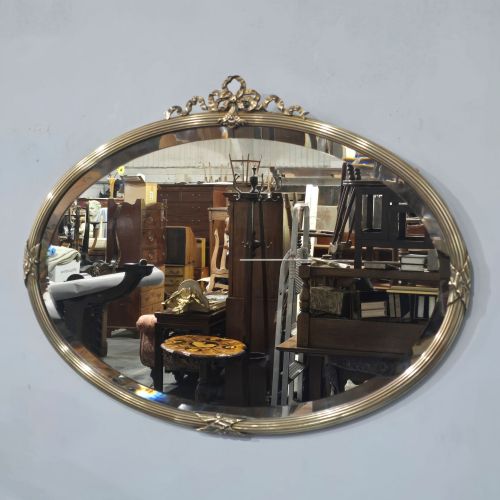


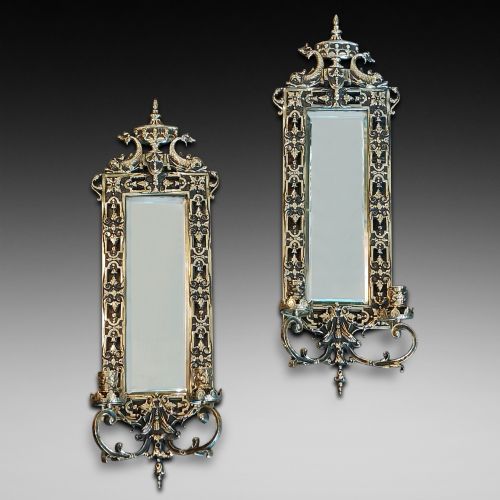


Bevelled Glass Brass Mirror
A bevelled glass brass mirror brings distinct period weight and bright reflection to a room through solid metal framing.
Bevelled Glass Brass Mirror
When you search for a bevelled glass brass mirror, you encounter wall mirrors, table mirrors, fireplace screens and cheval mirrors spanning the Victorian, Edwardian, and Art Deco periods. These items combine substantial brass, bronze, or metal frames with thick glass plates shaped by angled edge grinding.
The selection ranges from simple oval wall hangings to ornate cushion frames, horseshoe shapes, and figural novelties. Many examples reflect specific design movements such as Arts and Crafts, Art Nouveau, and French Chateau styles.
Most items you meet here date from the late nineteenth century through to the early decades of the twentieth century. They serve functional and decorative roles in hallways, principal rooms, and mantel settings.
Materials and construction
Makers utilised cast bronze, sheet brass, and gilt metal to build sturdy housings for heavy mirror glass. Frames frequently feature embossed details, cast mounts, or hand-tooled surfaces secured to wooden backs.
The glass itself underwent careful grinding along the margins to produce a sloping bevel that catches and refracts light distinctly. Metal elements were joined using period fixings, rivets, and structural timber supports hidden within the frame.
Listings feature Victorian, Edwardian, and Art Deco periods, utilising brass, bronze, glass, and mahogany across wall mirrors, fire screens, and cheval mirrors.
Assessing quality
Quality rests in the weight of the metalwork, the depth and clarity of the glass bevel, and the crispness of embossed or cast decoration. Superior pieces display rigorous hand-finishing on mounts and secure, integrated structural supports.
Lesser examples rely on thinner gauge metal and simpler stamped designs with less definition in the ornamentation. The integrity of the silvering on the mirror plate also distinguishes finer survivals from ordinary stock.
J C Moretti
The Bevelled Glass Brass Mirror Glossary
- Bevelled glass
- Glass with an angled edge ground and polished to a specific slope. This technique creates a prismatic light effect around the perimeter of the plate.
- Cushion frame
- A frame profile that curves outward toward the edges, creating a padded or convex appearance. This shape is frequently found on nineteenth-century pieces.
- Cheval mirror
- A freestanding full-length mirror suspended on a central pivot between two upright pillars. This form allows the glass to tilt to different angles.
- Fire screen
- A decorative panel placed before a fireplace grate when not in use. Many examples incorporate mirror glass and metal frames to brighten unlit hearths.
Bevelled Glass Brass Mirror: Frequently Asked Questions
How do I hang a heavy brass mirror safely?
Heavy brass and bronze mirrors require fixings secured directly into wall studs or solid masonry using appropriate wall anchors. The weight of the metal frame and thick glass plate demands robust load-bearing hardware.
Check that the hanging loops or chains attached to the back of the frame are structurally sound before mounting. Distribute the weight evenly across two anchor points for wider horizontal or cushion-framed models.
How do I clean an antique brass frame?
Dust the metal surface gently with a soft, dry cloth to remove accumulated particles without disturbing the underlying patina. Avoid harsh chemical polishes that strip away age-appropriate darkness and character.
Keep moisture away from the edges of the mirror plate where water can seep behind the glass and damage the silver backing. If necessary, use a damp cloth followed immediately by a dry one on the metal alone.
How do I date a brass mirror?
Examine the construction methods of the frame, the backing materials, and the style of any embossed or cast ornament. Victorian pieces often display heavy embossing or cushion profiles, while Edwardian and Arts and Crafts examples favour simpler, hand-worked surfaces.
Look at the glass itself, noting the width of the bevel and the condition of the silvering. Art Deco items from the 1920s and 1930s typically introduce geometric circular or streamlined shapes distinct from earlier designs.
Can these mirrors go in a bathroom?
High humidity environments can accelerate corrosion on antique metal frames and damage the silvered backing of old glass plates. Moisture easily seeps behind unsealed edges, causing dark spots and deterioration known as foxing.
Place these pieces in dry living areas, hallways, or bedrooms where temperature and humidity remain stable. This preserves both the structural integrity of the brass and the clarity of the reflection.