




Bentwood Side Chairs
These bentwood side chairs offer sculptural strength and lightweight practicality, making them an enduring choice for domestic and cafe seating.
Bentwood Side Chairs
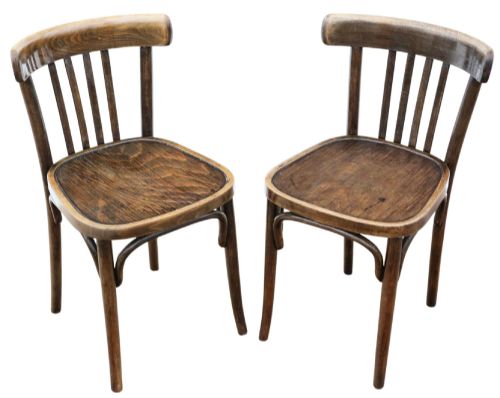
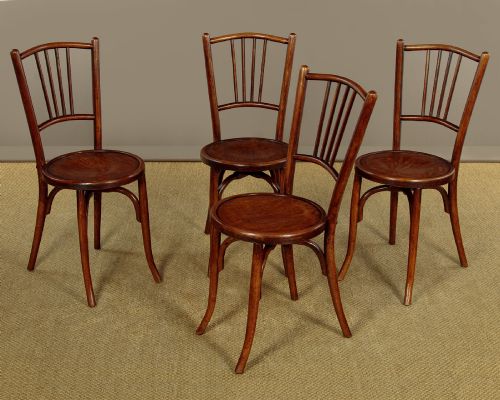
When buyers search for bentwood side chairs, they encounter seating designed around steam-bent solid timber frames. The selection on this page ranges from late Victorian and Edwardian examples to mid-century iterations.
You are most likely to meet bistro dining chairs featuring circular cane seats and perforated plywood backs. Sets often appear alongside individual carvers and armchairs.
Originating largely from Austrian and eastern European workshops, these pieces span eras including the nineteenth century, nineteen-hundred, nineteen-ten, nineteen-twenty, nineteen-forty, and nineteen-sixty.
Materials and construction methods
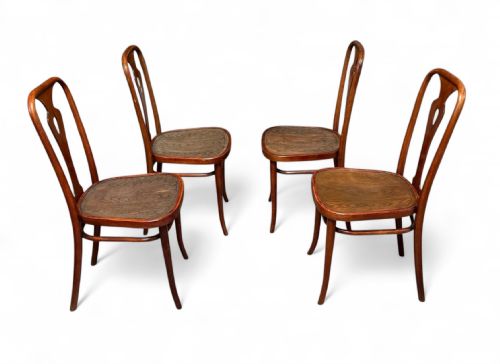
Makers utilised solid beech and beechwood, applying steam to soften the timber so it could be forced into smooth, continuous curves. This technique produced resilient frames without heavy joinery.
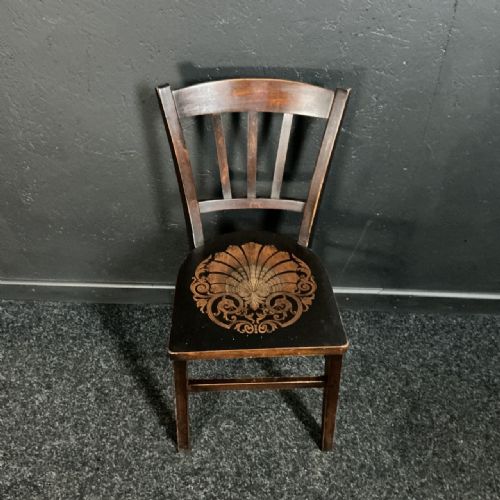
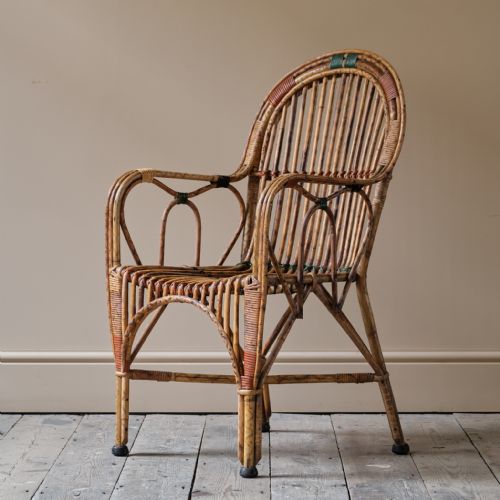
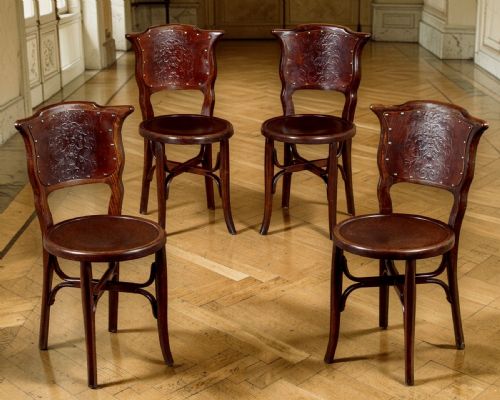
Seats and backs incorporate woven cane, woven rattan, and embossed plywood panels. Plywood sections often display intricate pressed floral or geometric patterns.
Several chairs on this page survived decades of bustling service in the historic Cafe Royal in London.
Assessing quality and execution
Quality rests in the tightness of the steam bends and the integrity of the original timber. Stronger examples maintain smooth, unbroken lines along the backrest loops without splintering at the stress points.
The fineness of the embossed plywood detailing and the neatness of the cane or rattan weaving distinguish standard utility pieces from finer workshop output.
Thonet·Codina·J & J Kohn
The Bentwood Side Chairs Glossary
- Bentwood
- Timber shaped by steam and pressure into curves. This process creates lightweight yet durable chair frames.
- Cane
- Woven material made from the outer skin of rattan palms. It provides a flexible and breathable seat pad.
- Embossed plywood
- Multiple plies of wood pressed with metal dies to leave a raised pattern. It frequently decorates the backrests of early pieces.
- Grotto style
- A decorative design featuring naturalistic shell and rockwork motifs. This style appears on early twentieth-century carver chairs.
Bentwood Side Chairs: Frequently Asked Questions
Are these chairs suitable for daily dining?
Their lightweight construction and sturdy steam-bent frames make them practical for everyday dining use.
Original cane seats require mindful weight distribution compared to solid wooden panels.
How do I date an older bentwood chair?
Dating relies on stylistic clues, workshop stamps, and the complexity of the plywood embossing.
Pieces originating around nineteen hundred often carry maker labels beneath the seat base.
Can cane seats be repaired?
Traditional hand-woven cane seats can be re-strung by specialists using matching natural materials.
Pre-woven cane panels fitted into a groove are replaced as a single unit.
Did these chairs originate in cafes?
Many examples were supplied in large quantities to European coffee houses and London establishments like the Cafe Royal.
Their robust design and ease of stacking suited bustling hospitality environments.