
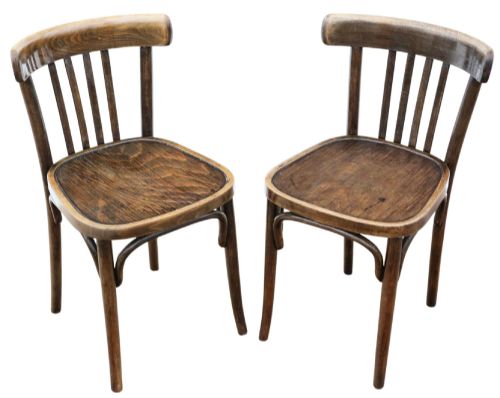
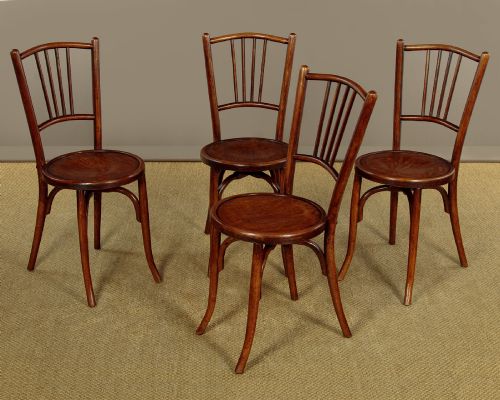
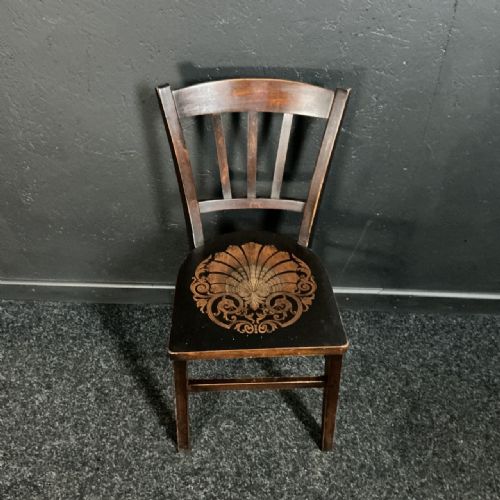


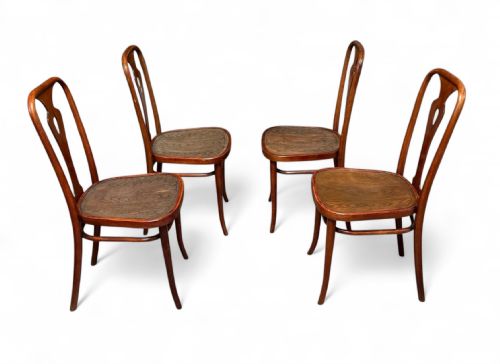


Wooden Cafe Seating
These wooden cafe seating pieces are robust dining chairs and stools built for commercial spaces, offering organic curves and enduring utility for modern interiors.
Wooden Cafe Seating
Wooden cafe seating encompasses dining chairs, armchairs, and stools designed for commercial hospitality environments and domestic use alike. These listings are dominated by bentwood bistro seating originating from major European makers.
The periods represented span the nineteenth century through the Edwardian era, extending into mid-century production. Forms range from single armchairs to matched sets of ten or twelve chairs.
Makers such as Thonet, Codina, and J & J Kohn define the primary offerings within this category. Buyers encounter both single pieces and large dining sets suitable for functional everyday placement.
Construction and materials
Construction relies upon solid beech and beechwood subjected to steam to achieve characteristic curved components. Bentwood techniques allow timber to form continuous structural frames without traditional joinery weakness.
Seats incorporate moulded pressed plywood, woven cane panels, or plain wood panels fixed securely to the bent frames. These materials combine resilience with lightness, which explains their historical popularity in bustling cafes.
Judging quality and provenance
Quality rests upon the integrity of the steam-bent timber and the clarity of maker attribution. Pieces bearing legible stamps or original labels from houses like Thonet command higher regard.
The uniformity of matched sets and the condition of original cane or plywood inserts dictate desirability. Finer examples retain their structural tautness and the subtle patination acquired through decades of public service.
Thonet·Codina·J & J Kohn
The Wooden Cafe Seating Glossary
- Bentwood
- Wood that has been rendered pliable via steam and then pressed into curved forms. This technique creates strong, lightweight frames characteristic of bistro chairs.
- Bistro chair
- A lightweight dining chair traditionally deployed in European cafes and brasseries. They are typically constructed to withstand heavy daily use.
- Plywood
- Engineered wood made from thin layers of wood veneer glued together. Pressed versions form contoured seats and backs.
- Cane
- Material woven from the outer portion of rattan palms. It provides a flexible, breathable seating surface.
Wooden Cafe Seating: Frequently Asked Questions
Are these chairs suitable for daily dining?
These chairs were originally engineered for bustling European cafes, meaning they are exceptionally durable for everyday home dining use.
Their lightweight construction also makes them easy to move around a dining table.
How do I identify a Thonet chair?
Authentic pieces often feature paper labels, brand stamps, or impressed marks directly into the underside of the wooden seat frame.
The fluidity of the steam-bent curves also offers a visual signature of the manufacturer's output.
Can I mix different bentwood styles together?
Mixing various Edwardian and mid-century bentwood designs creates an eclectic aesthetic around a kitchen or dining table.
Sharing common wood tones and curved silhouettes helps disparate chairs look cohesive.
How should I care for cane seats?
Cane seating benefits from occasional cleaning with a damp cloth to maintain moisture and prevent the natural fibres from becoming brittle.
Avoiding excessive weight drops and placing them away from direct heat sources preserves the weave.