


Baroque Cushion Wall Mirror
These baroque cushion wall mirror examples bring deep bevels and layered frames into a room, offering tactile presence.
Baroque Cushion Wall Mirror
When you search for a baroque cushion wall mirror, you encounter convex frames that project forward from the wall in pronounced profiles. These pieces frame central glass plates within stepped or rounded borders.
The versions most likely to meet you on this page span several revival periods and earlier centuries. They appear in forms associated with William and Mary styles, Dutch Baroque Revival taste, and Italian or French workshops.
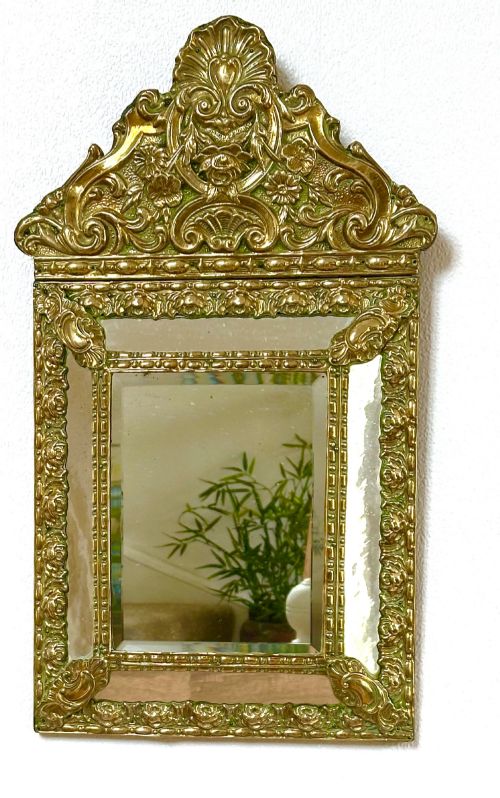
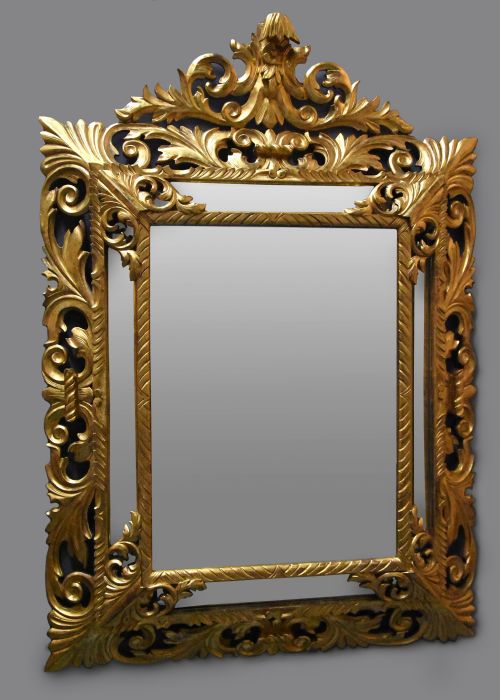
Makers utilised wood, brass, and giltwood to construct these substantial wall mirrors. The resulting objects combine architectural depth with reflective surfaces.
How they were made
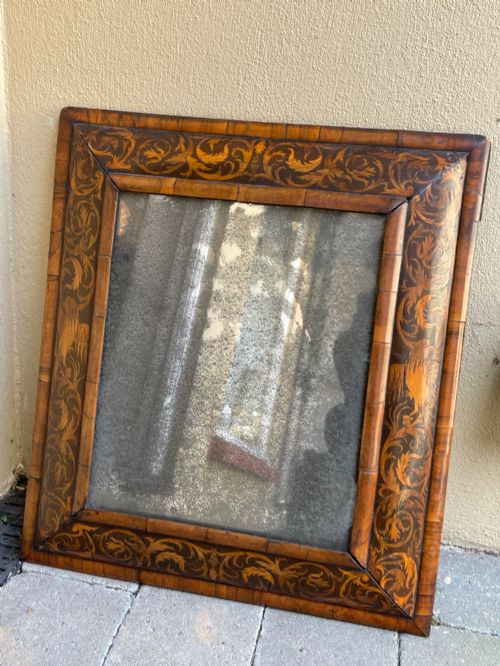
Constructors shaped wooden foundations into curved cushion profiles before applying veneers or surface decoration. Walnut and boxwood formed stable bases for intricate marquetry and oyster veneer patterns.
Giltwood versions received layers of gold leaf over carved wooden grounds to achieve a reflective metallic sheen. Repoussé brass panels were beaten into relief and fixed directly to wooden frames.
Listings span periods from the seventeenth century through to Edwardian and early twentieth-century revivals.
What varies in quality
The crispness of carved detail and the complexity of inlaid marquetry distinguish finer examples from simpler production. Subtle variations in the depth of the cushion moulding change how light catches the profile.
The integrity of the original mirror glass and the preservation of early gilding or veneer surfaces dictate the character of each piece. Superior execution appears in the harmony between the wooden carcass and its decorative skin.
The Baroque Cushion Wall Mirror Glossary
- Cushion mirror
- A wall mirror featuring a convex, rounded frame that swells outward toward the outer edge. This profile creates a distinct three-dimensional frame around the central glass plate.
- Marquetry
- The art of applying decorative pieces of veneer to a structure to form intricate patterns. Craftsmen utilised contrasting woods like walnut and boxwood for geometric designs.
- Oyster veneer
- Thin circular slices cut transversely from small branches or roots, revealing concentric growth rings. This technique produced distinctive circular patterns across wooden surfaces.
- Repoussé
- A metalworking technique where a malleable sheet of brass is hammered from the reverse side to create a raised design. It produced textured metallic frames on Flemish and Dutch examples.
- Giltwood
- Timber that has been coated with a thin layer of gold leaf. This finish provided a brilliant reflective surface popular in Italian and French revival schemes.
Baroque Cushion Wall Mirror: Frequently Asked Questions
What is a cushion mirror?
A cushion mirror is a wall mirror characterised by a convex frame that swells outward like a pillow. This profile surrounds the central glass with stepped architectural depth.
Such forms gained prominence during the late seventeenth century and saw revivals through the nineteenth and early twentieth centuries.
How do I hang a heavy wall mirror?
Heavy wall mirrors require secure fixings anchored directly into structural wall studs or masonry. Professional hanging hardware distributes the substantial weight safely along the frame.
Consult a specialist if the mirror relies on antique wooden brackets or internal hanging loops.
Where should I place a cushion mirror?
Cushion mirrors suit principal reception rooms, hallways, or above mantelpieces where their projecting profiles command attention. Their reflective surfaces amplify natural light within a space.
Keep them away from direct moisture sources to protect wooden veneers and delicate gilding.