




Barley Twist Drop Leaf
These barley twist drop leaf tables combine space-saving folding leaves with distinctive turned legs, offering practical function and traditional character for the home.
Barley Twist Drop Leaf
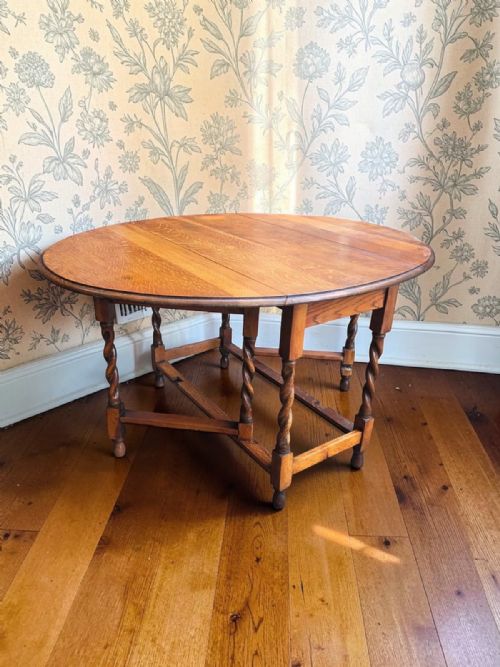
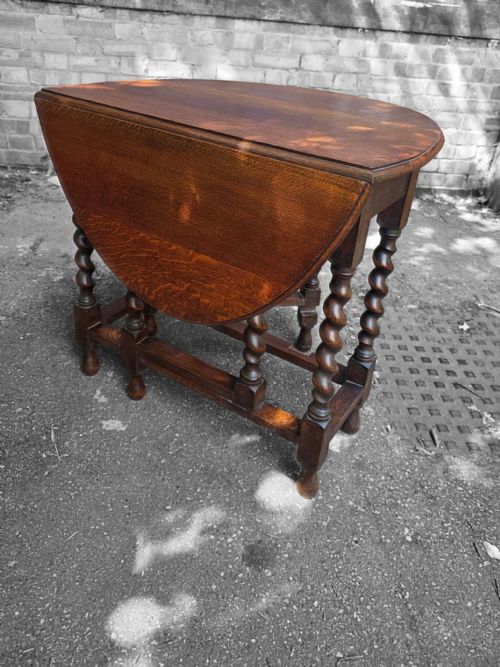
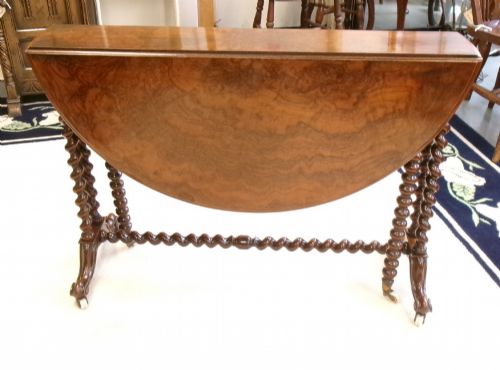
A barley twist drop leaf table is a versatile folding piece designed to expand for dining or work and contract for compact storage against a wall. The selection centres primarily on oak gateleg dining tables from the early twentieth century alongside walnut and burr walnut Sutherland tables from the Victorian period.
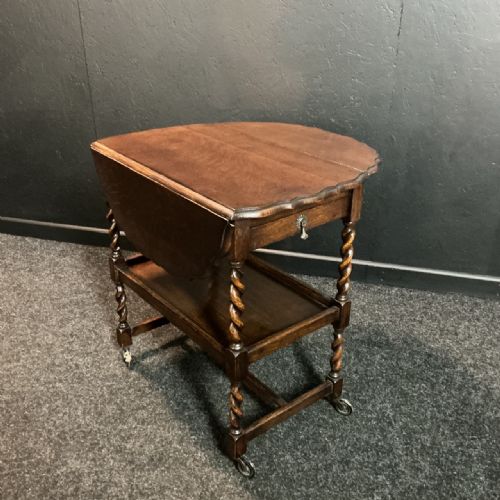
Makers utilised various formats, ranging from large gateleg dining tables and small occasional tables to tea trolleys and writing tables. Pieces originating from the eighteenth and nineteenth centuries appear alongside Edwardian and 1920s examples, showing a long tradition of domestic utility.
Buyers encounter numerous oval and rectangular table tops supported by swing legs that hold the folding flaps in place. The construction accommodates both everyday meals in family spaces and occasional use in smaller reception rooms.
How they were made
Cabinet makers constructed the primary framework using solid oak, mahogany, and walnut, often selecting burr walnut and olivewood veneers for decorative surfaces like table tops. Brass fittings, ceramic castors, and iron mechanisms supported the folding actions of tea trolleys and occasional tables.
The characteristic spiral supports were produced on a lathe by cutting a helical groove down the timber shaft to create the signature twist. Joinery relied on traditional mortise and tenon joints to bear the weight of the hinged leaves when extended.
Several tea trolleys on the site bring wheels to the table, ensuring afternoon tea can roll across the room with Victorian precision.
What varies in quality
The calibre of a piece rests upon the crispness of the timber turnings and the depth of the grain in woods like burr walnut and figured oak. Superior examples display carefully matched timber veneers on the leaves and harmonious proportions when the flaps are both raised and lowered.
Structural integrity depends on the precision of the gateleg pivot hinges and the stability of the frame under load. Tables with solid brass hardware and tight, movement-free joints represent the finer end of the surviving selection.
The Barley Twist Drop Leaf Glossary
- Gateleg table
- A drop leaf table where hinged legs swing outward from the centre frame to support the raised flaps. This design provides rigid support for dining surfaces while allowing the leaves to drop flat.
- Sutherland table
- A narrow-bodied drop leaf table featuring exceptionally slender folding leaves and low-set gatelegs. Victorian makers frequently produced these in walnut for use as occasional or tea tables.
- Barley twist
- A decorative spiral turning resembling a twisted rope, carved or shaped into furniture legs and uprights. This style gained widespread popularity during the seventeenth century and saw major revivals in the Victorian and Edwardian eras.
- Marquetry
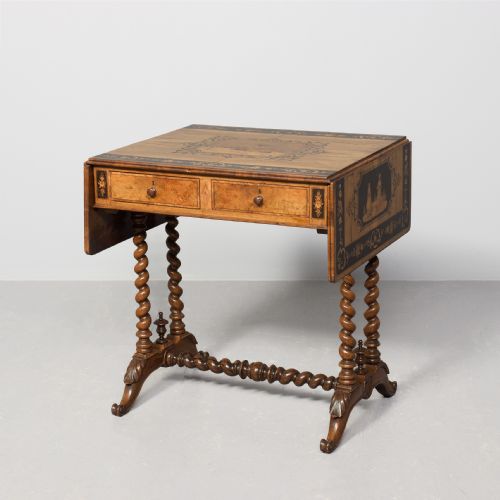
- The art of forming decorative patterns using fitted pieces of coloured wood veneer. Elaborate floral and geometric designs appear on the tops of Victorian tables.
- Goncalo Alves
- A dense exotic hardwood with striking dark brown and light golden-brown markings. Nineteenth-century cabinet makers utilised this timber for specialised writing and sofa tables.
Barley Twist Drop Leaf: Frequently Asked Questions
How do I use a drop leaf table?
Raise the hinged side flaps and swing the outer supporting legs outward until they lock into position beneath the leaf. This creates a stable surface for dining or writing.
Lower the leaves by swinging the support legs back toward the centre frame and dropping the flaps downward. The table then occupies minimal floor space against a wall.
What is a Sutherland table?
A Sutherland table is a narrow drop leaf table designed with exceptionally thin leaves that hang almost vertically when lowered. They originated in the nineteenth century as compact tea or occasional tables.
The low gatelegs swing out from a very slim central underframe to support the extended leaves. This construction allows the entire piece to fold into a remarkably shallow profile.
Are barley twist legs Jacobean?
Barley twist turnings originated during the seventeenth century, coinciding with the Jacobean period in England. Furniture makers revived the technique extensively during the Victorian and Edwardian eras.
Most barley twist tables on the market date from the late nineteenth and early twentieth centuries rather than the 1600s. The presence of later hardware and secondary timbers usually confirms these revival periods.