



Barley Twist Carver Chairs
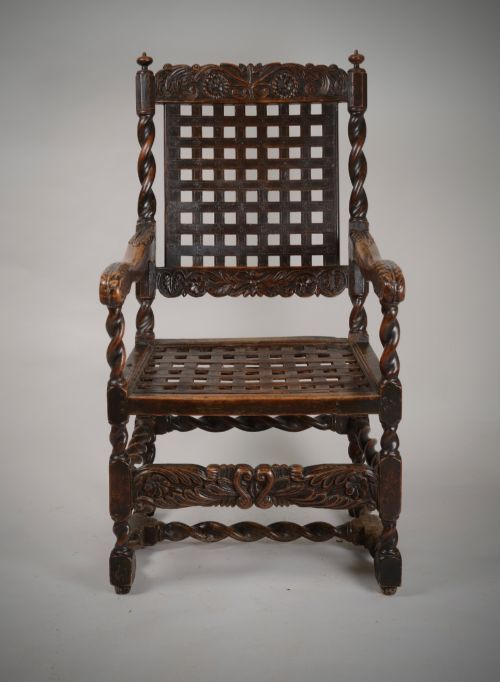
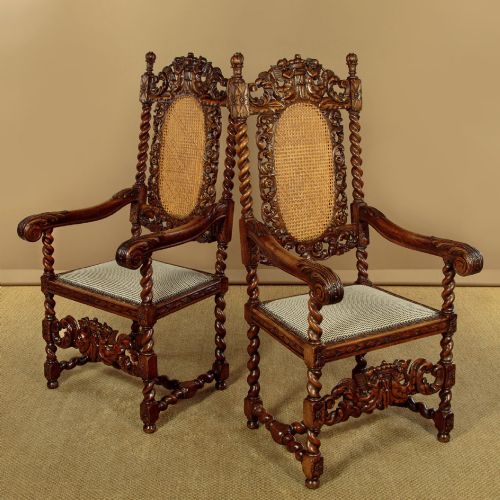
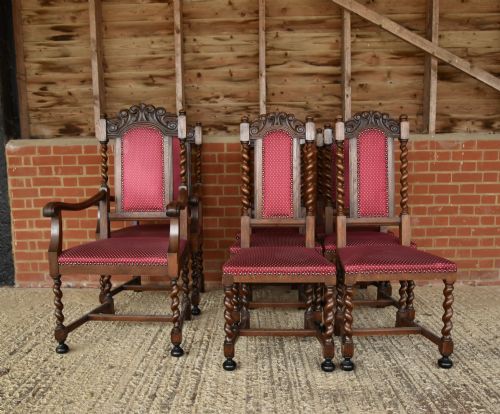
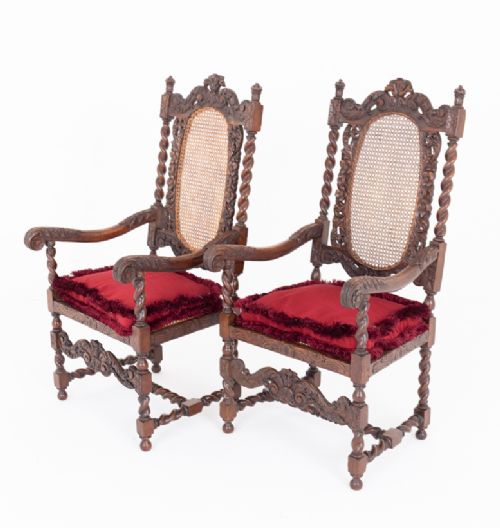
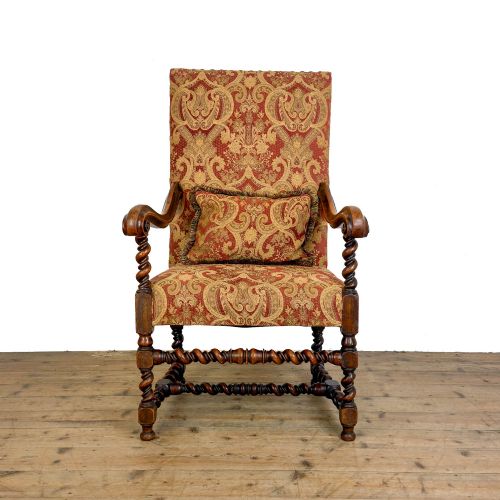
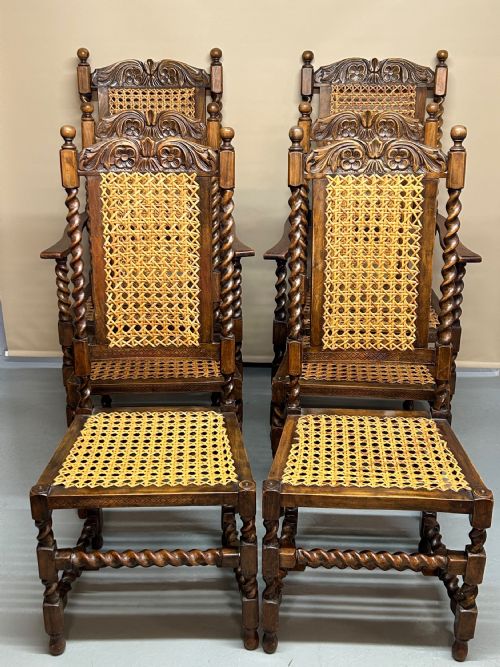
These barley twist carver chairs combine sturdy timber framing with distinctive turned columns, offering both substantial seating and striking period character.
Barley Twist Carver Chairs
Barley twist carver chairs are sturdy armchairs featuring spiral-turned wooden uprights or stretchers, historically designed to sit at the head of a dining table or serve as parlour seating. When searching for barley twist carver chairs, buyers encounter pieces spanning from the seventeenth century through to the revival periods of the nineteenth and early twentieth centuries.
Quality factors
The distinction between standard production and superior craftsmanship rests in the crispness of the timber turning and the depth of hand-carved detailing on the crest rails and arm terminals. Early seventeenth-century originals or faithful revival pieces with dense, heavy hardwoods demonstrate greater structural integrity than later mass-produced variants.
The choice of seating material also dictates overall refinement, with tightly woven cane work, supple leather, and hand-stitched tapestries marking out higher-grade commissions. Uniformity in the spiral twist and tight joinery at the arm joints further separate utilitarian seating from finer collector-grade specimens.
Denby and Spinks Leeds
The Barley Twist Carver Chairs Glossary
- Carver armchair
- A sturdy wooden armchair, traditionally designed with arms to accommodate heavier clothing and placed at the head of a dining table. These pieces often match a larger set of simpler side chairs.
- Barley twist
- A decorative spiral turning resembling a stalk of barley, created on a lathe during the seventeenth century and revived extensively in later Victorian and Edwardian furniture. This motif appears on legs, stretchers, and upright posts.
- Jacobean Revival
- A nineteenth and twentieth-century style imitating the heavy, dark oak furniture of the early seventeenth century. Pieces in this style typically feature straight lines, panelled backs, and deep carved ornamentation.
- Bergere
- An enclosed upholstered armchair with a wooden frame and cane back and seat panels. This style gained popularity during various revival periods for domestic drawing rooms.
- Cromwellian style
- A plain, functional seventeenth-century style characterised by straight wooden members, leather upholstery, and brass studding. These designs eschew elaborate carving in favour of austere practicality.
Barley Twist Carver Chairs: Frequently Asked Questions
What periods do these chairs come from?
The listings span from seventeenth-century originals through nineteenth-century Victorian interpretations up to early twentieth-century revival pieces.
Most items you encounter date from the Edwardian period and the nineteen-twenties, when revival styles enjoyed a sustained revival among cabinet makers.
How do I identify a true carver chair?
A carver chair is distinguished by its integral armrests, built to frame the seated user and elevate it above standard dining chairs.
They were traditionally positioned at either end of a dining table for the head of the household or honoured guests.
What woods were used for these chairs?
Oak and walnut form the vast majority of the frames across both seventeenth-century origins and later revival periods.
Occasional pieces utilise alternative timbers such as mahogany or laburnum, paired with cane, leather, or woven tapestry seats.
Are these chairs suitable for daily dining?
Many sturdy oak and walnut frames provide robust construction capable of regular daily use around a dining table.
Buyers should examine the specific upholstery and frame stability to ensure the piece matches intended domestic demands.
What is the difference between Jacobean and Carolean styles?
Jacobean revival furniture tends to be heavy and austere, featuring straight structural lines and muted geometric mouldings.
Carolean pieces incorporate more dynamic carving, open scrollwork, and elaborate crest rails inspired by the later seventeenth-century court of Charles the Second.