




Barley Twist Candle Holders
Barley twist candle holders bring tactile warmth and rich historical character to a room through their distinctive spiralling stems.
Barley Twist Candle Holders
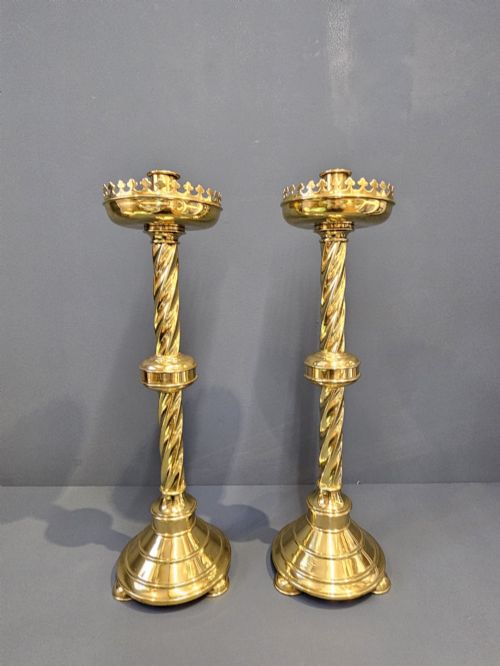
Barley twist candle holders are practical table and altar items defined by their characteristic spiral stems, which catch the light and add movement to domestic interiors. When exploring barley twist candle holders, collectors encounter forms ranging from compact domestic pairs to monumental church candlesticks.
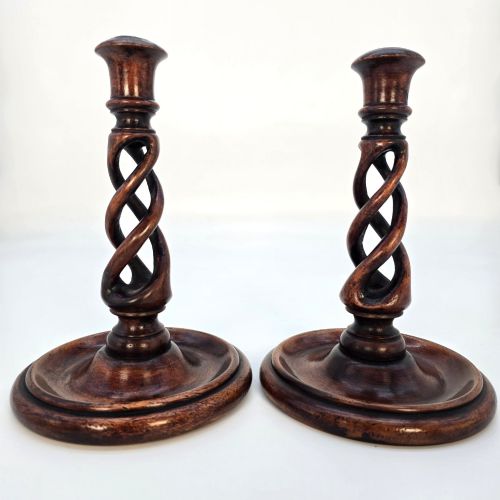
The selection spans multiple eras, including the eighteenth century alongside Victorian, Edwardian, and later twentieth-century periods. Oak, fruitwood, mahogany, and walnut dominate the wooden examples, frequently paired with brass bases and drip pans, while other pieces utilise solid brass or crystal glass.
Materials and construction
Woodturners shaped timber shafts into open and closed spirals using lathes and hand chisels, selecting dense hardwoods like oak, fruitwood, mahogany, and walnut to ensure structural integrity. These wooden stems often incorporate fitted brass nozzles, trays, and weighted bases to provide stability during use.
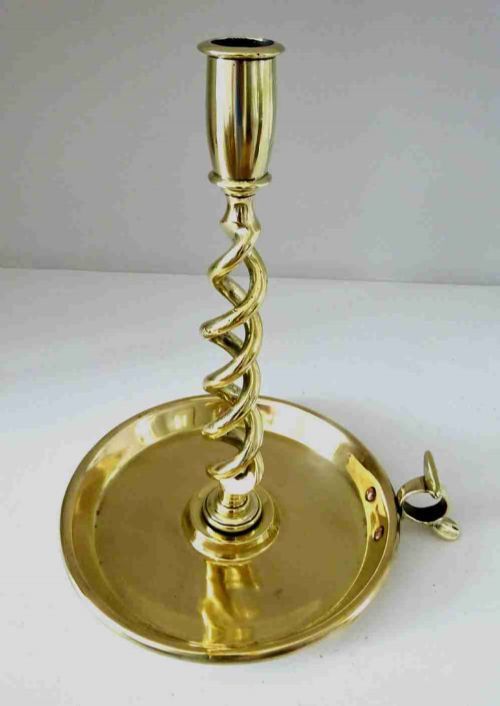
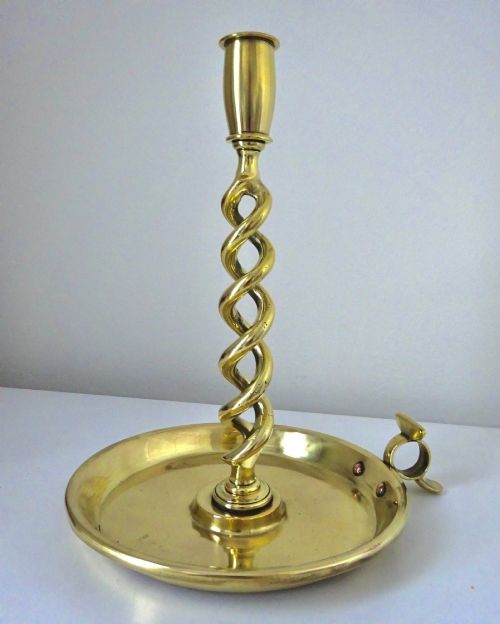
Metalworkers cast brass components in sand moulds before finishing the surfaces by hand, sometimes combining cast brass with Enamel or mounting the metal directly onto wooden plinths. Glassmakers utilised crystal glass to form transparent pieces complete with domed and folded feet.
Listings feature oak, fruitwood, mahogany, and walnut alongside brass, enamel, and crystal glass across eight distinct periods.
Judging quality
Quality rests upon the precision and rhythm of the spiral twist itself, where hand-carved open timber twists display a fluidity entirely distinct from mechanical turning. The crispness of casting detail on brass elements and the proportional balance between base, stem, and nozzle further separate superior examples.
Material selection dictates longevity and visual weight, with dense timbers, heavy cast brass, and clear crystal commanding greater appreciation. Original matched pairs with integrated drip trays or fitted handles also hold stronger appeal for collectors than assembled components.
T Thomason & Co
The Barley Twist Candle Holders Glossary
- Open twist
- A spiral form where material is carved away completely to leave a hollow, spiralling channel through the centre. This technique demands exceptional skill from the woodturner to prevent breakage.
- Ecclesiastical
- Pertaining to the Christian church, describing large brass candle holders originally manufactured for altar use. These pieces often feature heavy bases and prominent decorative moulding.
- Drip pan
- A small metal or glass tray positioned beneath the candle nozzle to catch melting wax. It protects the stem and table surface below.
- Folded foot
- A glassmaking technique where the rim of the base is folded back on itself to create a heavier, reinforced edge. This provides greater stability for tall candlesticks.
Barley Twist Candle Holders: Frequently Asked Questions
How do I date an oak barley twist?
Dating relies upon examining tool marks, timber shrinkage, and the method used to join the stem to the base. Earlier eighteenth-century examples display hand-worked surfaces, whereas twentieth-century pieces show more uniform mechanical precision.
Style indicators also help narrow the timeline, as Jacobean Revival pieces from the Edwardian era often mimic seventeenth-century forms with cleaner internal joints.
Are brass candle holders solid or weighted?
Most antique brass candlesticks are cast in solid brass sections, though some feature hollow bases filled with pitch or other weighting materials for stability. Heavier gauge metal indicates better quality.
Inspecting the underside often reveals the casting method and any internal support structures used to secure the stem to the base.
What is the difference between open and closed twists?
Closed twists retain a solid central core with a spiralling groove cut into the exterior surface, offering greater structural strength. Open twists feature carved air gaps through the centre, creating a lighter, more intricate silhouette.
Both styles were produced across different centuries, though open twists are particularly celebrated in fruitwood and oak.