


Open Barley Twist Pair
An open barley twist pair brings rhythmic architectural turning and enduring symmetry to a room, offering both traditional weight and visual lightness.
Open Barley Twist Pair
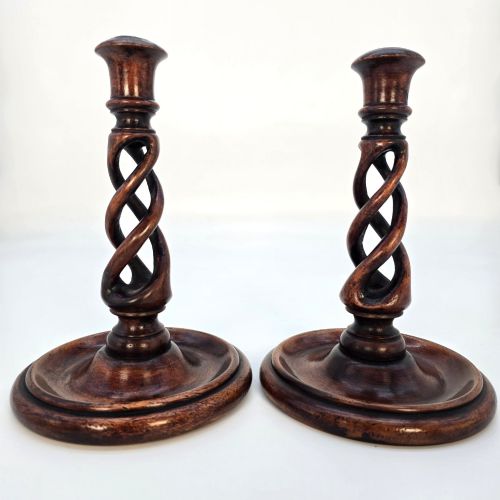
An open barley twist pair consists of symmetrically turned matching items, most commonly found as sturdy oak candlesticks fitted with brass tops or thistles from the late nineteenth and early twentieth centuries.
Collectors searching for this specific form encounter matching pairs spanning from the Victorian era into the Edwardian period, where the spiralling timber reveals an open channel through the core of the turning.
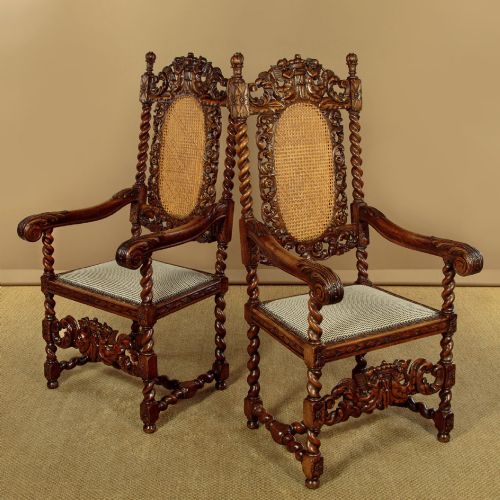
Beyond domestic candlesticks, the evidence shows the twist applied across larger domestic furnishings including walnut and fruitwood armchairs, whatnots, and occasional seating.
Evaluating Quality
The definition and depth of the helical cut dictate the visual impact, where sharper, cleaner apertures demonstrate superior lathe work and careful carving compared to shallow, sluggish turns.
Proportion and scale separate standard domestic objects from more substantial examples, with towering heights and balanced symmetry commanding greater presence.
The integration of secondary materials, such as heavy brass thistle tops fitted cleanly to turned oak shafts, reveals the original maker's attention to detail and structural harmony.
Listings feature oak, walnut, fruitwood, and mahogany, alongside brass fittings and tapestry fabric.
The Open Barley Twist Pair Glossary
- Barley Twist
- A helical turning resembling the stalk of barley, popularised during the seventeenth century and revived in later periods. This spiral form creates dynamic shadow lines along furniture legs and candlestick shafts.
- Thistle Top
- A brass socket shaped like a thistle flower fitted to the upper section of a turned wooden candlestick. This metal component holds the candle secure while protecting the timber below.
- Whatnot
- A set of open shelves supported by slender columns, designed for displaying ornaments and small objects. These tiered pieces often incorporate turned uprights matching the characteristic spiral style.
- Jacobean Revival
- A nineteenth-century design movement resurrecting seventeenth-century motifs, heavily utilising dark oak and prominent turning. Pieces from this revival emphasise historical weight and traditional craftsmanship.
- Fruitwood
- A dense, fine-grained timber harvested from fruit-bearing trees such as pear or apple, utilised for smaller turned items like candlesticks. The smooth grain allows for crisp, detailed shaping.
Open Barley Twist Pair: Frequently Asked Questions
What periods do these pieces come from?
The pieces span from the late eighteenth century through the Victorian and Edwardian eras up to the 1920s. Revival styles from the nineteenth century frequently borrow earlier seventeenth-century forms.
Most surviving examples date from the late 1800s to the early decades of the twentieth century, particularly reflecting Edwardian production methods.
How were barley twist candlesticks used?
These matching pairs stood on mantelpieces, sideboards, and dining tables to provide domestic illumination before the widespread adoption of electric lighting. The brass thistle tops caught melting wax and held tallow or wax candles safely.
Beyond illumination, matched pairs served a purely decorative function to create symmetry on furniture surfaces.
Are all twists hollow through the middle?
True open twists feature a distinct physical aperture running completely through the helical channel, allowing light and air to pass through the turning. Solid twists have a spiral groove carved into a solid cylinder without passing through to the other side.
Open turning requires greater skill from the woodturner to maintain structural integrity while removing the central core.
What woods are most common?
Solid oak dominates the surviving candlesticks and smaller turned items, often paired with polished brass components. Walnut and fruitwood appear more frequently on larger seating frameworks and earlier candlesticks.
Bleached oak and mahogany also feature in the broader selection of furniture pieces sharing the same turned vocabulary.