
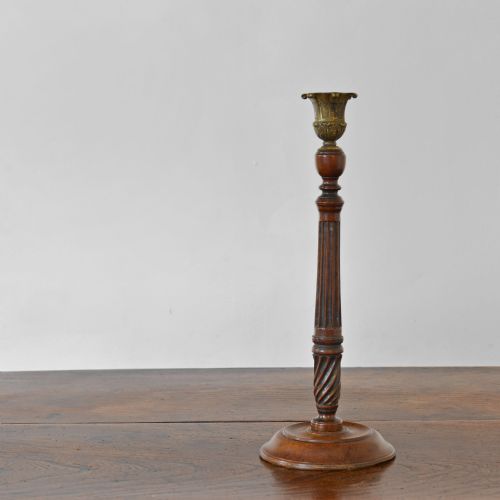


Turned Wood Candle Sconces
Turned wood candle sconces are practical domestic lighting pieces formed on a lathe, offering warmth and traditional craftsmanship for the home.
Turned Wood Candle Sconces
Turned wood candle sconces and candlesticks appear in various traditional forms spanning the Georgian, Victorian, and Edwardian eras. Buyers searching for turned wood candle sconces will discover items shaped on a lathe, predominantly in forms like pairs of candlesticks.
Designs range from classical George III style proportions to robust barley twist columns dating around nineteen ten. Compact travel pieces such as Brighton buns also feature in the available range.
How they were made
These items rely on lathe turning to shape blocks of hardwood into symmetrical columns and bases. Craftsmen utilised dense timbers like mahogany, oak, and exotic olive wood to withstand the pressure of the turning process.
Makers integrated turned wooden shafts with fitted brass tops and sconces to secure the candles and catch dripping wax. The resulting structures combine carved or turned timber profiles with fitted metal hardware.
Olive wood Brighton buns offer travellers a pocket-sized candle solution that unscrews like a humble wooden container.
What varies in quality
Quality rests in the precision of the lathe work and the choice of timber figure, with tighter grain patterns and well-proportioned baluster stems marking superior examples. The integration of the brass hardware into the turned wood body also dictates the refinement of the piece.
Substantial scale and balanced pairs command greater attention than smaller, single items. The crispness of carved details in revival styles further separates standard domestic objects from finer decorative items.
The Turned Wood Candle Sconces Glossary
- Barley twist
- A spiral column turned on a lathe to resemble a twist of barley. This decorative motif appears frequently on wooden stems from the Edwardian period.
- Brighton bun
- A small, pocket-sized turned wood travel container that unscrews to hold a candle inside. These portable items often utilise olive wood.
- George III style
- A revival aesthetic reflecting the neoclassical proportions and mahogany preferences of the late eighteenth century. Pieces in this style were frequently produced around nineteen hundred.
- Sconce
- The metal nozzle or socket fitted to the top of a candlestick to hold the candle upright. These are commonly cast in brass.
- Baluster
- A vertical turned pillar with a swelling base that tapers toward the top. It forms the main structural shaft of many traditional candlesticks.
Turned Wood Candle Sconces: Frequently Asked Questions
What periods do these pieces come from?
The selection spans from the Georgian era through the Victorian and Edwardian periods up to the nineteen twenties.
Many items date specifically around nineteen hundred or reflect earlier George III aesthetic traditions.
Are these items made entirely of wood?
While the main bodies and bases are turned from timbers such as mahogany, oak, and olive wood, numerous examples incorporate metal.
Brass tops and sconces are fitted to the wooden stems to hold the candles securely.
What is a Brighton bun?
A Brighton bun is a compact, spherical travelling candlestick made from turned wood that unscrews for portability.
They were designed for travellers to carry a candle safely in luggage during the Edwardian era.
How do I identify barley twist designs?
Barley twist columns feature a distinctive helical carving running up the shaft of the candlestick.
This technique was popular for oak stems produced in the early twentieth century.