


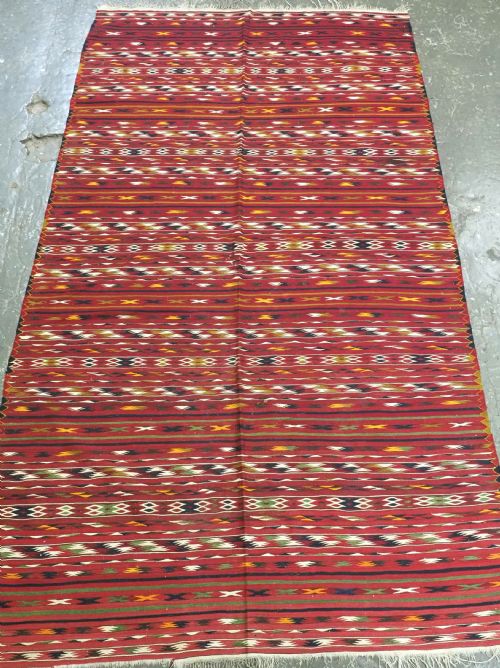
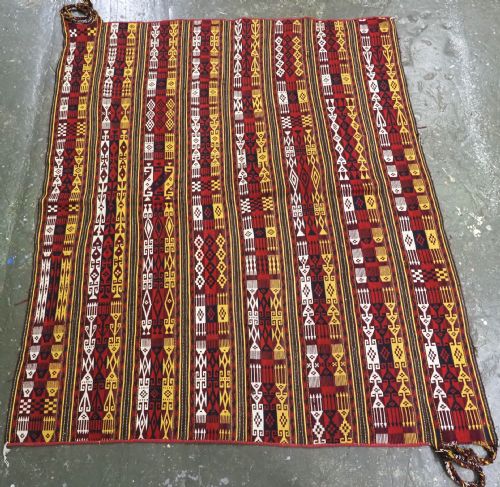
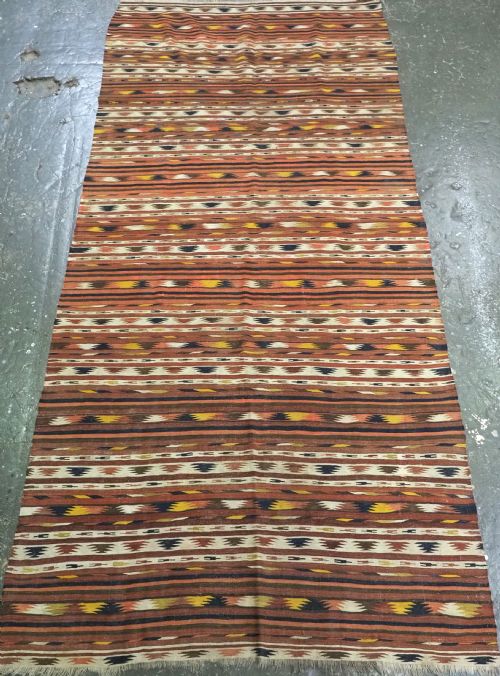
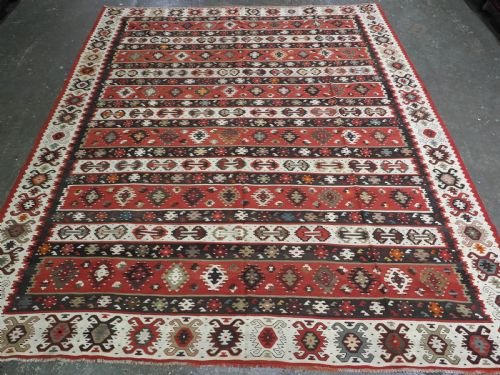
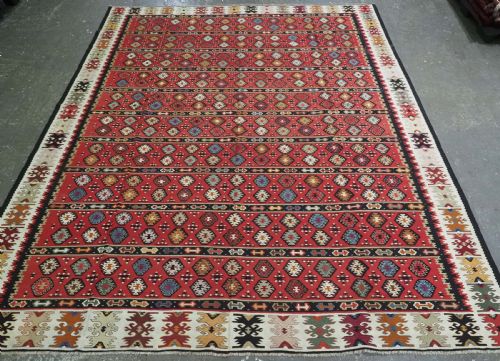

Banded Kilim Rug
A banded kilim rug brings linear rhythm and nomadic heritage into a room through geometric stripes woven flat without pile.
Banded Kilim Rug
A banded kilim rug is a flatwoven textile defined by horizontal stripes or bands of pattern, originating from tribal and nomadic weaving traditions across Central Asia, the Caucasus, and the Balkans. When searching for a banded kilim rug, buyers encounter historical flatweaves dating from the late nineteenth century through the early twentieth century, spanning styles such as Uzbek Gajeri, Caucasian Shirvan, and Balkan Pirot or Sarkoy.
The format ranges from small utility items such as saddlebags, mafrash faces, and tent bands up to large floor carpets and area rugs. Many examples reflect specific regional weaving groups, including Yomut Turkmen, Baluch, Qashqai, and Varamin, demonstrating how utilitarian household objects transitioned into decorative floor coverings.
How they were made
These textiles rely on hand-spun wool and cotton, worked in slit-tapery and weft-work techniques to build crisp horizontal bands of geometric motifs. Artisans employed natural dyes to achieve soft colour palettes, ranging from warm muted tones to bold clear hues.
The structure is unpiled, meaning the design is formed entirely by the interlacing of warp and weft threads. This method creates a sturdy, reversible textile well-suited to the demands of nomadic life and daily domestic use.
Several larger floor rugs began life as heavy-duty nomadic storage bags or structural tent bands before finding new life underfoot.
What varies in quality
The quality of a flatweave is determined by the fineness of the weave and the precision of the geometric banding. Tighter, denser interlacing of the wool produces a crispness in the pattern lines and greater structural longevity.
Colour selection and dye interaction also define the upper tier of pieces. The subtle tonal shifts achieved through natural dyeing create depth within the bands, elevating the visual harmony of the textile.
The Banded Kilim Rug Glossary
- Kilim
- An unpiled flatwoven textile produced by tightly interweaving warp and weft strands. This technique results in a thin, durable fabric without a raised pile.
- Mafrash
- A rectangular storage bag or chest panel used by nomadic tribes for bedding and household goods. These pieces often feature striking horizontal bands of flatweave.
- Slit-tapery
- A weaving method where the weft threads are looped back at the boundary of a colour change, creating a small vertical slit between motifs. It is the defining technique for sharp geometric designs in flatweaves.
- Tent band
- A long, narrow woven strip utilised structurally and decoratively within nomadic encampments. They frequently exhibit intricate banded weft-work patterns.
- Weft work
- The decorative filling threads woven horizontally across the vertical warp threads to create patterns. In these textiles, the weft carries the primary design and colour.
Banded Kilim Rug: Frequently Asked Questions
How do I clean a flatweave rug?
Gentle surface shaking and regular light vacuuming without a rotating brush help maintain the textile.
Professional specialist cleaning is recommended for deep maintenance to protect the wool and natural dyes.
Are these rugs suitable for high traffic?
The flatwoven structure lacks a pile, which makes these pieces durable and resistant to crushing under foot.
Using a quality underlay provides grip and extra cushioning on hard floors.
How do I identify a Balkan Pirot?
Pirot and Sarkoy flatweaves typically display fine banded compositions with soft, harmonious colour palettes.
They originate from the Balkan region and often present in larger room sizes.
What is a Gajeri kilim?
Gajeri describes a specific Uzbek flatweave tradition characterised by distinct bands of weft work.
These pieces often incorporate traditional Central Asian motifs within narrow striped fields.