
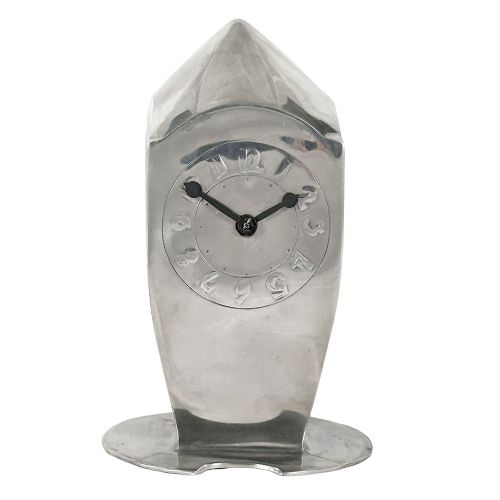
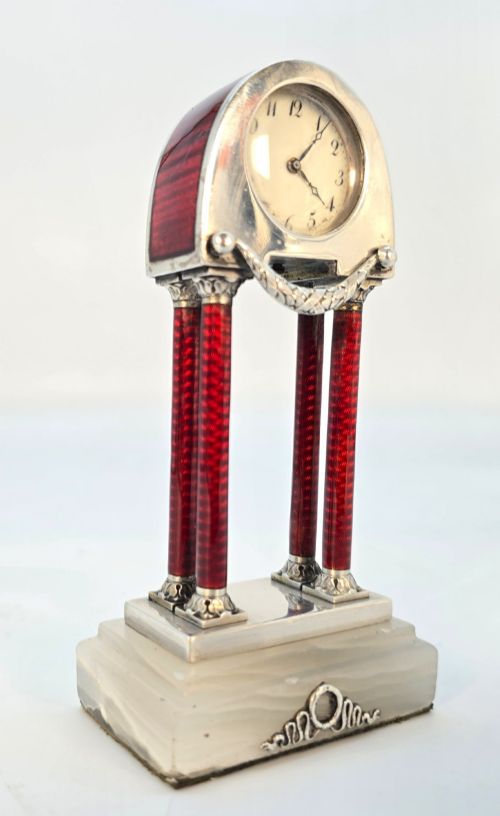
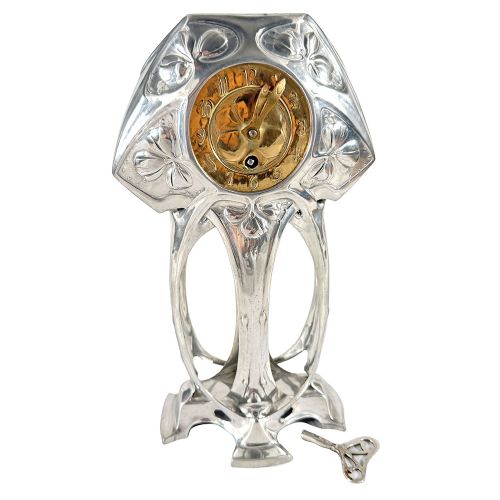


Art Nouveau Mantel Clock
When you search for an art nouveau mantel clock, you are looking for a domestic timepiece defined by organic lines, floral motifs and the Jugendstil aesthetic.
The Nature of Art Nouveau Mantel Clocks
An art nouveau mantel clock is a domestic timepiece produced around 1900, capturing the flowing, organic designs of the movement. These objects served both a practical domestic purpose and acted as decorative sculpture for a room.
The pieces available include French mahogany examples, German productions, silver plated Jugendstil designs and silver clad Portuguese items. You will frequently encounter inlaid wooden versions alongside metal and glass constructions.
Makers and retailers such as Samuel Marti, Lenzkirch and WMF contributed to these pieces, often combining traditional woodwork with contemporary metalwork styling.
Materials and Construction
Cabinet makers utilised mahogany, fruitwood, oak, ebony and general wood substrates for the bodies of these timepieces. Wood surfaces were frequently decorated with delicate inlay work depicting flowers, ribbons and abstract organic panels.
Metal components involved brass, copper, silver plate and solid silver, sometimes paired with glass panels to reveal the movement within. Enamel dials provide the face for many of these clocks, often carrying stylised numerals typical of the period.
Retail Price Guide 2026
Typical UK retail prices for art nouveau mantel clock, calculated from the Sellingantiques database of over a million retail prices indexed since 2003. This retail price guide relies exclusively on Sellingantiques data; no external sources or auction records are used, so the figures do not describe the wider market.
Some clocks feature delicate ribbon and urn inlays, proving that even a timepiece appreciates a well tied bow.
Judging Quality
Quality rests in the precision of the cabinet work and the fidelity of the stylistic details. Pieces featuring complex inlay work or bespoke metal castings sit at the higher end of the range.
The distinction between standard commercial output and superior work is found in the integration of materials, such as the seamless joining of glass, metal and polished timber.
Samuel Marti·Lenzkirch·WMF
The Art Nouveau Mantel Clock Glossary
- Jugendstil
- The German manifestation of the Art Nouveau movement, heavily represented in metalwork and clock design around 1900.
- Inlay
- A technique where contrasting woods or metals are inserted into depressions in the base material to create decorative patterns.
- Enamel
- A glassy substance fused to metal dial faces to provide a smooth, durable surface for clock numerals.
- Timepiece
- A clock that tells the time without a striking mechanism for hours or quarters.
Frequently Asked Questions
What is an art nouveau mantel clock?
An art nouveau mantel clock is a domestic timepiece made around 1900 featuring the curved lines and natural motifs characteristic of the movement. They were designed to sit on a fireplace mantel or shelf as both a useful instrument and a decorative object.
These clocks combine materials like mahogany, fruitwood, brass, copper, silver plate and glass. They range from simple inlaid wooden cases to complex glass and metal designs.
How do I identify a period piece?
Period pieces display the specific aesthetic markers of the movement, such as whiplash curves, floral marquetry and stylised enamel dials. Materials commonly used include mahogany, fruitwood, brass and silver plate, pointing to production around 1900.
Examining the construction methods on the interior and exterior helps distinguish authentic period pieces from later reproductions. Maker marks from firms like Samuel Marti or Lenzkirch also assist in verification.
Where were these clocks placed?
These clocks were intended for domestic reception rooms, sitting comfortably upon the mantelpiece above a fireplace or upon a sideboard. Their decorative fronts ensured they were viewed as ornamental centrepieces.
Because they were built for daily household use, their sizes varied to suit different room proportions and furniture scales.
How do French and German clocks differ?
French examples frequently utilise mahogany cases, sometimes with marquetry inlay or mechanical movements supplied by makers like Samuel Marti. They lean towards refined cabinet work and elegant proportions.
German productions, such as those associated with Lenzkirch, often incorporate robust wooden cases and distinctive metal details that align closely with the Jugendstil aesthetic.