
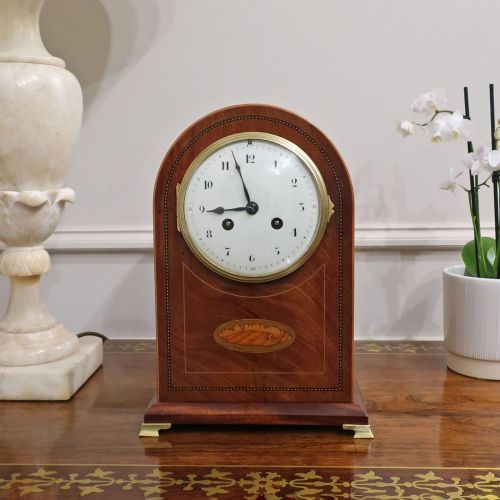


Belle Epoque Clock
These belle epoque clock designs combine mahogany, brass, and glass to mark time with French Victorian and Art Nouveau flair.
Understanding the Belle Epoque Clock
A belle epoque clock represents a specific period of decorative arts spanning the late nineteenth century and the Edwardian era. Buyers examining this category encounter timepieces originating from France, encompassing both mantel clocks and smaller travel or carriage pieces.
Mahogany mantel clocks form the core of what is available, frequently accompanied by brass four glass designs. These pieces range from simple lancet top wooden cases to elaborate decorative models featuring porcelain panels, enamel dials, and inlaid details.
The selection also includes variations in slate, marble, rosewood, and tortoise shell, reflecting the diverse material tastes of the period. Alongside distinct mantel clocks, miniature bedside travel clocks and engraved carriage designs appear from the 1890s and 1900.
Materials and Construction
Clockmakers utilised a combination of structural woods such as mahogany, rosewood, and occasionally black slate and marble for the main housings. Brass frames supported delicate four glass panels, allowing a clear view of the mechanical movements within.
Surface ornamentation involved intricate inlay work, champleve enamel, and silver gilt finishes. Dials frequently featured painted or fired enamel work, paired with engraved metal elements and cast spelter or brass decorative mounts.
Retail Price Guide 2026
Typical UK retail prices for belle epoque clock, calculated from the Sellingantiques database of over a million retail prices indexed since 2003. This retail price guide relies exclusively on Sellingantiques data; no external sources or auction records are used, so the figures do not describe the wider market.
Listings feature periods spanning 1890 to 1900 alongside the Edwardian era, predominantly showcasing French origin.
Distinctions in Quality
Quality rests upon the pedigree of the movement maker and the complexity of the housing. Pieces containing signed mechanisms from established French movement producers command distinct attention from collectors.
The choice of materials heavily influences the standing of a piece, moving from standard brass housings to sophisticated mahogany, rosewood, or tortoise shell cases with detailed inlay and porcelain additions.
Samuel Marti·L.P Japy·Japy Freres·A.D Mougin·Drocourt·Vincenti·E Portelance
The Belle Epoque Clock Glossary
- Four glass clock
- A mantel clock housed within a brass frame featuring glass panels on all four sides to expose the movement. This design gained popularity during the late nineteenth century.
- Champleve
- An enamelling technique where trenches are gouged into a metal surface and filled with vitreous enamel before firing. It frequently appears on decorative dial surrounds and mounts.
- Carriage clock
- A small, portable spring-driven clock designed for travel, typically featuring a carrying handle and glass sides. Miniature versions were produced for bedside use around 1900.
- Spelter
- A zinc alloy utilised as a cheaper alternative to bronze for cast decorative figures and mounts. It was often painted or electroplated to resemble more expensive metals.
- Lancet top
- A clock case profile featuring a pointed, arched top resembling a gothic window. This silhouette appears frequently among mahogany mantel clocks from the period.
Frequently Asked Questions
How do I wind a belle epoque clock?
Most mechanical clocks from this era utilise a key inserted into arbors on the dial to tension the springs. Care must be taken not to overwind the movement.
Consulting the specific requirements of the escapement helps maintain steady timekeeping without straining the internal components.
Where were these clocks made?
The vast majority of these timepieces originate from French workshops and factories. Many movements were produced by regional makers before being cased in France.
Retailers across Europe, including firms like Maple and Co, subsequently imported and retailed these finished clocks to domestic buyers.
What is the difference between a carriage clock and a mantel clock?
Carriage clocks are compact, portable timepieces traditionally equipped with a swinging handle for travel. They often feature exposed glass panels and smaller platform escapements.
Mantel clocks are larger, stationary objects designed to sit permanently on a fireplace mantel or shelf, constructed from heavy woods, slate, or brass.
How do I date a belle epoque clock?
Dating relies on stylistic clues such as the transition from heavy French Victorian designs to flowing Art Nouveau motifs. Case materials like mahogany and brass span both the 1890s and Edwardian periods.
Inscribed marks on the backplate from makers like Japy Freres or Samuel Marti provide precise chronological reference points for the movement.