




Art Nouveau Dresser
An art nouveau dresser brings organic line and thoughtful craftsmanship into a room, uniting functional storage with the distinct fluidity of the period.
Art Nouveau Dresser
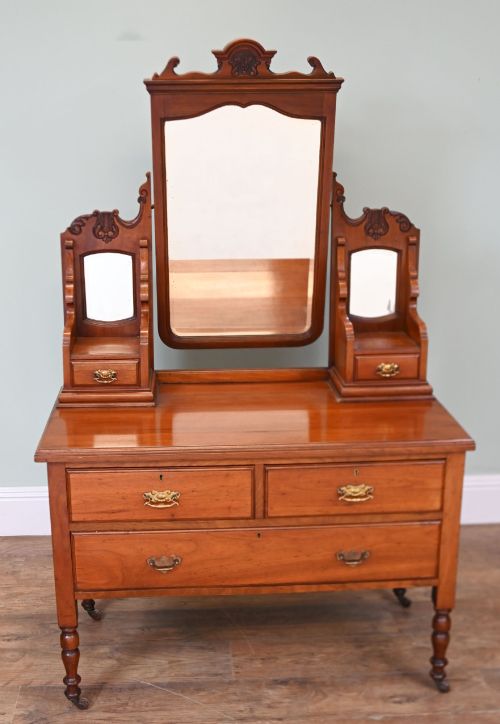
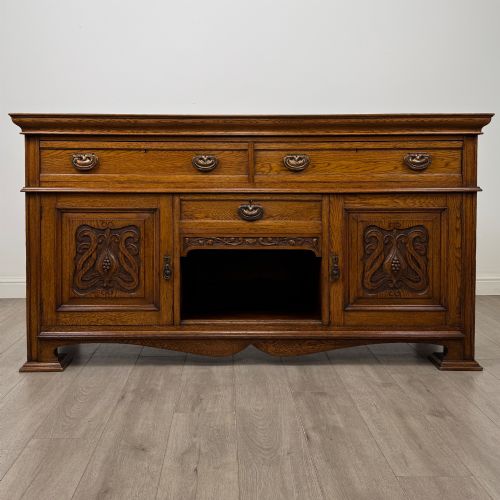
When you search for an art nouveau dresser, you encounter pieces designed around the turn of the twentieth century that merge storage utility with stylized natural forms. The selection includes examples in mahogany, oak, and walnut, often featuring mirror backs or elevated display sections.
These items span the Edwardian and Victorian eras through to the 1910s, reflecting both British and continental workshops. You will find sideboards and dressing tables that share the characteristic aesthetic of the movement.
The most frequent variations on this page combine traditional cabinetry with the distinctive visual vocabulary of the era. Makers applied curvilinear motifs to timber surfaces, creating practical furniture that doubles as sculptural design.
Materials and construction methods
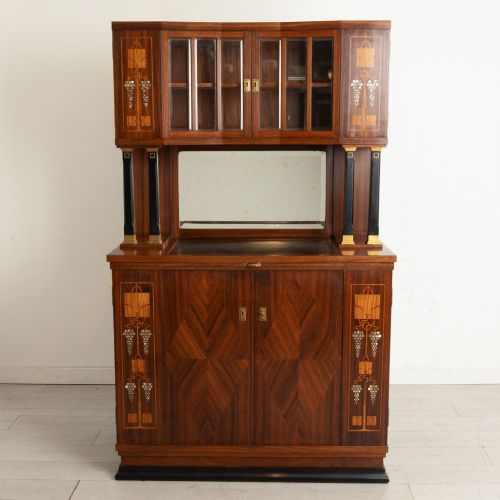
Constructed primarily from hardwoods such as oak, mahogany, and walnut, these cabinets employ traditional joinery alongside applied wood inlay to create durable carcasses. Ebonised wood occasionally provides a contrasting dark tone to highlight specific structural details.
Metalwork forms an integral part of the fabrication, with brass and copper utilised for handles, hinges, and decorative mounts. Glass elements appear in cabinet doors and display sections, shaped to complement the overall organic geometry.
Listings feature items from the Victorian, Edwardian, and 1910 periods, utilising materials such as mahogany, oak, walnut, brass, and copper.
Assessing craftsmanship and finish
The distinction between standard production and superior work lies in the handling of timber and the precision of inlaid details. Higher quality pieces display seamless integration of decorative metal fittings with the primary wood surface.
Cabinetry execution dictates the integrity of the piece, particularly in the construction of mirror backs and integrated shelving. Finer examples maintain crisp detailing in carved or inlaid motifs without relying solely on surface finishes.
August Ungethüm·Shapland and Petter·J R Mally and Co·Josef Margold
The Art Nouveau Dresser Glossary
- Art Nouveau
- A style of decorative art characterised by intricate linear designs and flowing patterns inspired by natural forms. It dominated international design around the turn of the twentieth century.
- Arts and Crafts
- A design movement emphasising handcraftsmanship, traditional materials, and simple forms. It heavily influenced the development of early twentieth-century furniture.
- Secessionist
- A modern art and design movement originating in Central Europe, particularly associated with Vienna. It favoured geometric simplification alongside organic motifs.
- Inlay
- A technique used to ornament wooden surfaces by embedding pieces of contrasting material into recessed areas. Wood inlay appears frequently on period cabinetry.
- Ebonised Wood
- Timber treated to resemble ebony through a staining and finishing process. It provides a dense black finish used for contrast in furniture design.
Art Nouveau Dresser: Frequently Asked Questions
What is an art nouveau dresser?
An art nouveau dresser is a piece of storage furniture produced during the late nineteenth or early twentieth century featuring the characteristic flowing lines of the movement.
These items typically take the form of sideboards, mirror-back cabinets, or dressing units constructed from woods like oak and mahogany.
How do I identify the period?
Period identification relies on examining the timber, construction methods, and stylistic motifs present on the cabinet. Pieces from this era often combine traditional joinery with distinct naturalistic brass or copper hardware.
Looking at the integration of glass and inlaid wood provides further clues to whether a piece belongs to the Victorian, Edwardian, or later Secessionist periods.
Where were these pieces made?
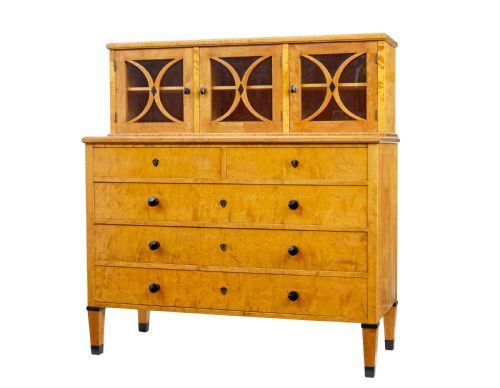
The pieces originate from various workshops across Britain and continental Europe, including notable production centres in Austria, Holland, and Sweden.
Regional differences emerge in the choice of woods, such as Swedish birch, and in the specific stylistic leanings towards Arts and Crafts or Viennese Secessionism.
How do I care for wooden cabinets?
Maintaining these pieces requires stable environmental conditions away from direct sunlight and excessive moisture fluctuations to protect the timber and inlay.
Regular dusting with a soft cloth preserves the polished surface of woods like walnut and mahogany without damaging original finishes.