
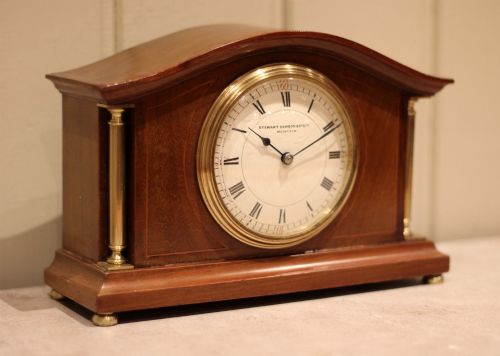
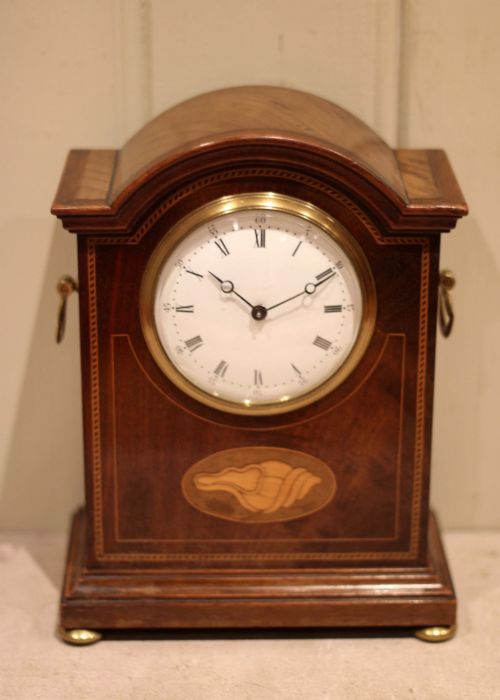
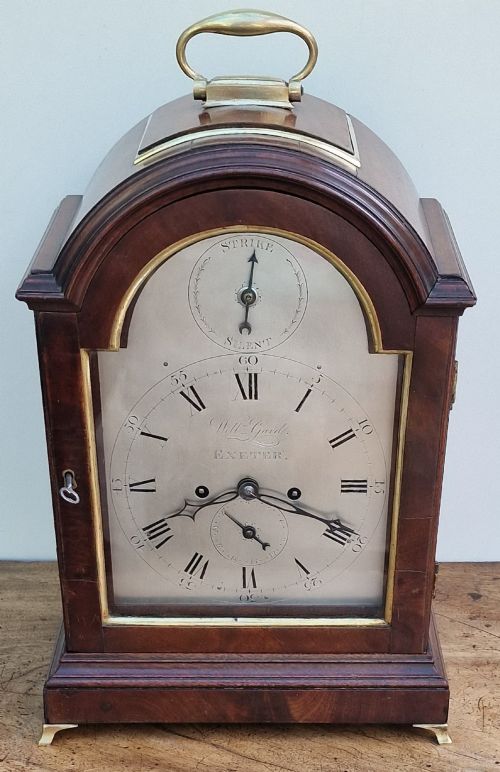
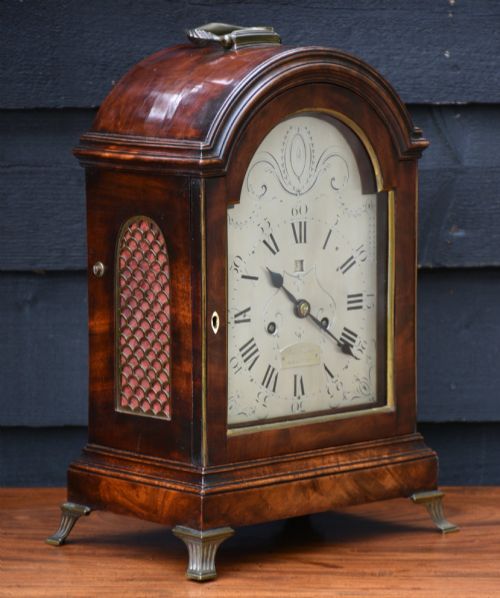
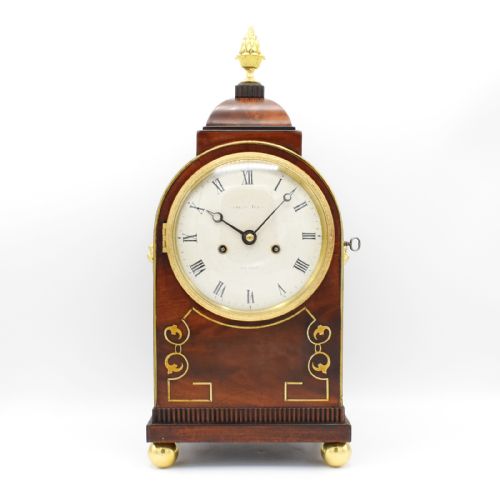
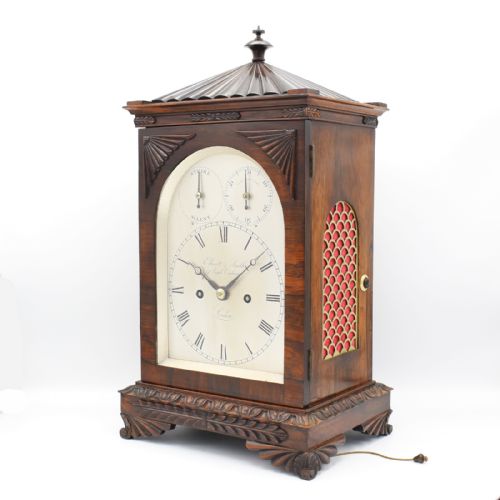
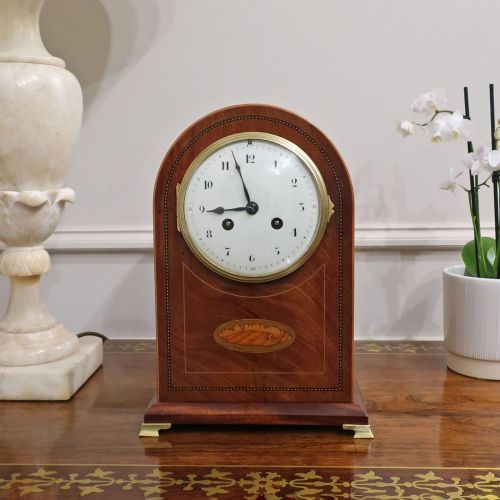
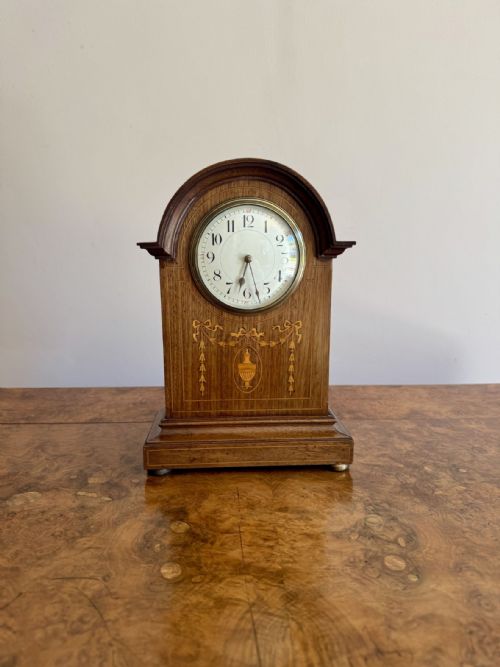
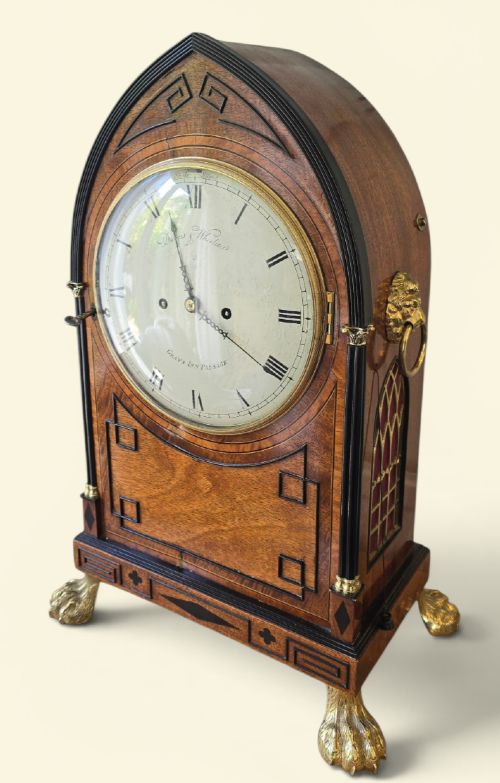
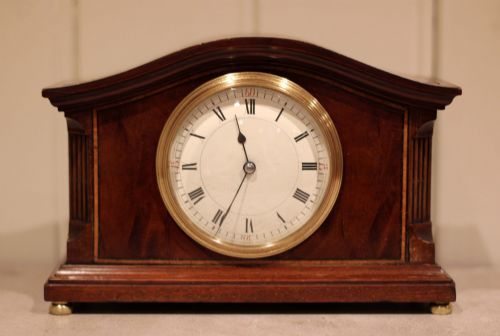
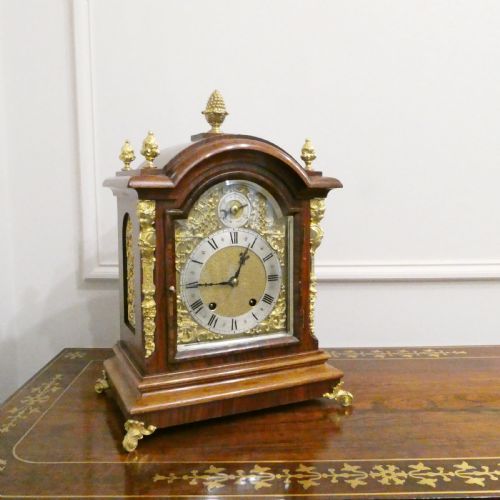
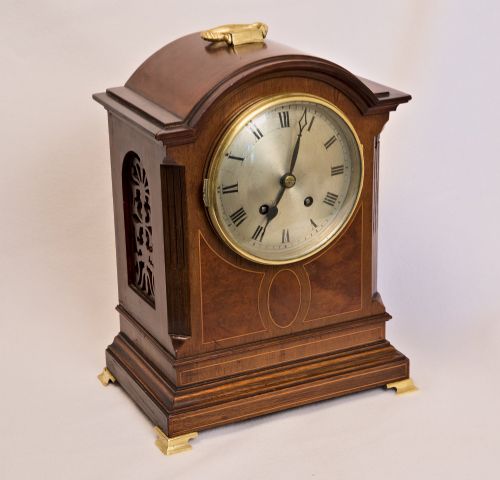


Arched Mahogany Mantel Clock
An arched mahogany mantel clock brings warmth and measured rhythm to a room, combining rich timber with precise mechanical engineering.
Arched Mahogany Mantel Clock
An arched mahogany mantel clock is a self-contained timekeeper designed to sit on a shelf, table, or mantelpiece. The pieces gathered here span periods from the Georgian era through to the early twentieth century, encompassing bracket clocks, table clocks, and traditional mantel designs.
The dominant aesthetic draws upon Georgian, Regency, and Edwardian styles, where architectural wooden cases frame functional dials. Makers adapted proportions from strict classical lines to softer Edwardian interpretations inlaid with satinwood or decorated with motifs like poppies.
Most examples rely on mechanical movements driven by springs or fuses, housed in timber cabinets topped with distinct arched, bell, or lancet profiles. These objects served both domestic utility and decorative display in period interiors.
How they were made
Cabinetmakers constructed the primary housings using solid and veneered mahogany, frequently embellishing surfaces with contrasting satinwood inlay, ebony stringing, or precision brass marquetry. The timber was selected for grain pattern and depth of colour, then polished to a smooth finish.
Internal mechanisms combined brass plates, steel gears, and graduated dials of silvered brass or enamel. Movements varied from simple timepieces to complex fusee and ting-tang striking systems produced by English and continental workshops.
Periods represented span the Georgian, Regency, Victorian, Edwardian, and Belle Epoque eras.
What varies in quality
Quality in these clocks rests upon the integration of movement and case. Finer examples display crisp hand-engraved backplates, original fusee movements, and well-proportioned timber housings with intact brass feet or sound fretwork sound-frets.
The precision of the cabinetwork dictates distinction, seen in the alignment of wood grain across curved arches and the restraint applied to inlay work. Maker attribution, through signed dials or engraved movements, further distinguishes standard production from master workshop output.
William Gard·Barwise·Charles Pratt·Ellicott & Smith·Desbois & Wheeler·Thomas Moss·Cording·Schneckenburger·Perigal·Dent·J Condliff·Brockbanks·Budgen·Wilkinson·Junghans·Winterhalder & Hofmeier·Hyde of Salisbury
The Arched Mahogany Mantel Clock Glossary
- Fusee
- A conical pulley used in spring-driven clocks to maintain equal power as the mainspring unwinds. This mechanism ensures more consistent timekeeping throughout the duration of the wind.
- Ting-tang
- A striking mechanism that sounds two different notes on bells or gongs to indicate the quarters. It provides an audible chime without a full hour strike sequence.
- Lancet-top
- A case design featuring a pointed, gothic-arch profile resembling a lancet window. This silhouette is particularly characteristic of Regency and early nineteenth-century bracket clocks.
- Verge escapement
- An early type of clock escapement controlled by a balance spring or pendulum. It represents traditional mechanical construction found in eighteenth-century bracket clocks.
- Silvered brass
- A metal dial finish created by applying a silver compound to brass plates before engraving numerals and signatures. This treatment produces high contrast and legibility under indoor lighting.
Arched Mahogany Mantel Clock: Frequently Asked Questions
What is a bracket clock?
A bracket clock is a portable mechanical timepiece originally built with a sturdy handle and designed to rest on a matching wall bracket or table surface.
Over time, the term evolved to describe larger table clocks housed in architectural wooden cases with glass panels and brass fittings.
How do fusee movements work?
A fusee movement uses a conical pulley connected to the mainspring by a fine chain or cord. As the spring loses tension, the chain moves to a wider part of the cone, leverage changes, and the clock receives steady force.
This clever mechanical adjustment helps the clock keep accurate time between windings.
How do I identify a Georgian clock?
Georgian clocks generally display classical architectural proportions, clean mahogany cases, and brass bracket feet or carrying handles. Their dials often feature finely engraved silvered brass plates signed by the maker.
Stylistic cues also include bell-tops and traditional verge or anchor escapements.
Where should I place a mantel clock?
Mantel clocks require a stable, level surface away from direct heat sources, dampness, and heavy vibrations. Placing them on a firm mantelpiece or sideboard ensures the pendulum or balance wheel swings evenly.
Keeping them out of direct sunlight also protects the polished mahogany finish and delicate dial enamels.