
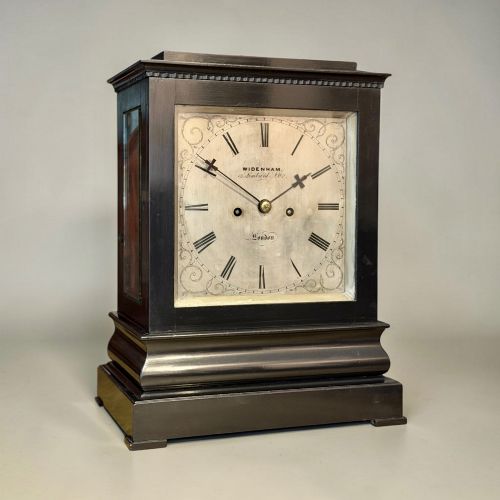
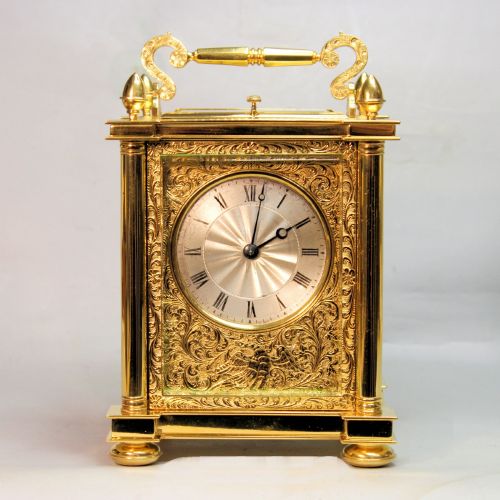
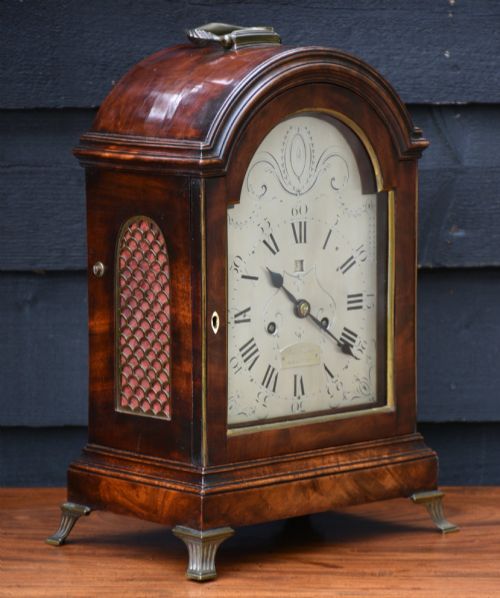


Engraved Dial Bracket Clock
An engraved dial bracket clock brings mechanical precision and rich cabinet-making into a room, offering both reliable timekeeping and period presence.
Engraved Dial Bracket Clock
When you search for an engraved dial bracket clock, you examine portable timepiece designs spanning the seventeenth century through to the twentieth century. These objects combine clockmaking mechanics with cabinet work in woods such as mahogany, rosewood, and ebonised timber.
The versions most commonly met on this page date from the nineteenth century, including Victorian interpretations and earlier Georgian survivals. Their forms range from traditional bracket clock shapes to library clocks, mantel clocks, and lantern clocks housed in glass or wood.
Makers housed these movements in sturdy table cases designed to be moved between rooms rather than fixed to a wall. Brass, gilt brass, and silvered metal components interact with glass panels to reveal the interior workings of each piece.
Materials and construction
Horologists built these pieces using brass and silvered metal for the dials and fusee movements, driving the gear trains with precision. Cases relied on dense timbers like mahogany and rosewood, often complemented by ebonised finishes.
Glass panels allowed visibility into the mechanisms, whilst gilt brass mounts provided structural and decorative detailing. Dials received fine hand-engraving to mark the hours and minutes with clarity.
Listings span multiple centuries, incorporating Victorian, Georgian, and seventeenth-century eras alongside diverse timbers like mahogany and rosewood.
Assessing quality
The division between simpler examples and finer works lies in the execution of the movement and the cabinetry. Master clockmakers integrated fusee movements and complex striking trains with greater mechanical refinement.
Cabinet quality shows in the selection of timber veneers, the crispness of brass mounts, and the intricacy of the engraved dial work. Cases constructed from solid rosewood or figured mahogany with careful joinery represent higher standards of production.
Widenham of London·Cousens & Whiteside·Mappin & Webb·John Spershott·Dent·Arnold and Frodsham·Frodsham & Baker·John Massey·L. Donne
The Engraved Dial Bracket Clock Glossary
- Fusee
- A conical pulley used in clock movements to maintain an equal pull as the mainspring unwinds. This mechanism ensures consistent timekeeping accuracy throughout the running period.
- Bracket clock
- A portable household clock originally designed to sit upon a bracket or table. These pieces typically feature robust movements housed in wooden or metal cases.
- Silvered metal
- A base metal treated with a silver coating to form a bright dial surface. Engraved markings are often filled with dark wax to stand out against the silvered background.
- Lantern clock
- An early form of domestic clock made primarily of brass, usually driven by weights or springs. They derive their name from their brass-framed box shape.
- Library clock
- A compact timepiece intended for desk or shelf placement within a study or library. These objects frequently utilise glass panels to expose the movement.
Engraved Dial Bracket Clock: Frequently Asked Questions
What is an engraved dial bracket clock?
An engraved dial bracket clock is a portable mechanical timekeeper featuring a metal face decorated with hand-engraved numerals and patterns. These pieces are housed in wooden or metal cases designed for tabletop placement.
They emerged from periods spanning the seventeenth century to the twentieth century, combining cabinet-making with complex gear movements.
How did people use them?
Owners placed these clocks on tables, brackets, or desks in principal rooms to track the hours and signal quarters or hours with strikes. Their portable nature allowed staff to move them between rooms as needed.
They served both as functional timekeepers and as decorative objects displaying the wealth and taste of the household.
Where should I place one?
These clocks suit stable surfaces away from direct sunlight, extreme temperature changes, and dampness. Placing them on a firm mantelpiece, desk, or dedicated wall bracket protects the mechanical movement from vibrations.
Allowing sufficient clearance around the case ensures proper sound projection for striking models.
How do I wind the clock?
Winding involves inserting a matching key into the dial winding holes and turning it gently until resistance meets the spring or weight's limit. Care must be taken not to overwind the mechanism.
Consulting specific instructions for fusee or spring-driven movements ensures the longevity of the internal brass gears.
How are periods told apart?
Periods are identified through a combination of case style, wood selection, and engraving techniques. Seventeenth-century pieces often display lantern forms, whilst Georgian and Victorian examples show evolving cabinet shapes.
Signatures on dials or movements and stylistic motifs like George II style or French Louis XIV influences help confirm the date of production.