


Antique Walnut Sheet Rack
An antique walnut sheet rack, commonly formed as a canterbury or music stand, organises folios and papers with nineteenth-century utility.
Antique Walnut Sheet Rack
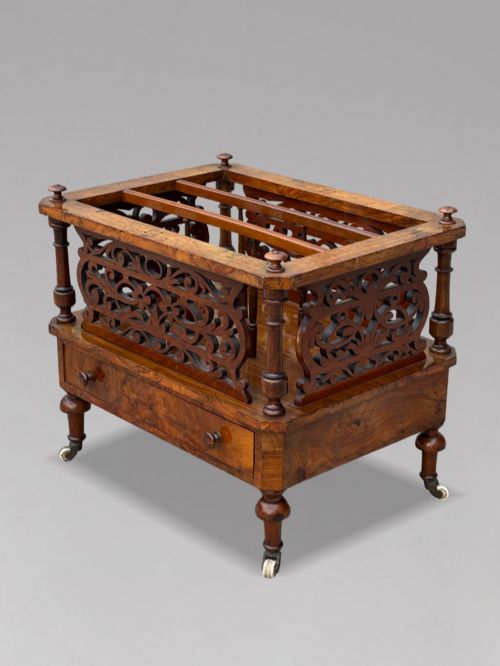
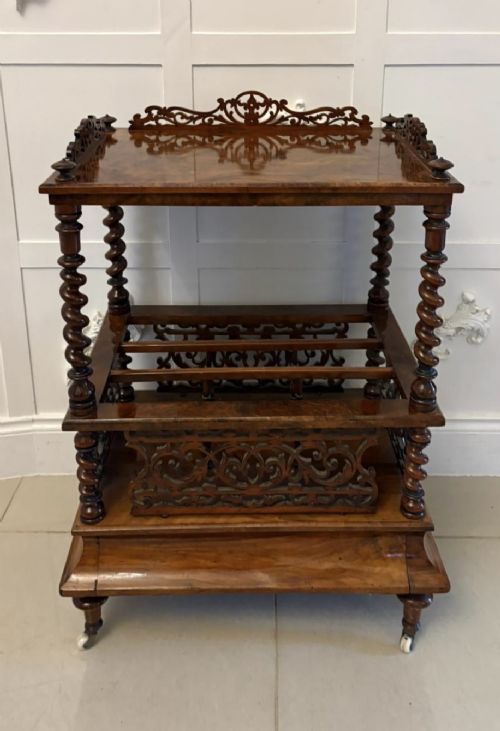
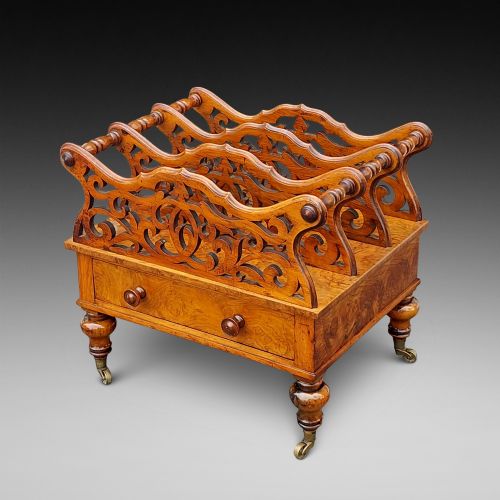
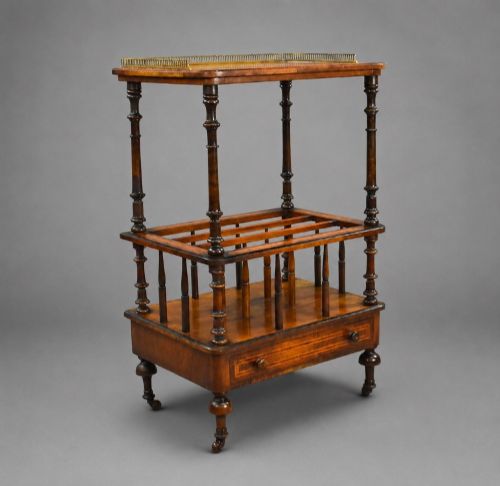
When you search for an antique walnut sheet rack, you are looking at nineteenth-century storage furniture designed to hold folios, music sheets, newspapers, and periodicals. The form most frequently met on this page is the canterbury, an open-partitioned stand often combined with a lower drawer, a shelf, or a small tabletop.
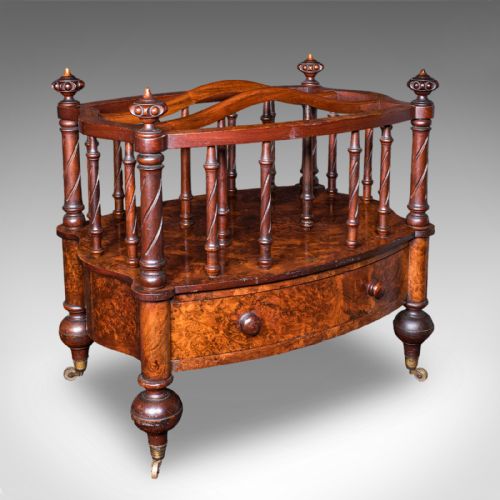
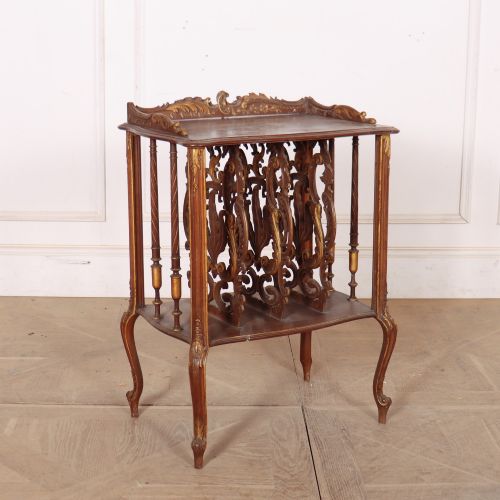
The material vocabulary centres on walnut, burr walnut, and figured walnut, complemented by black walnut and occasional French carved stands. Pieces span from the Regency era through the Victorian period, appearing in serpentine, oval, and rectangular shapes.
These items served various rooms, functioning as music stands, magazine racks, display tables, and etageres. Makers such as Edwards & Roberts and Shoolbred contributed to this functional repertoire, shaping how papers and folios were stored in the nineteenth-century parlour.
How they were made
Cabinet makers utilised walnut timber, specifically selecting burr and figured veneers for their rich, swirling grain patterns across the main surfaces. These wooden structures incorporate boxwood stringing, marquetry, and delicate wood inlay to accentuate panels and borders.
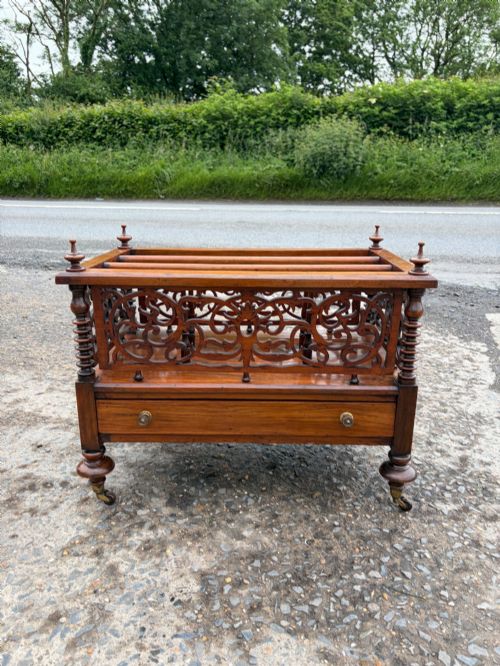
Designers integrated brass elements, ceramic castors, and porcelain components to add mobility and functional detail to freestanding frames. Structural integrity relies on pierced fretwork, carved supports, and fitted drawers constructed within nineteenth-century workshop traditions.
Listings span the Regency and Victorian periods, showcasing materials like burr walnut, boxwood, brass, and porcelain across canterburys and music stands.
What varies in quality
The grade of timber selection drives the primary division in quality, with highly figured burr walnut veneers commanding greater presence than plain dark walnut boards. Finer examples display meticulous matching of the grain across curved serpentine and oval forms.
Execution of decorative elements separates standard output from superior items. Pierced fretwork partitions, precise boxwood inlay, marquetry details, and integrated drawers with finished interiors demonstrate the elevated skill of makers like Edwards & Roberts.
Edwards & Roberts·Shoolbred
The Antique Walnut Sheet Rack Glossary
- Canterbury
- A low freestanding stand with upright partitions, originally designed for holding sheet music and folios. Nineteenth-century examples often incorporate lower drawers or tabletop tiers.
- Burr walnut
- A veneer sliced from the bulbous growths of a walnut tree, prized for its intricate, swirling grain patterns. It forms the primary decorative surface on high-grade Victorian pieces.
- Whatnot
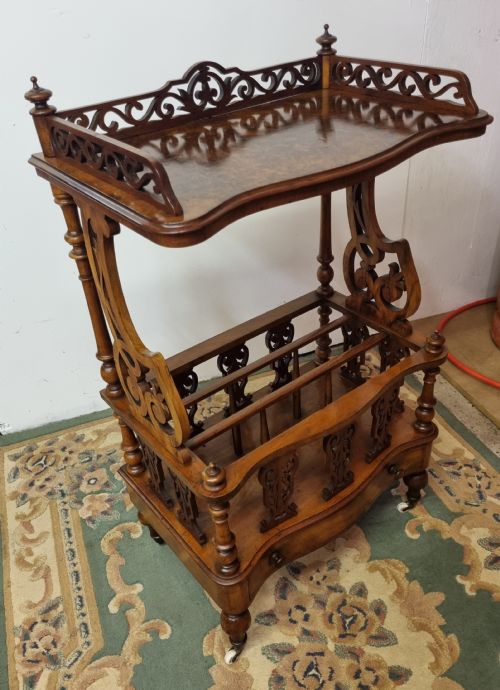
- A piece of open shelving furniture with multiple tiers used for displaying ornaments or holding books. In these listings, it frequently combines with a lower canterbury section.
- Marquetry
- The art of applying decorative pieces of wood veneer to a structure to form detailed pictures or geometric patterns. It appears frequently on the top panels of Victorian stands.
- Serpentine
- A furniture shape featuring a line that curves inward and outward in a smooth, continuous wave. This contour defines the front profile of several listed canterburys.
Antique Walnut Sheet Rack: Frequently Asked Questions
What is an antique walnut sheet rack used for?
These pieces functioned historically as dedicated storage for sheet music, newspapers, and unbound literary folios within the nineteenth-century home. The partitioned upright sections kept papers sorted and upright while remaining accessible beside a piano or seating area.
Today, they serve a similar practical role for modern magazines, vinyl records, or contemporary periodicals. Many versions also double as occasional tables, lamp tables, or display stands due to their flat upper tiers.
How do I tell a Regency piece from a Victorian one?
Regency items date from the early nineteenth century and typically display cleaner, classical lines with restrained use of ornamentation. Their woodwork tends to rely on architectural proportions rather than heavy carving.
Victorian pieces, which make up the majority of these listings, often exhibit more exuberant details such as burr walnut veneers, inlaid marquetry, pierced fretwork, and serpentine outlines. They frequently incorporate multi-tiered structures like whatnots and attached drawers.
Can I use a sheet rack as an end table?
Many examples on this page double as occasional tables, lamp tables, or etageres, featuring a solid top surface above the partitioned storage. This dual purpose makes them well-suited for placement beside a sofa or armchair.
Their freestanding nature allows them to sit comfortably in room corners or beside seating arrangements without dominating the floor space. The flat top surface provides a stable platform for lamps, decorative items, or cups.