
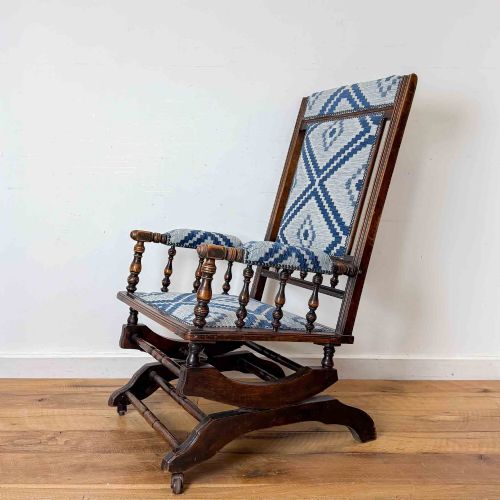


Antique Upholstered Rocker
An antique upholstered rocker brings both gentle motion and period character to a room, offering comfort that mass-produced seating simply lacks.
Antique Upholstered Rocker
When you search for an antique upholstered rocker, you are looking at nineteenth-century and early twentieth-century seating designed for motion, spanning Victorian, Edwardian, and American traditions. These pieces combine a timber frame with padded seats or button backs, intended for restful sitting rather than formal parlour use.
The versions you are most likely to meet on this page include Victorian mahogany and walnut examples, often featuring low profiles or nursing chair proportions. You will also encounter Edwardian inlaid designs alongside American styles from the late nineteenth and early twentieth centuries.
Forms range from full-sized upholstered armchairs to smaller childs rocking chairs in fruitwood and beechwood. Many pieces show the specific influence of traditional American or Shaker design alongside standard British periods.
Materials and construction
Frames are constructed from solid hardwoods such as mahogany, walnut, beechwood, and fruitwood, sometimes finished with ebonising or detailed with mahogany inlay. These timbers provide the structural strength needed to support continuous rocking motion without twisting the joints.
Upholstery incorporates traditional textiles including velvet, leather, and various contemporary fabrics secured with brass details. Button back cushioning appears on low rocking chairs, providing both support and a tailored appearance across the Victorian and Edwardian periods.
The listings here include timber frames in mahogany, walnut, oak, beechwood, and fruitwood, alongside steel and brass elements.
Judging quality and character
The distinction between ordinary and superior examples lies in the integrity of the timber frame and the precision of the joinery where the rockers meet the legs. Finer pieces maintain their stability without excessive play in the joints, even after decades of movement.
Proportion and wood selection also separate standard production from better work, visible in the grain of the mahogany or walnut and the balanced curve of the wooden rockers. Finer examples display careful turning and inlay that complement the upholstered portions rather than overwhelming them.
The Antique Upholstered Rocker Glossary
- Victorian
- Belonging to the reign of Queen Victoria, spanning the nineteenth century. This period encompasses heavy mahogany frames and ornate button-backed upholstery.
- Edwardian
- Dating from the early twentieth century, characterised by lighter proportions and decorative elements such as mahogany inlay.
- Nursing chair
- A low-seated chair traditionally used in nurseries or bedrooms. These pieces often feature upholstered button backs designed for comfort.
- Bentwood
- Wood softened by steam and bent into curved shapes. This technique creates lighter, flowing frames.
- Shaker
- A style associated with the United American religious sect known for clean lines and functional design. Shaker rocking chairs prioritise utility and simple woodwork.
Antique Upholstered Rocker: Frequently Asked Questions
How do I date an antique rocker?
Dating relies on identifying stylistic markers, timber choices, and construction methods associated with periods such as Victorian or Edwardian.
Changes in upholstery styles and wood finishes across the nineteenth and twentieth centuries help narrow the decade of manufacture.
Are these chairs comfortable for daily use?
Many examples are designed with padded seats and upholstered backrests for comfortable sitting.
Low profiles and supportive wooden frames make them practical for everyday relaxation in living spaces.
What is a nursing chair?
A nursing chair is a low-seated rocking chair originally intended for nurseries and bedrooms.
They frequently feature button-backed upholstery and compact dimensions compared to standard armchairs.
How do I distinguish American styles?
American style rocking chairs often feature distinct proportions and turning patterns compared to standard British Victorian seating.
Materials like beechwood and specific structural forms separate these pieces from local cabinet work.