
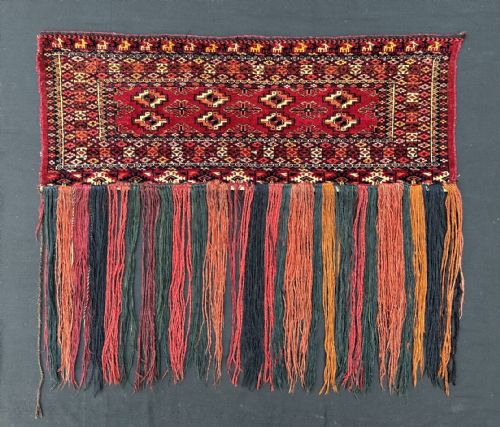
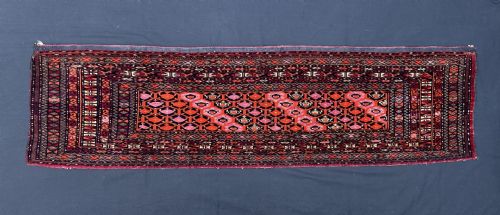

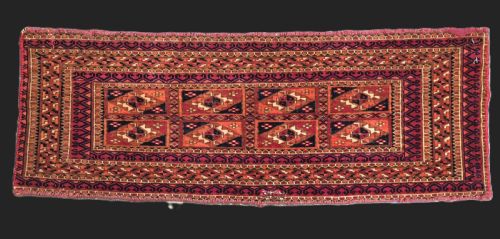
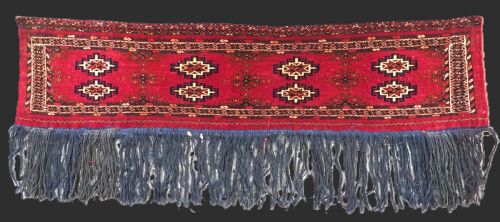
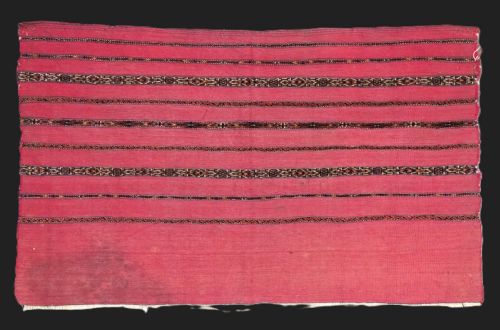


Antique Turkmen Rug Face
An antique turkmen rug face represents the portable tribal art of Central Asian nomadic weavers, prized for rich wool and geometric motifs.
Antique Turkmen Rug Face
Most examples encountered on this page date from the nineteenth century, spanning from the eighteen-fifties through to nineteen-twenty, alongside earlier eighteenth-century fragments. They served primarily inside nomad tents for household possessions before being separated into decorative textile panels.
The format showcases distinct tribal patterns, including primary motifs like Salor guls, kepse guls, and curled leaf designs. Collectors value them for their direct link to traditional Central Asian nomadic culture and distinct tribal weaving traditions.
What varies in quality
Knot density and structural tightness set finer examples apart from coarser or standard tribal production. Superior pieces display exceptional precision in the drawing of intricate tribal guls and balanced proportions across the field.
The depth and clarity of natural dye palettes contribute significantly to visual quality, alongside the integrity of the remaining wool pile. Unusual design variations and complete original formats also distinguish more desirable specimens.
Nomads wove these portable masterpieces while camped in the desert, often packing their entire worldly goods inside them.
The Antique Turkmen Rug Face Glossary
- Gul
- A primary octagonal or repeating medallion motif used across Central Asian tribal weaving. Each tribe utilised distinct variations to signify lineage and identity.
- Chuval
- A large tent bag used for storing bedding and heavy items. Fragments of these large containers frequently survive as decorative rug faces.
- Kap
- A general term for a bag or sack produced by Turkmen and neighbouring tribes. They display dense pile work and characteristic tribal iconography.
- Jollar
- A tent bag designed for hanging on the walls of a nomad dwelling. They share structural and design traits with torbas.
- Flatweave
- A textile constructed without pile by interweaving warp and weft threads. Examples include banded designs on mafrash and back panels.
Antique Turkmen Rug Face: Frequently Asked Questions
What is a turkmen rug face?
A turkmen rug face is the decorated front section of a nomadic storage bag, removed from its plain woven back.
These panels preserve the intricate tribal guls and rich wool pile created by weavers in Central Asia during the nineteenth century.
How were these bags used?
Nomadic families utilised these bags inside tents to store clothing, bedding, and household goods.
They hung against lattice walls or stacked on animals during migration, functioning as both utility items and markers of tribal identity.
How do I identify different tribes?
Tribal attribution relies on the specific structure of the primary guls and the dominant colour palette.
Tekke, Yomut, Saryq, and Ersari weavers each employed distinct geometric arrangements and drawing styles that separate their work.
How should I display a rug face?
These textile faces mount securely onto stretched backing fabrics or specialist conservation grade Velcro systems for wall hanging.
Keeping them away from direct sunlight protects the natural dyes from fading over time.