


Antique Teak Armchair
An antique teak armchair brings substantial colonial craftsmanship and dense tropical timber into a room.
Antique Teak Armchair
When you search for an antique teak armchair, you encounter a distinct cross-section of nineteenth and early twentieth-century seating built for colonial outposts, maritime service, and domestic gardens. The selections range from deep-seated plantation chairs with extending arms and reclining backs to elaborately carved Anglo-Indian elbow chairs and slatted garden seats.
You meet pieces originating from British colonial workshops, maritime contexts like ships and naval vessels, and domestic makers such as Heals of London. The forms span monumental ceremonial thrones, folding campaign chairs, and revolving ship models designed for rigorous use.
The most prevalent examples on this page reflect Anglo-Indian, British colonial, and Edwardian garden aesthetics. These pieces utilise sturdy tropical hardwoods to withstand both humid climates and heavy maritime service.
Construction and materials
Makers built these chairs primarily using dense teak and secondary hardwoods, often combining the timber with leather upholstery, woven cane, rush seating, and brass inlay. Structural joints relied on solid framing to support heavy carving or mechanical reclining actions.
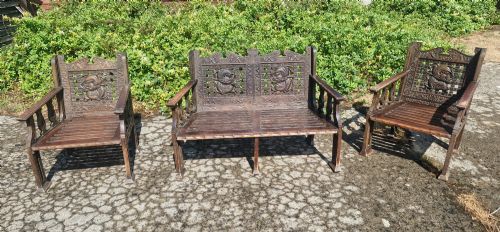
Surface detailing frequently involves profuse hand carving depicting floral or peacock motifs, alongside brass or cast iron fittings utilised in campaign and ship chairs. Garden and maritime variants often employ slatted construction designed for drainage and durability.
Listings feature teak, hardwood, leather, brass, cane, oak, cast iron, and rush across nineteenth and early twentieth-century periods.
Distinctions in quality
Quality rests upon the depth and crispness of the hand carving, the integrity of the timber frame, and the survival of original components such as leather upholstery, brass fittings, and extending arm mechanisms. Pieces featuring dense, unblemished teak and complex Moghul or Burmese ornamentation sit at the higher end of the range.
Construction methods also dictate standard, where robust joinery and functional reclining or folding actions separate superior examples from simpler utilitarian forms. Maker attribution, particularly pieces associated with Heals or naval vessels, further distinguishes the standing of individual chairs.
Heals of London·Hughes Bolckow
The Antique Teak Armchair Glossary
- Teak
- A dense, durable tropical hardwood prized for its natural oils and resistance to moisture. It forms the primary structural material for colonial and maritime seating.
- Plantation chair
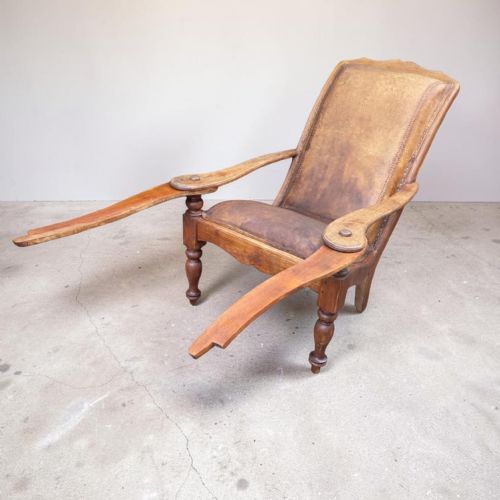
- A deep-seated armchair featuring extended arms designed for resting the legs. These chairs often incorporate reclining backs for tropical comfort.
- Savonarola style
- A folding armchair constructed from intersecting curved wooden slats, creating a scissors-like frame. The design draws on Renaissance Italian forms adapted in Indian workshops.
- Anglo-Indian
- Describing furniture made in India during the British period, combining local craftsmanship and native timber with European forms. These pieces often feature profuse floral carving.
- Campaign chair
- Portable folding furniture built for military officers and travellers on the move. They utilise clever joints and collapsible frames for ease of transport.
Antique Teak Armchair: Frequently Asked Questions
What is a plantation chair?
A plantation chair is a deep-seated armchair with wide, extending arms designed so the occupant can rest their feet upon them.
These chairs frequently feature reclining mechanisms and were constructed in tropical regions to provide comfort during hot weather.
How do I identify an Anglo-Indian armchair?
Anglo-Indian armchairs are identified by dense teak construction paired with profuse, intricate hand carving of floral or figural motifs. They reflect British furniture forms executed by Indian artisans.
Many examples date from the nineteenth century and originate from regional centres such as Hoshiarpur or Burma.
Were these chairs used on ships?
Yes, several variants were specifically engineered for maritime service aboard naval vessels and passenger liners. Examples include revolving chairs from P and O ships and slatted seats salvaged from warships like HMS Lion.
These pieces utilised sturdy teak and secure fixings to withstand motion at sea.
How do I care for antique teak furniture?
Antique teak requires minimal intervention thanks to the natural oils inherent in the timber. Dusting with a dry cloth and keeping the piece away from direct heat sources preserves the surface.
Leather, cane, and rush elements benefit from gentle cleaning suited to their specific material needs.