
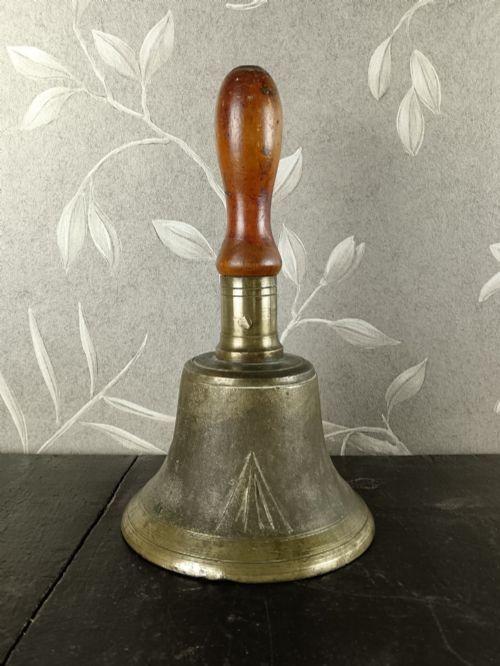


Antique School Bell
An antique school bell carries a clear, commanding tone that evokes traditional classrooms and busy corridors.
Antique School Bell
When you search for an antique school bell, you encounter hand-held ringers with turned handles alongside wall-mounted chimes. These pieces date from the Victorian and Edwardian eras, spanning the late nineteenth and early twentieth centuries.
The hand bells most frequently seen on this page combine cast brass or bronze domes with handles fashioned from walnut, oak, lignum vitae, or other dense hardwoods. Wall-mounted variants appear less often, featuring iron brackets designed for school yards or corridors.
Beyond domestic classrooms, the selection includes related instruments sharing similar utilitarian origins, such as town crier ringers and military warning devices. Each example serves a practical summoning function rather than purely decorative display.
Materials and construction
Foundry casting shaped the metal domes of these bells, using alloys of brass or bronze to produce a clear, carrying resonance. Metal thickness varied according to intended volume, from classroom handbells to heavier tower and warning instruments.
Turners shaped the wooden handles on lathes, utilising hardwoods capable of withstanding daily handling. Screws, threaded rods, and internal iron clappers secured the components together for lasting durability.
Town criers shared the same loud hand-ringing equipment as strict Victorian schoolmasters, ensuring both unruly pupils and wandering citizens paid attention.
Distinctions in quality
Superior quality rests in the purity of the alloy and the precision of the casting, which together determine the richness and duration of the chime. Finer examples retain unblemished metal surfaces and well-balanced handles turned from choice timbers.
The proportion between the dome and the handle dictates the ergonomic feel of a handbell. Examples produced with carefully seasoned hardwoods and robust internal clappers demonstrate greater durability than lighter, mass-produced alternatives.
The Antique School Bell Glossary
- Clapper
- The internal ball or hammer suspended inside a bell that strikes the sound bow to produce the tone. It hangs from a loop or staple secured at the crown.
- Bronze
- An alloy consisting primarily of copper, traditionally combined with tin. It yields a warmer and more resonant tone than standard brass.
- Lignum vitae
- A dense, heavy wood historically utilised for turned components that endure heavy friction and handling. Its natural oils provide a smooth, resilient finish.
- Hand bell
- A portable bell designed to be picked up and rung by hand, typically featuring an upright handle attached to the crown.
- Sound bow
- The thickest part of a bell's exterior surface where the clapper makes direct impact to create the acoustic wave.
Antique School Bell: Frequently Asked Questions
How were school bells used?
Teachers and administrators used these bells to signal the start of lessons, the end of recess, and whole-school assemblies. Their sharp, carrying tones cut through playground chatter and classroom noise.
Hand bells remained practical fixtures in nineteenth and twentieth-century institutions before electronic public address systems became standard. Their straightforward mechanical design required no external power source.
What woods appear on handles?
Turned handles on these bells commonly employ dense hardwoods such as walnut, oak, and lignum vitae. These timbers resisted splitting and swelling during daily use.
Cabinetmakers selected seasoned woods that offered a comfortable grip and a balanced weight relative to the metal dome.
Are brass and bronze different?
Brass is an alloy of copper and zinc, whereas bronze combines copper with tin. Bronze typically yields a deeper, more resonant tone suitable for larger bells.
Both materials appeared in educational settings, though bronze examples often indicate earlier or higher-specification production.
How do I date a bell?
Dating relies upon manufacturing style, metal composition, and the turning characteristics of the wooden handle. Victorian examples often display robust proportions and dark-finished hardwoods.
Edwardian pieces tend to show slightly lighter turning profiles while maintaining traditional foundry methods.