


Victorian Handbell
These Victorian handbell pieces are functional ringing instruments in brass, glass and silver, prized for their clear tone and period character.
Victorian Handbell
A victorian handbell brings together domestic, institutional and ceremonial forms ranging from school bells to table bells and cased sets.
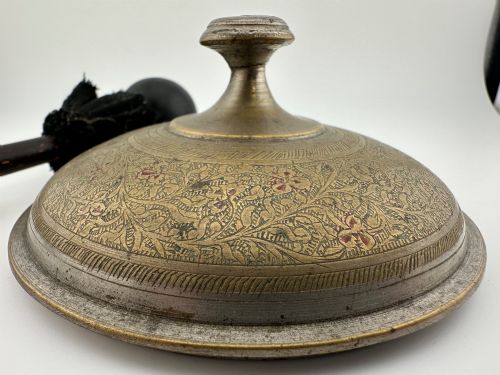
The version most commonly met on this page is the brass or bronze hand bell, often featuring a turned wooden handle.
These items originate across the nineteenth and early twentieth centuries, spanning periods from the Victorian era to Edwardian times.
Materials and construction
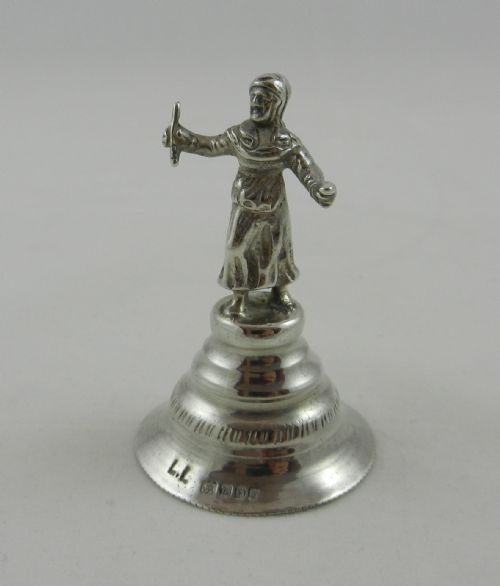
Makers utilised cast brass, bronze and sterling silver for the bell bodies, frequently pairing metal with turned wood handles.
Decorative examples incorporate ruby glass, gold leaf and enamel work, particularly within Victorian Bohemian styles.
A twelve-bell set by Warners suggests someone took ringing very seriously indeed.
Judging the work
Quality rests upon the crispness of the casting and the resonance of the metal when struck.
Refinement shows in the proportion between the handle and the bell body, alongside the execution of decorative gilding or glass cutting.
Warners of London
The Victorian Handbell Glossary
- Handbell
- A bell designed to be held in the hand and rung by swinging, fitted with an internal clapper.
- Ganging bell
- A bell made to sound alongside others, often found in matched pairs or larger sets.
- Table bell
- A small bell placed upon a flat surface for summoning assistance.
- Bohemian ruby
- A deep red glass associated with Central European decorative metal and glassware traditions.
Victorian Handbell: Frequently Asked Questions
What were victorian handbell pieces used for?
These bells served practical purposes in schools, town crier duties and large households for summoning staff.
They also functioned as decorative table accessories and dinner chimes.
How do I identify a Victorian piece?
Look to the construction methods, such as traditional metal casting and turned wooden handles typical of the period.
Materials like ruby glass and sterling silver alongside period hallmarks help date the object.
Are these bells still functional?
Most examples retain their internal clappers and produce a clear ring when activated.
Cased sets were built for musical performance as well as signal use.
What materials are most common?
Brass and bronze dominate the utilitarian school and town crier bells.
Glass and silver examples appear more frequently among decorative table bells and Victorian Bohemian pieces.