
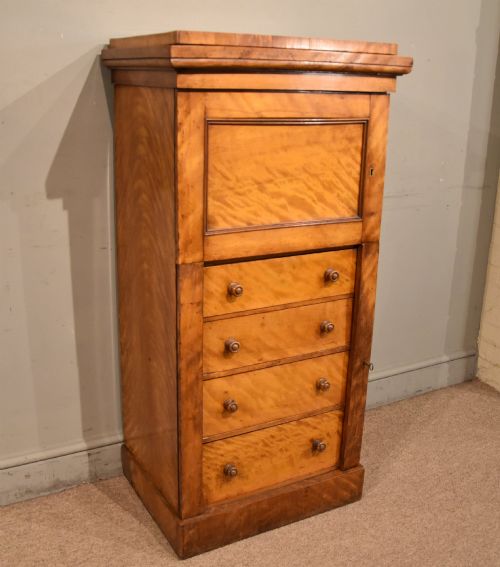
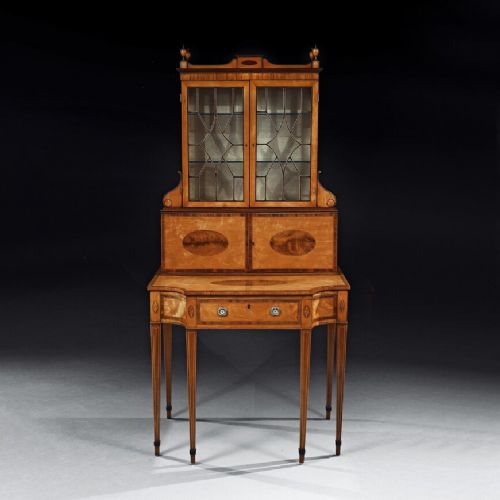
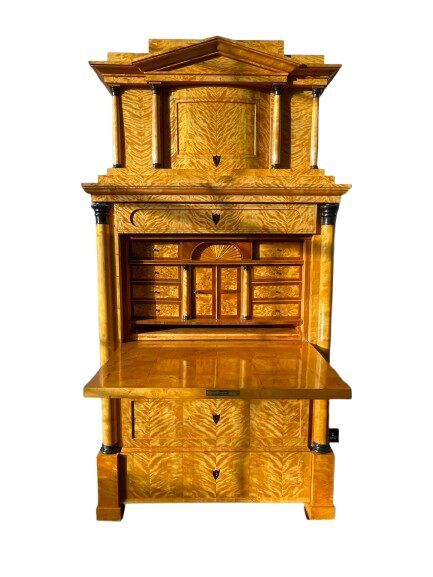


Antique Satinwood Secretaire
These antique satinwood secretaire pieces are refined writing cabinets and bookcases crafted to display grain and conceal a fitted desk.
Antique Satinwood Secretaire
When you search for an antique satinwood secretaire, you encounter formal writing cabinets, chests and tall bookcases originating from the Georgian and Victorian periods. The selection on this page ranges from George III cylinder desks and writing cabinets to large glazed secretaire bookcases.
The dominant forms combine storage with a drop-down writing flap or sliding drawer concealing pigeonholes and small drawers. Pieces span styles from Sheraton and Regency to Biedermeier and French Transitional, reflecting refined domestic interiors.
You are most likely to meet George III and 18th-century examples alongside 19th-century interpretations in Sheraton Revival and Victorian aesthetics. These items served as both libraries and private writing spaces in prosperous households.
Materials and construction
Construction relies heavily on figured satinwood veneers applied to secondary woods like mahogany and birch, often enhanced by marquetry inlays. Cabinetmakers paired satinwood with contrasting timbers such as ebonised wood and sabicu to delineate panels and borders.
Glazed doors feature delicate astragal bars, while interior compartments incorporate small drawers and concealed pigeonholes behind fitted writing slides. Brass hardware, including handles and key escutcheons, provides functional and decorative accents across the pieces.
Some secretaires hide tiny secret drawers behind pigeonholes, designed for letters best kept away from prying eyes.
What determines quality
Quality rests upon the selection and matching of the satinwood veneer, where figuring and grain continuity across drawer fronts demonstrate superior craftsmanship. The intricacy of marquetry inlay and the precision of the cabinet joinery further distinguish finer examples.
Internal arrangement complexity, such as fitted compartments with secret drawers and well-executed cylinder actions, separates standard production from exhibition-grade pieces. The integration of secondary woods and the preservation of original brass fittings also define the tier of the piece.
Gillows·Edwards and Roberts
The Antique Satinwood Secretaire Glossary
- Satinwood
- A hard, yellow timber prized for its lustrous, reflective grain and smooth texture, frequently used as a veneer in fine cabinetmaking.
- Secretaire
- A piece of furniture containing a built-in writing drawer or fold-down flap that conceals a desk interior.
- Marquetry
- Decorative patterns formed by the insertion of different coloured veneers into a prepared wood surface.
- Astragal
- A moulded strip of wood or metal separating panes of glass within a glazed cabinet door.
Antique Satinwood Secretaire: Frequently Asked Questions
What is a secretaire bookcase?
A secretaire bookcase combines an upper section of glass-fronted shelves with a lower cabinet containing a pull-down writing desk.
This dual function allowed owners to store a library while maintaining a dedicated, concealed writing surface below.
How do I identify a George III secretaire?
George III pieces date from the second half of the 18th century and typically exhibit restrained neoclassical proportions, fine satinwood veneers, and delicate marquetry.
They often feature subtle stringing and high-grade brass hardware characteristic of the period's cabinetmakers.
Where should I place a satinwood cabinet?
Satinwood is sensitive to direct sunlight, which can fade its characteristic yellow lustre over time.
Position your cabinet away from windows and direct heat sources to preserve the condition of the veneer and finish.