


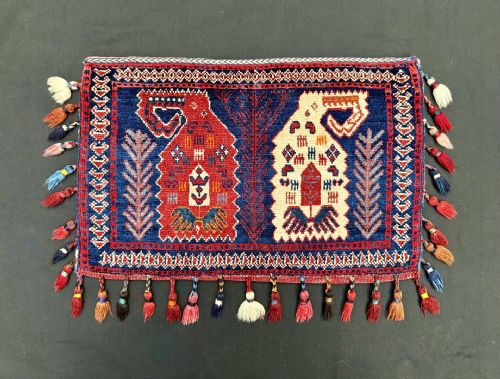

Antique Saddle Bag Rug
An antique saddle bag rug brings the bold geometry and nomadic heritage of Persian, Caucasian, and Anatolian weavers directly into a modern interior.
Antique Saddle Bag Rug
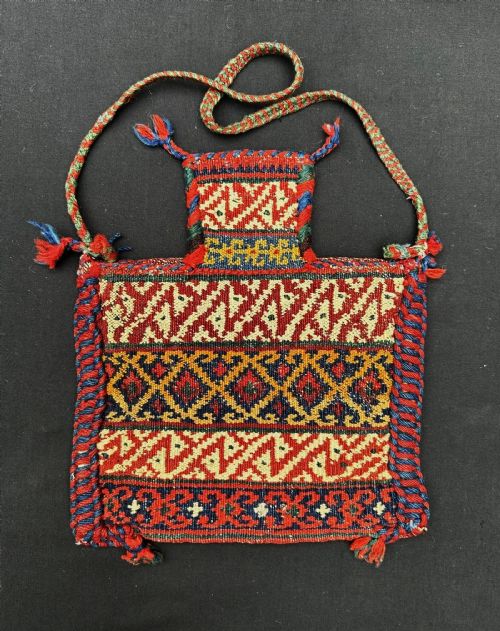
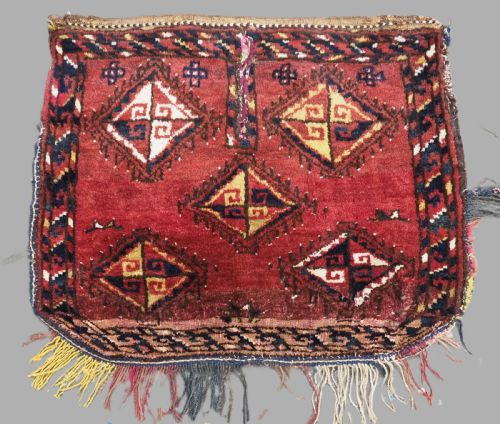
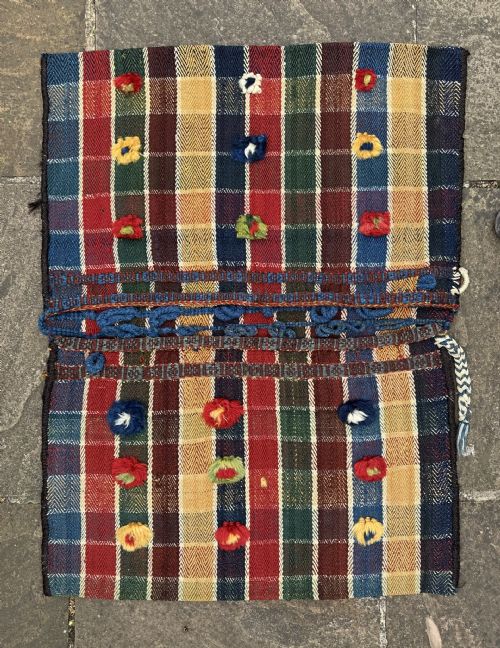
When you search for an antique saddle bag rug, you are looking at utilitarian nomadic containers, known as khorjin or heybe, which were originally woven to carry possessions on pack animals. These pieces range from complete double pouches with their plain-weave backs intact to single bag faces and trimmed fragments designed to function as small floor rugs or cushion covers.
The selections here are dominated by tribal works originating from nomadic confederations and village weavers across Persia, the Caucasus, and Anatolia. You will encounter distinct regional identities such as the Qashqa'i, Afshar, Shahsavan, Luri, and Kurdish tribes, spanning the mid nineteenth century into the early twentieth century.
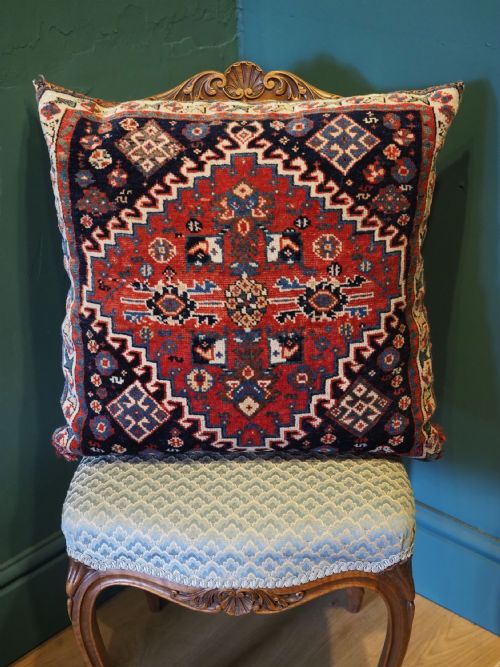
Many survivors are individual bag faces or halved sections because the central slit and back panels endured heavy friction during transit and were often separated over time. Collectors frequently encounter these textiles adapted into compact decorative formats, including square cushion covers and small vanity bags.
How they were made
Weavers relied on hand-spun wool for the pile and foundation yarns, often combined with cotton and occasionally leather or metal elements for structural reinforcement. This hand-spun wool yielded natural oils that interacted with traditional natural dyes to produce deep, varied hues.
Construction techniques varied by tribal group, encompassing traditional pile knots alongside flatweave soumak and kilim structures. Soumak work utilised wrapping techniques over warp threads to create crisp geometric patterns and textured surfaces without a cut pile.
Listings span the mid nineteenth century to the early twentieth century, incorporating wool, cotton, leather, and natural dyes.
What varies in quality
The distinction between ordinary and exceptional pieces rests upon the handle of the wool and the vibrancy of the dye palette. Lustrous, luminous wool combined with saturated natural colours elevates a textile beyond standard utilitarian output.
Structural completeness also dictates standing, as surviving examples retaining their original plain-weave backs, complete closure systems, or matching pairs command greater technical interest than isolated fragments.
The Antique Saddle Bag Rug Glossary
- Khorjin
- The traditional Persian term for a double-sided saddle bag used by nomadic tribes for transport. These were slung over pack animals and often separated into individual faces over time.
- Soumak
- A flatweave technique involving coloured wool wrapped horizontally across warp threads. This method creates a sturdy structure with a clean face and unclipped floats on the reverse.
- Chuval
- A large tent bag used by Turkmen tribes for storage within a yurt. They typically feature repetitive rows of guls.
- Gul
- An octagonal medallion or floral motif repeated across Central Asian and Turkmen tribal textiles. Each tribal group utilised distinct geometric variations to signify lineage.
- Boteh
- A stylised almond or pear-shaped motif representing a sprout or cypress tree. It appears frequently across Persian and Afshar tribal weaving.
Antique Saddle Bag Rug: Frequently Asked Questions
What is a khorjin?
A khorjin is a traditional double-pouch saddle bag woven by nomadic tribes to transport belongings on animals.
These functional containers featured two pockets connected by a central web, which were routinely separated as the items aged or broke apart.
How do I use a bag face?
Bag faces function well as small decorative floor rugs, wall hangings, or surface mats for tables and benches.
Many collectors also mount them as textiles or stuff them to create compact decorative cushions.
Why do some have plain backs?
The plain-weave back panels provided a lightweight, durable structure that rested against the animal's flank.
Surviving pieces that retain both the decorated face and the original back are uncommon because the backing took the brunt of the wear.
How are tribes identified?
Tribal attribution is determined by specific structural traits, colour palettes, and repeating geometric motifs.
Weaving habits associated with groups like the Shahsavan or Qashqa'i display characteristic borders, knotting densities, and dye combinations.