

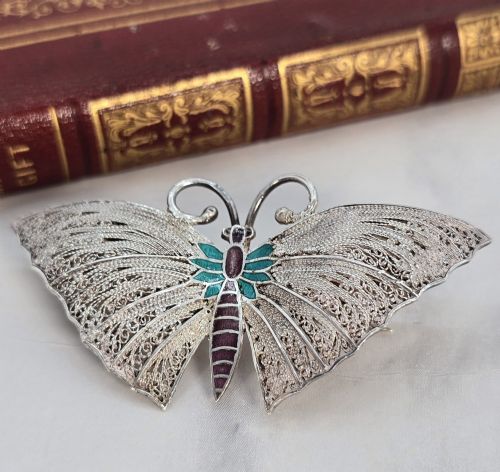


Antique Purple Brooch
An antique purple brooch brings deep violet stones and rich gold work together, offering the timeless charm of Victorian and Edwardian craftsmanship.
Antique Purple Brooch
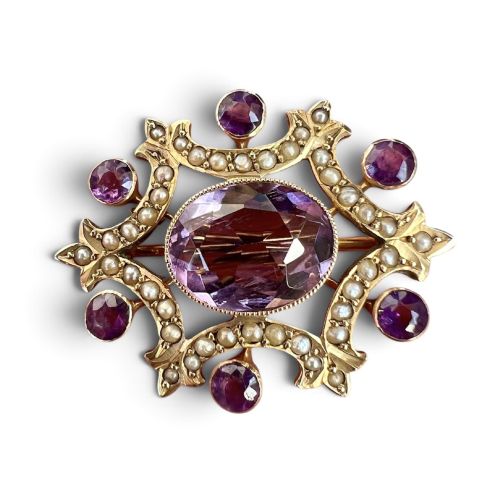
An antique purple brooch typically centres on violet amethysts framed by warm gold or cool silver, capturing the distinct aesthetic of the Victorian and Edwardian eras. These pieces range from substantial cluster designs to delicate heart-shaped and target motifs.
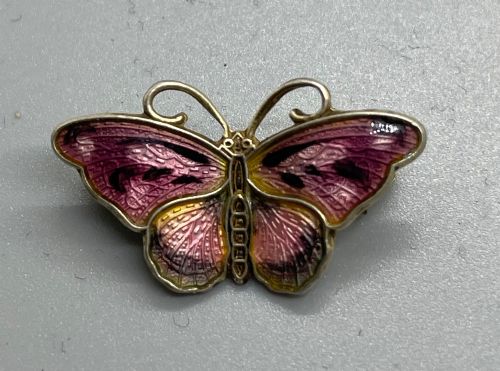
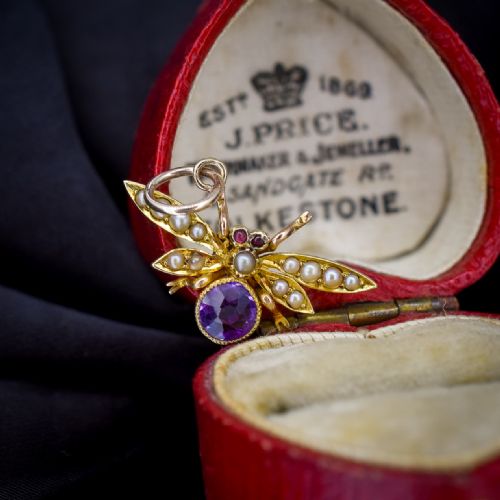
The pieces you encounter on this page span the nineteenth century through the early twentieth century, taking the form of traditional brooches, convertible pendant combinations, and occasional insect motifs such as flies and butterflies.
How these pieces were made
Goldsmiths worked primarily in nine-carat and fifteen-carat gold, as well as silver, to set amethysts alongside seed pearls and natural pearls. Detailed filigree work and enamel occasionally complement the stones.
Makers utilised secure prong and collet settings to anchor deep purple amethysts, frequently accenting the central stones with delicate rings of pearls or contrasting metalwork.
What varies in quality
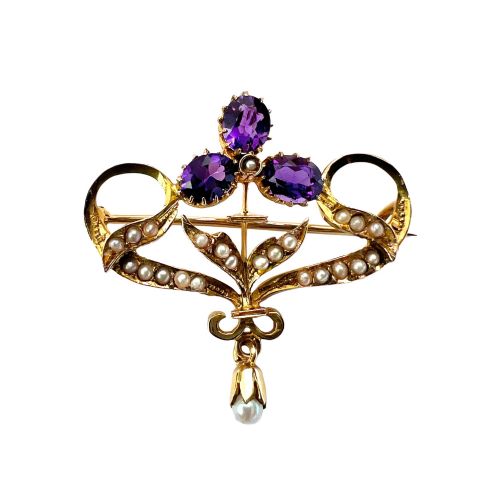
Quality rests in the depth of colour and clarity of the amethyst, alongside the precision of the metalwork in settings like cluster and target designs. Better examples demonstrate meticulous seed pearl arrangement and substantial gold weight rather than hollow construction.
The integrity of the pin mechanism and the refinement of subsidiary details, such as gold drops or fine filigree, separate standard production pieces from finer artisan jewellery.
The Antique Purple Brooch Glossary
- Amethyst
- A purple variety of quartz prized for centuries as a primary gemstone in cluster and heart brooches.
- Seed pearl
- Very small natural pearls, often half-drilled and glued or pegged onto fine wire settings around a central stone.
- Filigree
- Ornamental work consisting of fine wire, usually gold or silver, twisted into delicate openwork patterns.
- Target brooch
- A circular brooch design featuring a central stone surrounded by concentric rings of contrasting gems or metalwork.
- Collet setting
- A flat-bottomed metal collar that surrounds the sides of a gemstone to hold it securely in place.
Antique Purple Brooch: Frequently Asked Questions
How do I date an antique purple brooch?
Dating relies on the stylistic clues within the metalwork, such as the heavier gold settings common in Victorian pieces versus the lighter, airy motifs of the Edwardian era. Material choices like nine-carat gold or silver filigree also point directly to specific decades.
Examining the pin mechanism and the cut of the amethyst provides further confirmation of the period of manufacture, aligning the piece with nineteenth or early twentieth-century workshops.
Are amethyst brooches fragile?
Amethysts are durable stones with good hardness, making them suitable for regular wear when mounted securely in gold or silver. However, delicate seed pearls and fine filigree require gentle handling to prevent damage.
Storing the brooch separately from other jewellery prevents scratching, and avoiding harsh chemical cleaners protects both the purple stones and the surrounding metal.
Can I wear a brooch as a pendant?
Many Edwardian and Victorian pieces were designed with dual functionality, featuring integrated loops or drop attachments that allow them to transition easily from a jacket fastening to a neck chain. This versatility was popular in period jewellery.
Checking the reverse of the piece reveals whether a hinged loop is present to accommodate a chain safely.
What is a target brooch?
A target brooch is a circular piece featuring a prominent central amethyst encircled by precise rings of seed pearls or contrasting metals. This geometric layout creates a focused visual impact.
The style became particularly prominent during the Edwardian period, showcasing symmetry and balanced proportions.
What metals were used in these brooches?
The pieces utilise various purities of gold, predominantly nine-carat and fifteen-carat yellow gold, alongside silver and Continental metalwork. These metals provided the structural strength needed to hold amethysts and pearls securely.
The choice of metal often reflects the period, with silver frequently appearing in nineteenth-century designs and specific continental butterfly motifs.