




Antique Pot Pourri Jar
An antique pot pourri jar brings the heavy scent of dried petals and spices into a room through pierced porcelain and earthenware covers.
Antique Pot Pourri Jar
When you search for an antique pot pourri jar, you are looking at decorative vessels designed specifically to hold fragrant plant material while allowing the scent to diffuse into a chamber. The pieces on this page span the nineteenth and twentieth centuries, taking the form of vases, urns, and covered jars.
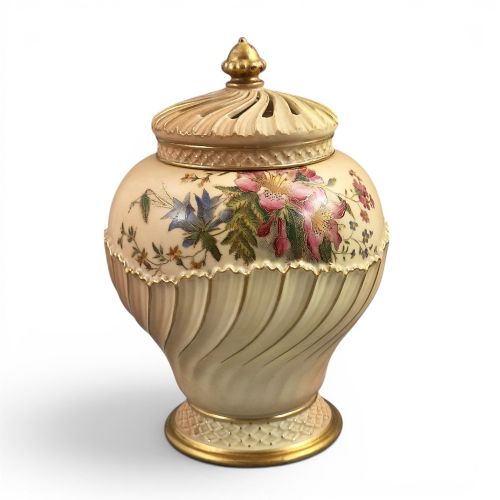
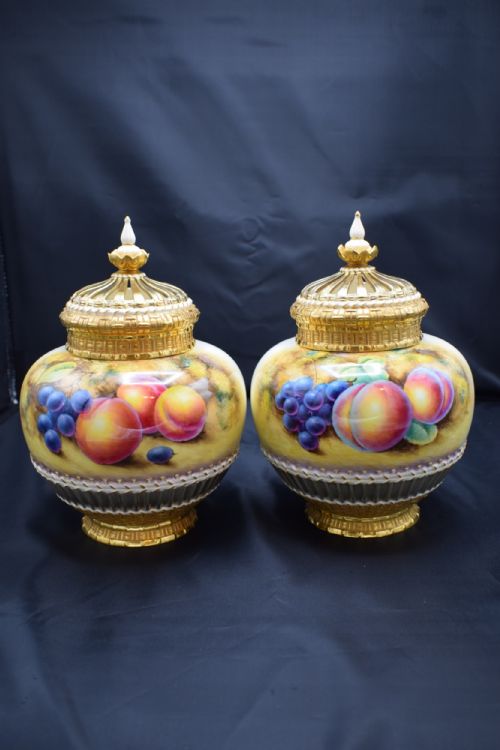
You are most likely to meet English porcelain examples, particularly blush ivory pieces produced by Royal Worcester from the Edwardian era through the mid-twentieth century. These frequently feature pierced crown covers and painted floral or fruit decoration.
The selection also includes earlier English ironstone and nineteenth-century French porcelain mounted in gilt bronze, alongside large Moorcroft earthenware pieces. Forms vary from simple ovoid jars to elaborate three-piece garnitures designed as centrepieces.
Materials and construction
The makers relied primarily on ceramic bodies, ranging from soft-paste porcelain and bone china to ironstone and earthenware. These clay forms were shaped into vases, urns, and jars, often finished with pierced lids or crown covers that served the practical purpose of releasing stored aromas.
Decoration relied heavily on hand-painting, particularly floral studies and fruit scenes executed by named artists, alongside transfer printing and intricate gilding with gold leaf. Gilt bronze and ormolu mounts appear on French pieces, adding weight and architectural structure to the ceramic bodies.
Listings feature porcelain, ironstone, and earthenware bodies finished with enamel, gilding, and gilt bronze mounts.
Judging quality in pot pourri vessels
Quality rests in the crispness of the piercing on the cover and the detail of the modelling, where sharp apertures and well-defined mouldings separate better workshops from standard production. The presence of a matching, original cover is essential.
Hand-painted decoration elevates a piece significantly, particularly when signed by known factory artists who worked with fine brushwork on blush ivory or fruit-painted surfaces. The application of heavy gilding and the integration of ormolu or gilt bronze mounts further distinguish the finer examples.
Royal Worcester·Samuel Alcock·Masons Ironstone·Moorcroft Macintyre And Co
The Antique Pot Pourri Jar Glossary
- Blush ivory
- A matte cream-coloured porcelain ground developed by Royal Worcester, typically decorated with soft floral sprays and gilt highlights. It forms the most common finish found on English pieces from this period.
- Crown cover
- A pierced ceramic lid shaped like a crown or dome, designed to sit atop the vessel and allow scent to escape from the dried botanicals inside. These covers are frequently fitted with inner lids.
- Imari
- A style of ceramic decoration employing a distinctive palette of underglaze blue, iron red, and gilt, originating in Japan and copied by English factories such as Masons. It appears on early nineteenth-century jars.
- Ormolu
- Cast brass that has been finished with a gold-wash coating, used for decorative mounts on nineteenth-century French porcelain vessels. It provides a heavy, metallic contrast to the ceramic body.
Antique Pot Pourri Jar: Frequently Asked Questions
What is an antique pot pourri jar?
An antique pot pourri jar is a covered ceramic vessel created to hold dried flowers, herbs, and spices while perfuming a room through pierced openings in the lid.
These pieces range from modest Victorian jars to large Edwardian pedestal vases painted with fruit and floral studies.
How were pot pourri jars used?
Historically, households placed these jars in living spaces and antechambers to mask domestic odours and provide a constant, gentle fragrance.
The pierced covers allowed the scent of rose petals and spices to drift out while keeping the dried plant matter contained within the ceramic body.
How do I date a Royal Worcester pot pourri jar?
Royal Worcester pieces can often be dated using the factory's standard system of printed date ciphers and dots found on the underside of the base.
Stylistic shifts, such as the transition from late Victorian blush ivory to mid-twentieth-century painted fruit, also help establish the decade of manufacture.
Are the covers on these jars original?
Many surviving jars retain their matching pierced crown covers, which were made alongside the vessel body as a single matched set.
Because the lids are pierced and relatively delicate, checking that the cover shares the same ceramic body and factory marks is a key part of assessing a piece.