


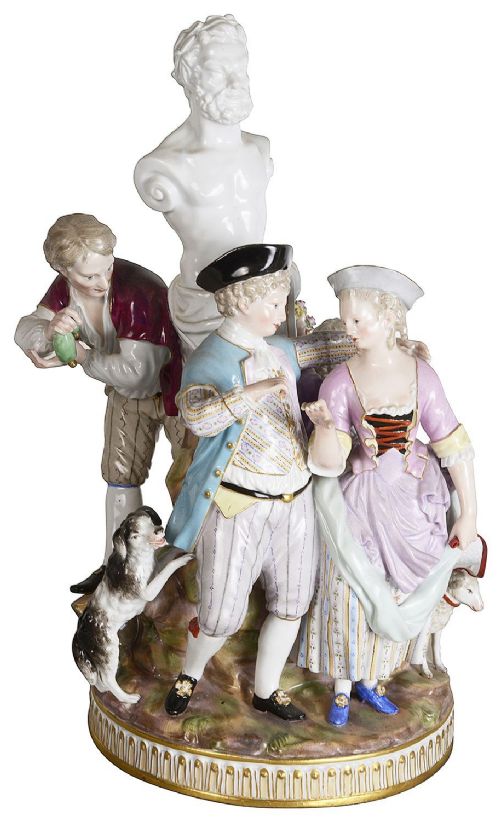


Antique Porcelain Court Couple
An antique porcelain court couple brings the grace of the 18th and 19th centuries right into your room.
Antique Porcelain Court Couple
When you search for an antique porcelain court couple, you are looking at figures, decorative figurines, and larger groups that capture romantic and aristocratic scenes. These pieces take the form of paired figures, musical groups, and lace groups depicting gallant figures and their ladies.
The versions you are most likely to meet on this page hail from the nineteenth century, including Victorian interpretations and German manufactories, alongside earlier eighteenth-century examples. They range from cabinet figures to table lamps, often reflecting ornate French and German tastes.
Many of these objects survive as pairs, showing couples in elaborate attire engaged in courtly pursuits. The grouping often includes musical instruments, harps, or classical details that set a theatrical scene.
Materials and Manufacture
These figures are fashioned from hard-paste porcelain, bisque porcelain, and parian, which provide a smooth or matte white surface for the detailed forms. Manufacturers shaped the clay into complex postures before firing and finishing.
Makers added vibrant colour through enamel painting, complemented by gold leaf, gilding, and metal elements. Some French and German pieces also utilise faience or incorporate delicate porcelain lace to render textured garments.
Listings feature hard-paste porcelain, bisque porcelain, and enamel alongside metal mounts and gold leaf.
Assessing Quality
The complexity of the composition also distinguishes the work, with multi-figure groups and pieces incorporating lace or metal mounts requiring greater skill from the potter. The reputation of the originating factory, such as Meissen or Volkstedt, naturally influences the standing of the piece.
Bourdois & Bloch Paris·Letu & Mauger Paris·Triebner Ens & Co
The Antique Porcelain Court Couple Glossary
- Biscuit Porcelain
- Unglazed porcelain fired to a matte, white finish that resembles marble and highlights sculptural detail. It is frequently seen on nineteenth-century figures.
- Hard-paste Porcelain
- A dense, durable ceramic composed of kaolin and petuntse, fired at very high temperatures. It forms the robust body of many continental figures.
- Enamel
- Vitreous coloured decoration applied over the glaze and fired again to fix the pigments. It provides the bright hues on costumes and floral motifs.
- Gilding
- The application of gold leaf or gold paint to highlight architectural elements, bases, or costume details. It adds a reflective quality to the finished group.
- Faience
- Tin-glazed earthenware produced in imitation of porcelain or oriental wares. It offers an opaque, whitish ground for painted decoration.
Antique Porcelain Court Couple: Frequently Asked Questions
What is an antique porcelain court couple?
An antique porcelain court couple is a figurine or group depicting a gentleman and a lady in historic or romantic dress. These pieces often show characters in pastoral or musical settings.
Originating largely from European factories in the eighteenth and nineteenth centuries, they served as decorative ornaments for mantelpieces and tables.
How were these figures used originally?
These figures were displayed in wealthy homes as table centrepieces or decorative ornaments on mantelpieces and cabinets. They demonstrated the owner's taste and appreciation for classical and romantic themes.
Some later examples were adapted into functional items like table lamps while retaining their sculptural figures.
How do I distinguish German and French pieces?
German pieces often originate from centres like Meissen or Volkstedt and frequently utilise hard-paste porcelain with detailed hand-painting and modelled flora. French examples, including those from Paris or Sevres styles, often lean towards ornate gilding and romantic biscuit figures.
Markings on the base, where present, can also point towards the specific continental factory of origin.
How should I care for porcelain figures?
Keep porcelain figures out of direct sunlight to protect the enamel colours and gilding from fading over time. Dust them gently with a soft, dry brush rather than using water or cleaning solutions.
Handle them by their solid bases rather than delicate extremities like hands, instruments, or lace.
What periods do these figures come from?
The listings span from the eighteenth century through the nineteenth century, including Victorian interpretations and later revivals. Eighteenth-century pieces often reflect early neoclassical or rococo tastes.
Nineteenth-century examples frequently embrace revivalist styles inspired by earlier French and German aesthetics.