


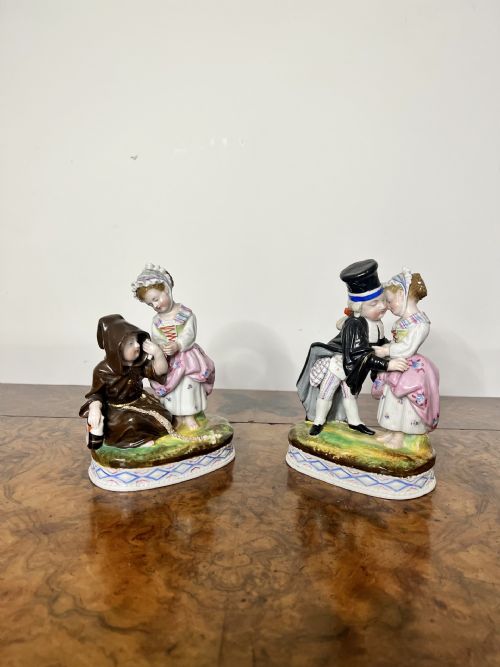


Painted Porcelain Couple Figures
These painted porcelain couple figures bring romantic pastoral charm and refined historic craft directly into your interior.
Painted Porcelain Couple Figures
Painted porcelain couple figures encompass delicate figurines, decorative statuettes, and larger sculptural groups depicting pairs in romantic or agrarian settings. When you search for painted porcelain couple figures, you encounter works spanning the eighteenth, nineteenth, and early twentieth centuries, originating from renowned European centres such as Germany, France, and Britain.
The pieces most frequently met on this page include nineteenth-century pairs produced during the Victorian era, alongside continental German porcelain workshops and French manufactories. They often take the form of harvesters, gardeners, musicians, and romantic companions arranged in pairs or small groups.
Makers represented in these listings include Bourdois & Bloch, Letu & Mauger, Volkstedt, C. G. Schierholz, Chantilly, Meissen, Staffordshire, Minton, Carl Thieme, and Sitzendorf. These works utilise both glazed finishes and biscuit porcelain, occasionally accented with gold leaf and enamel.
How They Were Made
Makers utilised hard-paste porcelain and bisque porcelain as the primary foundations for these figures, shaping the clay through detailed moulding techniques. Bisque porcelain provided an unglazed, matte surface favoured for neoclassical and romantic subjects, while hard-paste porcelain offered a durable, vitrified body suitable for intricate lace work and fine detailing.
Artisans applied hand-painted enamel colours and glaze to the fired bodies, often incorporating gold leaf accents to highlight garments and decorative bases. Subsequent firings fixed the pigments into the glaze, securing the vibrant polychrome surfaces seen across the Victorian and earlier examples.
Listings feature works spanning the eighteenth to the twentieth centuries, utilising hard-paste porcelain, bisque porcelain, enamel, and gold leaf.
What Varies in Quality
The refinement of the modelling and the precision of the hand-painted enamels dictate the standing of a piece within its period. Superior examples demonstrate crisp facial expressions, deeply undercut drapery, and delicate additions such as applied porcelain lace or intricate musical instruments.
Origin and maker attribution heavily influence desirability, with works from established houses like Meissen, Ludwigsburg, and Sitzendorf commanding particular attention. The preservation of original polychromy and gold leaf gilding without extensive restoration also determines the standing of these figures.
Bourdois & Bloch·Letu & Mauger·Volkstedt·C. G. Schierholz·Chantilly·Meissen·Staffordshire·Minton·Carl Thieme·Sitzendorf·Ludwigsburg
The Painted Porcelain Couple Figures Glossary
- Bisque porcelain
- Un-glazed porcelain fired once to create a matte, marble-like surface. It is frequently employed in nineteenth-century French and English figures.
- Hard-paste porcelain
- A dense ceramic composition fired at very high temperatures. It contains kaolin and petuntse, yielding a bright white body.
- Enamel
- Opaque vitreous pigments applied to the surface of fired porcelain. Artisans use them to create the polychrome details on garments and flora.
- Gold leaf
- Thin sheets of beaten gold applied to porcelain surfaces as gilding. It highlights borders, bases, and decorative elements.
- Glaze
- A glassy coating fused to the ceramic body during firing. It provides a smooth, protective finish across the painted porcelain.
Painted Porcelain Couple Figures: Frequently Asked Questions
How are these porcelain figures cleaned?
Dust the surfaces gently with a soft, dry brush to prevent accumulation in the intricate folds of the garments and lace.
Avoid using water or chemical cleaners, particularly on bisque porcelain and areas with gold leaf gilding, as moisture damages delicate painted details.
Where were most of these couples made?
The majority originate from prominent European ceramic centres in Germany, France, and Britain during the eighteenth and nineteenth centuries.
German factories like Meissen and Sitzendorf, alongside French makers such as Chantilly, produced many of the detailed pairs seen in these collections.
What subjects do the figures depict?
The figures frequently portray romantic companions, musicians with instruments, and agricultural workers such as harvesters and gardeners.
These pastoral and romantic themes reflect the prevailing decorative tastes of the Victorian period and earlier European revivals.