


Antique Mirrored Whatnot
An antique mirrored whatnot brings tiered display space and reflective depth into a room, offering a practical surface for ornaments alongside integrated mirror glass.
Antique Mirrored Whatnot
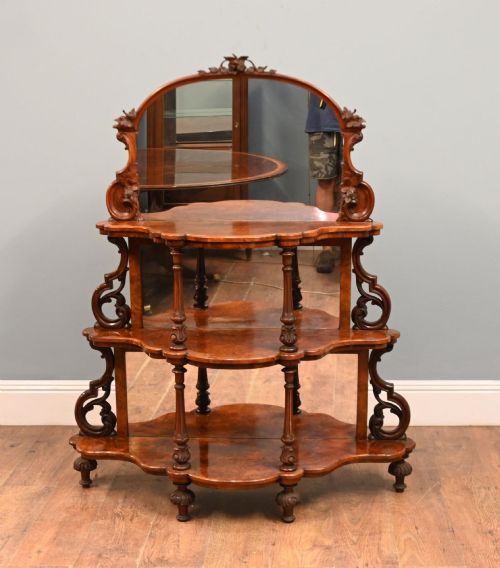
An antique mirrored whatnot is a multi-tiered display unit designed to hold ornaments, books, or small possessions while incorporating a mirror panel. These pieces combine the function of open shelving with the decorative and light-enhancing qualities of glass backing.
The versions most commonly met on this page belong to the Victorian period, dating from the mid to late nineteenth century. They typically take the form of multi-tiered etageres or fitted chiffoniers made for domestic display.
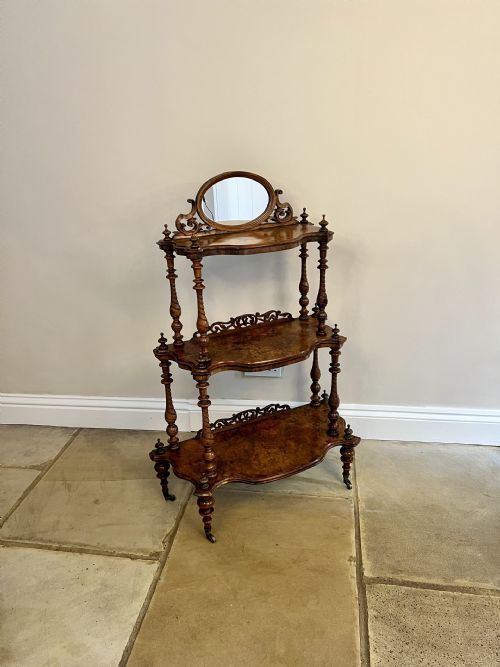
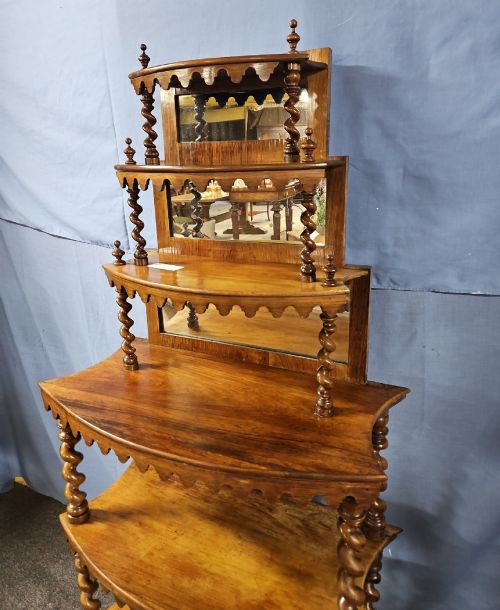
Makers of the period utilised various configurations, ranging from simple three-tier open shelves to complex six-tier structures and combination pieces featuring drawers, side cabinets, and canterbury sections. The inclusion of mirror glass distinguishes these particular items from standard shelving units.
Materials and construction
Cabinet makers of the nineteenth century built these pieces using dense hardwoods such as mahogany, rosewood, and burr walnut, often selecting veneers to highlight rich grain patterns. Timber selection dictated the structural integrity of the upright supports and the weight of the multiple tiers.
Marquetry inlay, brass detailing, and turned wooden supports frequently accompany the primary timbers, as seen in hollow barley twist columns and carved elements. Mirror glass is integrated into the back panels or framing structures to reflect light and display objects from multiple angles.
Current listings feature pieces predominantly from the Victorian period, spanning the nineteenth century with specific examples dated to the 1860s, 1870s, and 1880s.
Separating the fine examples from standard pieces
The quality of an antique mirrored whatnot is determined by the choice of timber and the precision of its decorative work. Finely figured burr walnut and carefully matched rosewood veneers indicate higher craftsmanship than plainer domestic timbers.
The Antique Mirrored Whatnot Glossary
- Whatnot
- A piece of furniture consisting of a set of open shelves for displaying small objects. They became popular in the nineteenth century for domestic display.
- Etagere
- A piece of furniture with a set of open shelves for displaying ornaments. The term is often used interchangeably with whatnot.
- Burr walnut
- A veneer taken from the warted growths on walnut trees, prized for its swirling grain pattern. It was widely used in Victorian cabinet making.
- Marquetry
- Decorative veneer work forming patterns or pictures using thin slices of wood. It appears on the surfaces of finer Victorian pieces.
- Canterbury
- A low stand with partitions for holding music sheets or books, sometimes incorporated into larger furniture pieces. Examples include combination whatnot stands.
Antique Mirrored Whatnot: Frequently Asked Questions
What is an antique mirrored whatnot used for?
An antique mirrored whatnot serves as an open display unit for ornaments, china, and small prized possessions within a domestic setting. The multiple tiers allow for structured arrangement while the integrated mirror adds visual depth to the room.
Historically, these pieces occupied drawing rooms and parlours where homeowners displayed decorative items to guests. Today, they function in much the same way, providing vertical display space without heavy enclosed cabinetry.
How do I date an antique mirrored whatnot?
Dating relies on identifying period characteristics, construction methods, and materials associated with nineteenth-century cabinet making. Pieces from this era frequently display Victorian stylistic traits such as burr walnut veneers, rosewood timbers, and turned supports.
Specific dates or decades are often indicated by the presence of registry marks, specific hardware styles, or documentation tied to the piece. Comparing the timber grain and inlay work against established Victorian forms helps narrow the timeline.
Are all antique whatnuts mirrored?
Not all antique whatnuts incorporate mirrors, as many traditional designs consist solely of open shelving supported by vertical columns. The inclusion of mirror glass became a popular variation during the Victorian period to enhance light reflection.
Pieces listed with mirrors often feature them as back panels behind the shelves or as part of an upper cabinet structure. Standard or simpler formats omit the glass entirely in favour of plain wood backing.
How do I live with an antique mirrored whatnot?
Living with one of these pieces involves placing it against a stable wall where its multiple tiers can support balanced arrangements of decorative objects. Care should be taken not to overload the upper shelves, as nineteenth-century joints are designed for moderate ornamental weight.
Positioning the unit away from direct sunlight protects the timber veneers and mirror backing from environmental degradation. Regular dusting and occasional wax polishing preserve the finish of the wood.