




Antique Mercury Gauge
These antique mercury gauge items combine precision brass, glass and timber to record atmospheric changes.
Antique Mercury Gauge
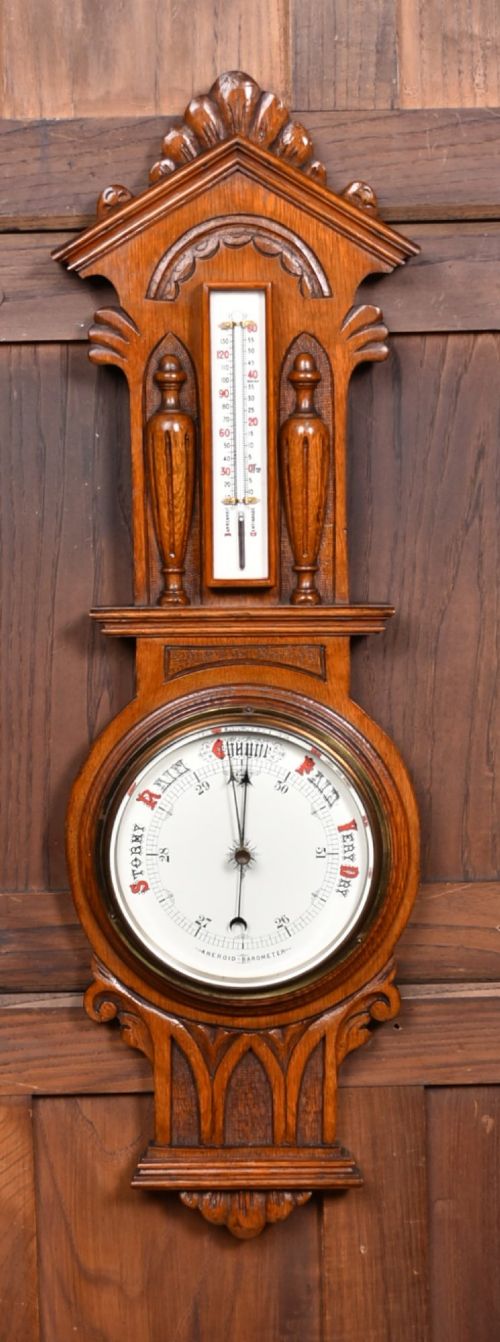
When you search for an antique mercury gauge, you are examining historical instruments designed to measure atmospheric pressure or temperature using liquid metal within glass tubes. These items include stick barometers, wheel barometers and wall or desk thermometers spanning the Georgian, Victorian and Edwardian eras. The Victorian banjo barometer in mahogany or rosewood is the most frequently encountered form on this page, often paired with a built-in thermometer.
The selection ranges from utilitarian travel instruments housed in leather cases to large domestic wall pieces featuring boxwood inlay or carved oak. Scientific makers sign several of the barometers and thermometers, linking domestic pieces directly to professional observation. Collectors find examples spanning the eighteenth century through to the Art Deco period.
Materials and construction
Makers housed sensitive glass tubes within robust timber cases, predominantly selecting mahogany, oak and rosewood for domestic wall and banjo barometers. Brass fittings secure the scales and dials, while silvered metal provides a clear surface for engraved graduations. Travel thermometers employ protective leather outer cases lined to secure the delicate glass components during transit.
Woodworkers shaped these enclosures using traditional joinery and carving techniques appropriate to each period, from Georgian mahogany framing to Victorian Gothic Revival detailing. Silvered metal scales feature finely etched numerals and inscriptions naming the maker and retail location. Boxwood inlay adds linear contrast to several rosewood and mahogany cases.
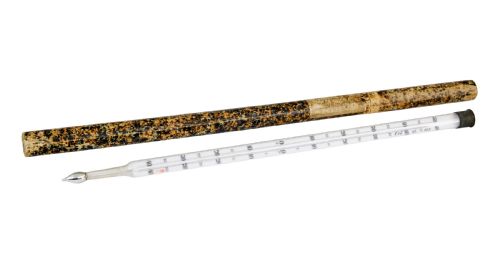
The selection includes portable travel thermometers in protective leather cases alongside large domestic wall barometers and desk accessories.
Distinctions in quality
Quality rests upon the crispness of the engraved silvered dial and the fidelity of the maker's signature. Signed instruments by known instrument makers command greater attention than unsigned workshop pieces. The choice of timber grain and the complexity of case carving also separate standard production from superior examples.
The preservation of the original mercury tube and the legibility of the engraved scales determine the integrity of each gauge. Finer pieces retain their secondary components, such as original cistern covers and matching thermometer bulbs, without modern replacement parts.
George Adams of Fleet Street·Alexander Wright·Goldsmiths of London·Negretti & Zambra·Cox of Plymouth Dock·Thomas Harris & Son·James H Kelly of Glasgow·Dollond London·W Watson & Sons London
The Antique Mercury Gauge Glossary
- Stick barometer
- An instrument that measures atmospheric pressure by balancing the weight of mercury against the atmospheric pressure acting on a cistern. These tall, slender pieces hang vertically on a wall.
- Banjo barometer
- A domestic barometer named after its rounded shape resembling the musical instrument. It typically houses a hygrometer, thermometer and dial face within a shaped wooden body.
- Silvered metal
- A brass or copper plate treated with a silver solution to create a bright, reflective surface for engraving scale markings. It provides high contrast against dark instrument cases.
- Fortin stick barometer
- A precision barometer featuring an adjustable leather-bottomed cistern that allows the mercury level to be set to a fixed ivory pointer before reading. This design improves measurement accuracy.
- Minimum thermometer
- A specialised thermometer designed to record the lowest temperature reached over a given period, often utilising spirit or mercury within a graduated glass tube.
Antique Mercury Gauge: Frequently Asked Questions
How do I read an antique mercury barometer?
Read the main dial or scale by noting the position of the mercury column relative to engraved weather indicators. Tap the glass gently to ensure the indicator needle moves freely before taking your reading.
Compare the current reading with the secondary pointer if the instrument includes a manually set marker. Rising levels generally indicate improving weather, while falling levels suggest approaching storms.
Where should I hang a wall barometer?
Select an interior wall away from direct sunlight and strong drafts to protect the wooden case and ensure accurate temperature responses. Stable room environments prevent the wood from warping and protect the mechanical joints.
Secure the instrument firmly to wall studs using appropriate fixings suited to the weight of the timber case. Ensure the barometer hangs perfectly vertical so the mercury column operates correctly.
Can I travel with a stick barometer?
Traditional stick barometers contain exposed mercury cisterns that require careful handling and specific transport procedures to avoid breaking the glass tube. Travel thermometers in leather cases were specifically designed for portability, unlike long wall barometers.
If moving a stick barometer, it must be tilted carefully to fill the tube completely with mercury or the cistern must be properly secured. Many collectors prefer professional transport services for delicate scientific instruments.
How do I date a barometer?
Examine the style of the wood case, the shape of the dial surround and the typography used on the silvered scale. Georgian pieces often feature architectural pediments, while Victorian banjo barometers display rounded shoulders and carved crests.
Maker signatures provide a reliable chronological anchor when combined with stylistic evidence from the period. Trade directories often record the working dates of firms like Negretti & Zambra or Dollond.