


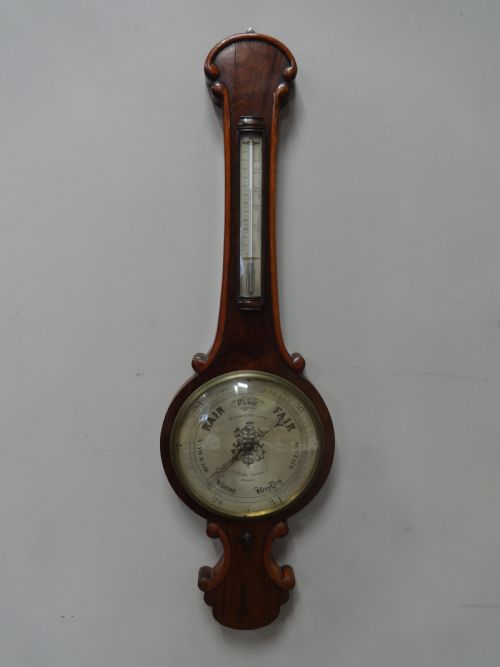

Vintage Rosewood Weather Glass
These vintage rosewood weather glass instruments combine domestic prediction with deep cabinet timber, offering both practical meteorological records and rich optical depth.
Vintage Rosewood Weather Glass
When you search for a vintage rosewood weather glass, you find nineteenth-century domestic instruments designed to measure atmospheric pressure through mercury, spirit, or aneroid mechanisms housed in dark tropical timber. The examples meeting you on this page span the Victorian era, alongside a few Georgian and Regency survivals, taking the form of stick barometers, wheel or banjo barometers, and combined clock-barometer units.
Makers housed these sensitive barometers in richly grained rosewood frames, frequently embellished with boxwood stringing, shell inlay, or bone scales. They served as essential household fixtures in grand halls and parlours before electronic forecasting, tracking impending weather changes through visible columns of liquid or rotating dials.
How they were made
Cabinetmakers constructed the main bodies from solid rosewood or pine carcasses veneered with figured rosewood, applying shellac polishes to bring out the dark oil-rich grain. They integrated contrasting lighter woods such as boxwood for string inlay, and cut mother-of-pearl to form floral or geometric medallions embedded directly into the wood.
Instrument makers fitted silvered brass dials, engraved scales, and mercury columns within glazed brass bezels, securing delicate internal levers and pulleys for wheel barometers. Where present, hydrometers, thermometers, and spirit levels used bone or ivory plates alongside turned brass cistern covers.
What varies in quality
The sophistication of the case decoration and the reputation of the recording maker separate standard examples from finer works. Simple wheel barometers share space with signed marine stick barometers and specialised clock-barometer combinations produced by noted London or provincial makers.
The crispness of the engraved silvered brass dial and the preservation of the original rosewood polish dictate the visual success of the piece. Better specimens retain their delicate bone adjustment knobs, intact mercury columns, and uncompromised boxwood or mother-of-pearl marquetry.
Ganthony of London·Fagioli of Clerkenwell London·Jenkins Of Old Swindon·Joseph Somalvico and Co
The Vintage Rosewood Weather Glass Glossary
- Aneroid barometer
- An instrument that measures air pressure using a flexible metal vacuum box rather than liquid mercury. It moves a pointer across a dial without the risk of spills.
- Wheel barometer
- A hanging domestic weather glass featuring a large circular dial, often called a banjo barometer due to its silhouette. A concealed weight and pulley system links the mercury tube to the pointer.
- Stick barometer
- A tall, narrow wall instrument where the mercury column remains directly visible against a graduated scale. This form provides high reading precision.
- Silvered metal
- A brass plate treated with a silver compound to produce a matte white metallic surface. Makers engraved calibrations and maker names onto this surface before blackening the incisions.
- Boxwood inlay
- Narrow strips of pale boxwood fitted into channels cut within the dark rosewood case. This technique creates crisp geometric borders.
Vintage Rosewood Weather Glass: Frequently Asked Questions
How do I read a mercury weather glass?
Observe the height of the mercury column within the glass tube against the engraved scale to determine current atmospheric pressure. Rising levels suggest improving weather, while falling columns indicate approaching rain or wind.
Make use of the secondary manual pointer on wheel dials to mark the current pressure position. Comparing subsequent readings against this marker reveals the direction of pressure change.
Can these antique barometers still predict weather?
Many surviving examples retain functional internal mechanics and respond accurately to local barometric pressure shifts. Calibrating them against known local measurements helps align the indicator needle.
Treat the readings as general domestic guides rather than scientific certainties. Changes in household temperature can also influence enclosed mechanisms.
How should I hang a heavy rosewood barometer?
Secure the instrument directly into structural wall studs or use heavy-duty wall anchors rated for the combined weight of the timber and glass. Hang the body plumb so the internal mercury or mechanical linkages move freely without friction.
Avoid exterior walls subject to dampness or locations near direct heat sources such as radiators. Fluctuating temperatures can warp the rosewood case and affect internal liquid levels.
How do I date a rosewood barometer?
Examine the dial signature, case silhouette, and secondary woodworking details to establish an approximate period. Georgian and Regency pieces often feature architectural pediments and distinct regional dial layouts, whereas Victorian examples tend toward heavier frames and enriched mother-of-pearl inlay.
Look for maker signatures recorded on the brass dial plates or engraved scales. Cross-referencing these names with trade directories narrows the production window.