


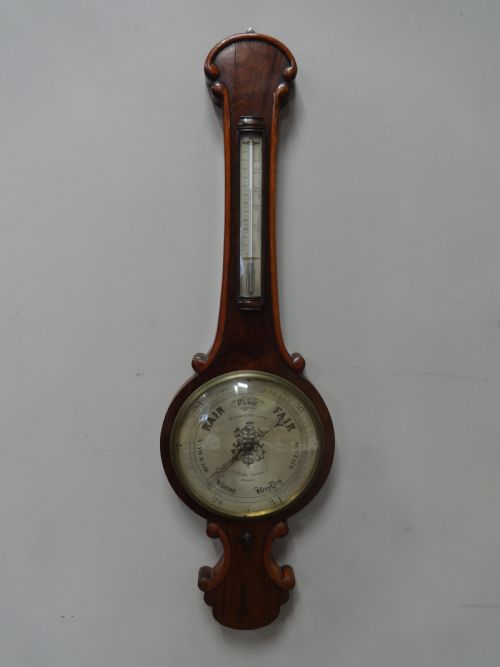


Antique Rosewood Barometer
An antique rosewood barometer measures atmospheric pressure while bringing rich timber grain and period craftsmanship into a room.
Antique Rosewood Barometer
An antique rosewood barometer is a domestic weather instrument housed in a dark, richly grained case, most commonly appearing in Victorian wheel, banjo or stick formats. These instruments range from large dial barometers designed for principal rooms to slender marine stick barometers built for stability at sea.
The versions most frequently met on this page date from the nineteenth century, encompassing Georgian, Regency and Victorian eras. Makers often incorporated thermometers, hygrometers and spirit levels alongside the primary pressure dial.
The form evolved from tall, vertical mercury tubes to domestic banjo shapes decorated with stringing and shell inlay. Buyers select these pieces both for their functional meteorological display and as decorative furniture of substance.
How they were made
Cabinetmakers constructed the wooden housings from solid rosewood or applied dense veneers over secondary timbers, often embellishing the surfaces with boxwood inlay, fruitwood and shimmering mother-of-pearl. Brass bezels protected the dials, while delicate silvered metal plates displayed the engraved pressure scales and weather inscriptions.
Instrument makers filled the glass tubes with purified mercury for mercurial barometers, or relied on sealed metal bellows for later aneroid mechanisms. Fine wheel and banjo barometers required precise internal linkages to translate subtle shifts in air pressure into visible needle movements on the dial.
What varies in quality
Quality rests in the crispness of the cabinetwork and the finesse of the dial engraving, where sharp lettering and detailed floral or geometric inlay separate standard workshop output from superior commissions. The choice of timber grain, particularly matched rosewood veneers and well-selected mother-of-pearl escutcheons, dictates visual depth.
The standard of the internal scientific apparatus also defines the tier of the piece, from basic domestic indicators to signed mercurial movements by established makers with finely calibrated vernier scales.
Ganthony of London·Fagioli of Clerkenwell London·Jenkins Of Old Swindon·Joseph Somalvico & Co·Corti of Exeter·Ballard of Cranbrook
The Antique Rosewood Barometer Glossary
- Barometer
- An instrument used to measure atmospheric pressure in order to forecast weather changes. Most antique examples utilise either a mercurial column or an aneroid capsule.
- Banjo barometer
- A domestic wall barometer shaped somewhat like a banjo, featuring a circular dial at the base and a tall stem housing a thermometer or hygrometer. This layout dominated nineteenth-century parlours.
- Stick barometer
- A tall, narrow wall instrument where the mercury tube remains largely exposed behind glass, often protected by a arched or broken pediment top. They provide precise readings and lean towards a more architectural aesthetic.
- Aneroid barometer
- A type of barometer that measures pressure using a flexible sealed metal box without employing liquid mercury. This design became common during the Victorian period.
- Silvered metal
- A brass or copper dial plate treated to achieve a bright silver finish, onto which graduations and maker details are engraved and blackened. It reflects light softly behind a glass bezel.
Antique Rosewood Barometer: Frequently Asked Questions
How do I read an antique barometer?
Read the main dial by observing the position of the pointer relative to engraved weather words like "Rain", "Change" and "Fair". Many instruments include a secondary movable pointer set by hand to track whether pressure rises or falls over subsequent hours.
For mercurial stick models, read the height of the mercury column against the scale in inches or centimeters. Tapping the glass gently before reading ensures the mechanism settles freely.
Where should I hang a wall barometer?
Hang your barometer on an interior wall away from direct sunlight, radiators and heavy vibrations from slamming doors. Stable room temperatures prevent undue stress on the wooden case and internal brass components.
Secure the instrument to a sturdy wall fixing using the hanging bracket provided on the rear of the case. Ensure it hangs completely plumb so the internal plumb line or mercury tube functions accurately.
Are these barometers still accurate?
Many antique barometers continue to respond to real atmospheric pressure changes, though older domestic dials serve primarily as general trend indicators rather than precision meteorological tools. Aneroid models can often be calibrated via a screw on the rear to match local barometric pressure.
Mercurial barometers require careful handling and professional setup if moved, but their physical response to weather remains fundamentally sound when the glass tube stays intact.
How do I date a rosewood barometer?
Examine the overall shape, secondary materials and signature styles to establish a period. Earlier nineteenth-century examples often feature exposed mercury tubes and swan-neck pediments, while mid-Victorian pieces lean towards heavier banjo forms with extensive mother-of-pearl inlay.
Makers' signatures engraved on the dial or pasted on paper labels behind the case offer the most precise dating evidence. Comparing the dial layout to documented maker timelines narrows the window further.