
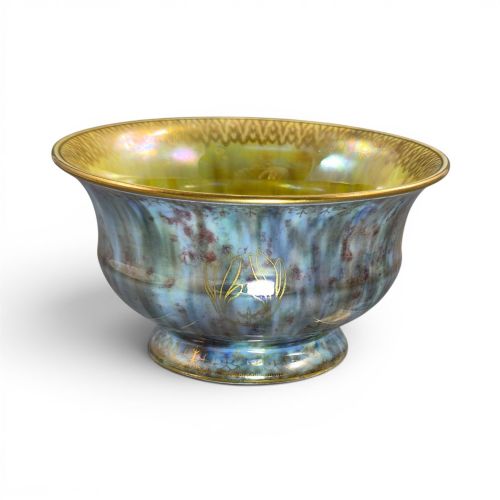


Antique Lustreware Dish
An antique lustreware dish brings shifting metallic sheens and deep glazes to a room, catching the light in a way ordinary ceramics cannot.
Antique Lustreware Dish
When you search for an antique lustreware dish, you encounter decorative bowls spanning several distinct periods, from pre-sixteenth century Persian works to Edwardian and twentieth-century British creations. The selection here leans heavily towards early twentieth-century porcelain and bone china bowls, alongside earlier ceramic pieces from Persian Islamic and Seljuk traditions.
The decorative bowls take various forms, including octagonal, miniature, lantern, and footed shapes. Collectors frequently find pieces featuring intricate imagery such as dragons, butterflies, horses and riders, and tulip patterns set against mottled or gilt backgrounds.
What varies in quality
The refinement of the painted detail and the complexity of the pattern distinguish finer pieces from simpler examples. Elaborate pictorial subjects, such as detailed dragons or figurative riders, demand greater skill than abstract mottled grounds.
The brilliance and uniformity of the metallic glaze across complex bowl geometries determine the visual success of the piece. Crisp application of gold leaf and lustre glaze enhances the depth of the design.
Materials represented across the bowls include porcelain, bone china, ceramic, gold leaf, lustre glaze, and gilt.
Wedgwood·Daisy Makeig-Jones·James Hodgkiss
The Antique Lustreware Dish Glossary
- Lustre Glaze
- A type of pottery glaze containing metallic salts that produce an iridescent or metallic sheen upon reduction firing. This finish gives the ceramics their distinctive reflective quality.
- Bone China
- A type of soft-paste porcelain composed of bone ash, feldspathic material, and kaolin. It provides a strong, bright white body suitable for detailed surface decoration.
- Porcelain
- A ceramic material made by heating materials, generally including clay in the form of kaolin, in a kiln. It offers a dense, non-porous structure.
- Art Nouveau
- An international style of art, architecture, and applied art popular during the late nineteenth and early twentieth centuries. It is characterised by organic forms and sinuous lines.
Antique Lustreware Dish: Frequently Asked Questions
How do I care for my antique lustreware dish?
Keep ceramic and porcelain pieces away from direct, harsh sunlight to protect the metallic glazes and gilt details over time.
Dust the surface gently with a soft, dry cloth rather than using liquid cleaners or abrasive materials that might damage the delicate glaze.
What periods do these dishes come from?
The pieces span a wide chronological range, including pre-sixteenth century Persian Islamic and Seljuk examples alongside Edwardian and 1930s British works.
Twentieth-century items from the 1910s and 1920s form a significant portion of the available decorative bowls.
How were Persian lustre bowls made?
Potters applied metallic pigments over an opaque white glaze and fired the ceramic a second time in a reduced oxygen environment.
This technique left a thin, metallic layer on the surface, creating an iridescent sheen that imitated precious metals.
What motifs appear on these bowls?
Common decorative subjects include mythical creatures such as dragons and phoenixes, alongside butterflies, floral tulip patterns, and figurative horse and rider scenes.
Backgrounds often feature mottled orange, green, or gilt finishes that complement the central imagery.