
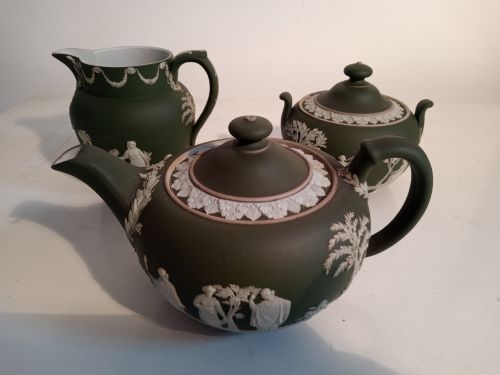


Antique Jasperware Pottery
Antique jasperware pottery brings neoclassical relief figures and contrasting matte coloured bodies into your home, offering a distinct aesthetic rooted in the nineteenth century.
Antique Jasperware Pottery
Antique jasperware pottery comprises utilitarian and decorative forms from the Victorian era and the nineteenth century, most frequently encountered as biscuit barrels, teapots, cheese dishes, and relief vases.
Buyers seeking this ware will routinely find classical relief decorations applied across blue, olive green, and stone-coloured ceramic bodies, often paired with silver plate mounts.
The objects on this page span table accessories and decorative vessels, representing neoclassical and Victorian styles produced by prominent Staffordshire potteries.
How they were made
Potters formed these items using stoneware and earthenware, applying contrasting white moulded clay reliefs by hand onto a fine-grained, unglazed ceramic body.
Many serving pieces combine ceramic bodies with silver plate fittings, requiring precise metalwork to mount hinged lids, rims, and swing handles securely onto the pottery.
This site's listings show nineteenth-century jasperware spanning utilitarian items like biscuit barrels and teapots, alongside decorative vases and cheese dishes.
What varies in quality
The standard of an antique jasperware piece rests on the crispness of the moulded relief work and the subtlety of the colour saturation across the ceramic body.
Superior examples demonstrate clean separation between the applied white figures and the background clay, alongside finely detailed metal mounts where silver plate is utilised.
Wedgwood·Copeland Spode·James Dudson·William Adams and Sons·Adams
The Antique Jasperware Pottery Glossary
- Jasperware
- A type of fine stoneware developed by Josiah Wedgwood, characterised by a matte surface and contrasting white relief ornamentation. It requires precise chemical control of metal oxides to achieve uniform background colours.
- Neoclassical
- A style drawing inspiration from classical antiquity, featuring symmetrical forms and motifs such as Greco-Roman figures and floral garlands. This aesthetic heavily influences nineteenth-century ceramic decoration.
- Biscuit Barrel
- A covered ceramic container designed to hold dry biscuits or cookies during Victorian tea service. These vessels frequently feature decorative metal rims and swing handles.
- Cheese Dish
- A two-part serving piece consisting of a domed cover and a flat stand, intended for storing and presenting cheese at the dining table. The cover traps humidity to keep the cheese fresh.
- Stoneware
- A dense, vitreous ceramic fired at high temperatures until impervious to liquid even without glaze. It provides a durable foundation for fine exterior relief work.
Antique Jasperware Pottery: Frequently Asked Questions
What is jasperware pottery?
Jasperware is a fine ceramic material developed in the eighteenth century, known for its unglazed matte surface and contrasting white relief figures.
Potters use metallic oxides to colour the clay body, producing characteristic shades of blue, green, and dark tones.
How do I date antique jasperware?
Dating relies on identifying maker marks stamped into the base, style cues, and associated metal mounts from the Victorian period.
Nineteenth-century pieces often include registry marks or specific factory ciphers that narrow down the year of production.
How were biscuit barrels used?
Victorian households utilised biscuit barrels on the dining or tea table to store dry biscuits and keep them fresh throughout the day.
The lidded vessels often featured silver plate mountings and handles for ease of transport during formal gatherings.
Can I use these for food?
While historic teapots and tableware were made for culinary use, many collectors prefer to display antique pottery rather than put it back into active service.
Displaying them protects the unglazed surfaces and delicate applied reliefs from modern dishwashers and staining.