


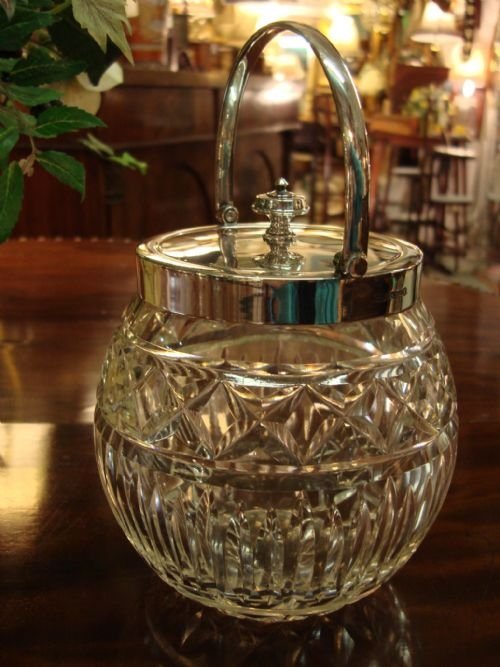
Silver Topped Biscuit Jar
A silver topped biscuit jar brings elegance to the tea table, combining gleaming metal with cut glass, ceramic or oak.
Silver Topped Biscuit Jar
A silver topped biscuit jar is a decorative container designed for storing dry biscuits and cookies during the Victorian and Edwardian eras. These pieces sit comfortably on a dining table or sideboard, offering both practicality and visual charm.
The versions most commonly met on this page span the Victorian, Edwardian, and George V periods. They take the form of cylindrical barrels or drum shapes, often paired with matching silver plated or sterling silver mounts.
How they were made
Makers fashioned the bodies of these vessels from cut glass, faceted glass, cranberry glass, stoneware, jasperware, earthenware, and English oak. Glass bodies were frequently heavy and deeply cut to catch the light, whilst ceramic bodies featured classical reliefs or painted details.
The lids, rims, and swinging handles were typically formed from silver plate or hallmarked sterling silver. These metal components required precise fitting to the ceramic or glass bodies to ensure a secure closure.
Listings span from the 1860s through the 1930s, encompassing Victorian, Edwardian, George V, and Art Deco styles.
What varies in quality
Quality rests heavily on the crispness of the glass cutting or the fineness of the ceramic relief work. Pieces with deep, sharp facets or well-defined jasperware details stand apart from simpler iterations.
The weight and thickness of the silver plating or the presence of solid sterling silver hallmarks elevate a piece. Heavier metal mounts and fully articulated swinging handles demonstrate superior manufacturing standards.
Walker & Hall·Crown Devon·Wedgwood·James Dixon and Sons
The Silver Topped Biscuit Jar Glossary
- Jasperware
- A type of pottery developed by Josiah Wedgwood, characterised by a matte unglazed finish and contrasting raised white reliefs. It appears frequently on nineteenth-century examples.
- Cranberry glass
- A rich red-pink glass coloured with gold chloride during the melting process. It creates a striking visual contrast against silver plated mountings.
- Silver plate
- A layer of silver fused to a base metal such as copper or nickel brass. Most Victorian and Edwardian examples utilise this technique rather than solid silver.
- Hallmark
- An official stamp applied by an assay office to indicate the purity of precious metals. Sterling silver components carry these specific marks.
Silver Topped Biscuit Jar: Frequently Asked Questions
What is a silver topped biscuit jar?
A silver topped biscuit jar is a covered container used in the nineteenth and early twentieth centuries to serve biscuits in polite society.
They combine a glass or ceramic body with a metal lid and handle, often designed to sit on the drawing room sideboard.
How were biscuit barrels used?
These vessels were brought out during afternoon tea or after-dinner gatherings to keep dry biscuits fresh and crisp.
Hostesses would lift the metal lid to offer guests a selection of sweet or savoury accompaniments.
How do I date a biscuit barrel?
Dating relies on the materials, decorative styles, and any metal hallmarks present on the mountings.
Victorian pieces often feature heavy cut glass or jasperware, whilst later Edwardian and George V examples show simpler geometric or neoclassical lines.
How do I care for my jar?
Gentle cleaning with warm soapy water preserves both the glass body and the delicate metal surfaces.
Avoid harsh abrasives on silver plated components to prevent wearing away the thin precious metal layer.