


Antique Tableware Biscuit Jar
These antique tableware biscuit jar pieces are refined lidded containers designed to hold dry baked goods on the dining table, combining practical storage with Victorian and Edwardian elegance.
Antique Tableware Biscuit Jar
When you search for an antique tableware biscuit jar, you encounter lidded vessels created to serve dry baked goods during formal dining and afternoon tea. These containers belong to a tradition of elegant table service that flourished from the Victorian era into the early twentieth century.
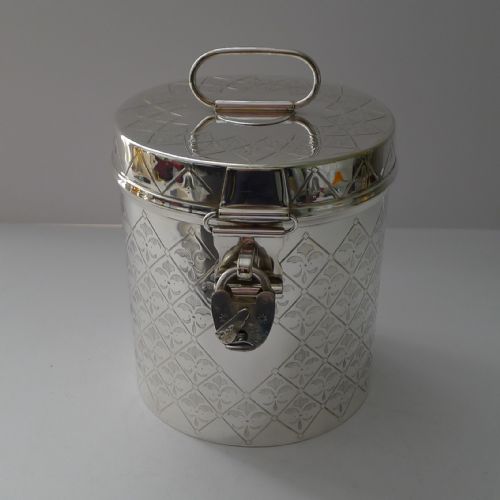
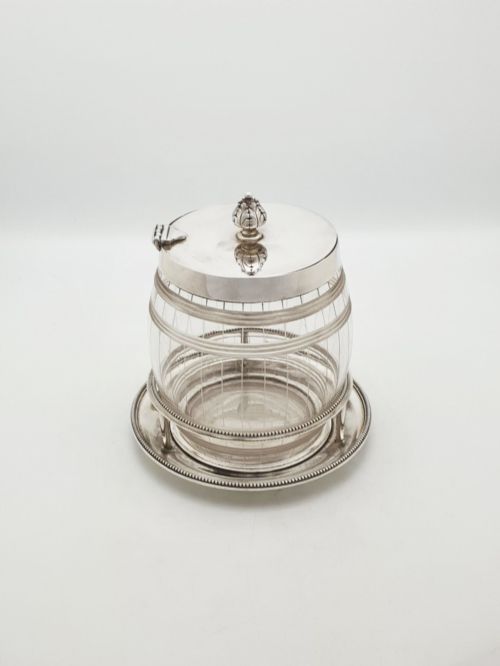
The versions most commonly met on this page include silver plated mountings paired with cut glass, cranberry glass, or ceramic bodies such as Jasperware and stoneware. Formats range from simple cylindrical boxes to elaborate designs featuring stands, twisted handles, and decorative finials.
Originating predominantly from English workshops, these pieces encompass Victorian, Edwardian, Neoclassical, and Art Deco styles. Makers utilised diverse materials to create functional containers that doubled as ornamental centrepieces for the dining room.
Materials and construction methods
Makers combined metalwork and glass production, pairing electroplated nickel silver or solid sterling silver mounts with cut glass, faceted glass, or cranberry glass bodies. Glass liners and bodies were often moulded or cut to catch the light on the dining table.
Ceramic variations incorporated Jasperware and stoneware, demonstrating skilled moulding and applied relief work. Metal components involved silver plating over a base metal, alongside complex mechanisms such as locking boxes and pierced galleries.
Listings span from the Victorian period through the Edwardian era into the 1920s, showcasing silver plate, cut glass, and Jasperware.
Distinctions in craftsmanship and design
Quality rests upon the crispness of the glass cutting, the weight and durability of the silver plating, and the structural integrity of hinged mounts and locking mechanisms. Finer examples display intricate piercing, well-fitted glass liners, and detailed cast finials.
Design complexity also separates standard production from superior pieces, with notable makers incorporating specialised stands, heraldic motifs, and multiple handles that elevate the functional object into an ornamental statement.
Mappin and Webb·Elkington·Robert and Belk·Walker and Hall·Wedgwood
The Antique Tableware Biscuit Jar Glossary
- Silver Plate
- A thin layer of silver applied to a base metal such as copper or nickel silver. This technique provided the appearance of solid silver at a more accessible cost for nineteenth-century households.
- Jasperware
- A type of fine stoneware developed with a matte finish, famously featuring contrasting applied white classical reliefs against a coloured background. It remains closely associated with prominent pottery manufacturers.
- EPNS
- An abbreviation for electroplated nickel silver, which denotes a base alloy coated in silver using an electrical process. It serves as a standard indicator of nineteenth and twentieth-century metalware.
- Finial
- A decorative ornamental knob or figure attached to the top of a lid. On these containers, they often took sculptural forms such as heraldic dragons.
- Cranberry Glass
- A rich pink or red transparent glass coloured by the addition of gold chloride during manufacture. It was highly favoured for decorative tableware during the Victorian and Edwardian periods.
Antique Tableware Biscuit Jar: Frequently Asked Questions
What were biscuit jars used for?
These vessels were designed to hold sweet biscuits and dry baked goods safely on the Victorian or Edwardian dining table.
They kept contents fresh and dry while serving as an elegant decorative element during afternoon tea or formal meals.
How do I identify a Victorian biscuit jar?
Victorian examples often feature heavy silver plated mounts combined with cut glass, Jasperware, or elaborate ornamentation.
Look for stylistic cues such as Neoclassical motifs, heraldic finials, and maker marks associated with the mid to late nineteenth century.
Are glass liners original?
Many surviving pieces retain their original fitted glass liners, which protected the metal interior from crumbs and moisture.
Because liners were fragile, replacement glass is sometimes found paired with antique silver plated mounts.
How should I clean silver plated mounts?
Silver plate requires gentle cleaning with a soft cloth and a specialised polish formulated for plated items.
Avoid harsh abrasives that can wear away the thin silver layer and expose the underlying nickel or base metal.