


Antique Japanned Tall Clock
An antique japanned tall clock brings a brilliant scheme of orientalist lacquer and brass movement into a room.
Antique Japanned Tall Clock
An antique japanned tall clock is a longcase timekeeper decorated in the European imitation of East Asian lacquer work, frequently described in the trade as chinoiserie. These pieces stand upright with tall wooden cases enclosing the weight-driven movement and pendulum, originating primarily in the Georgian period and the eighteenth century alongside a smaller number of later expressions.
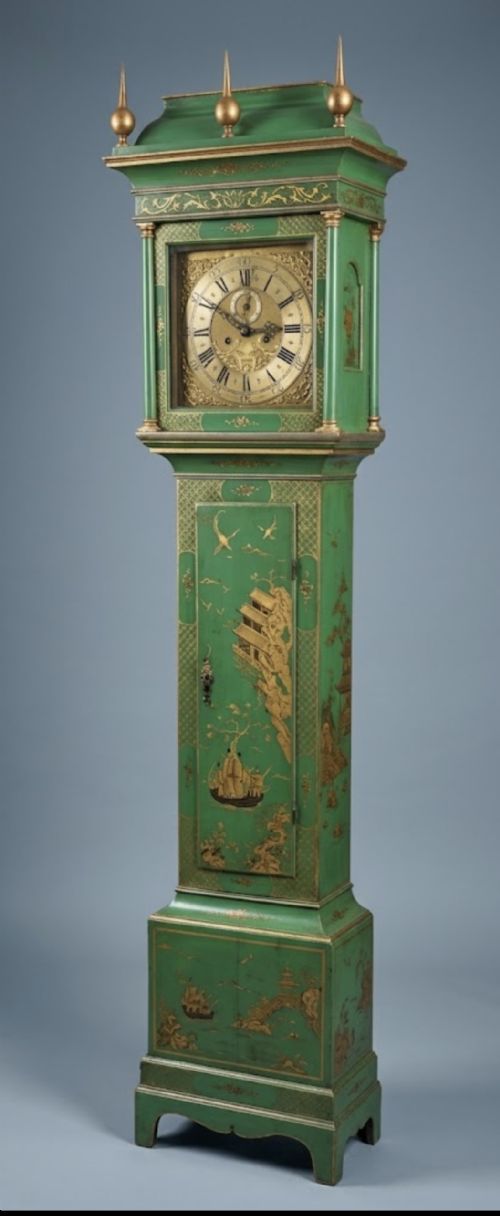
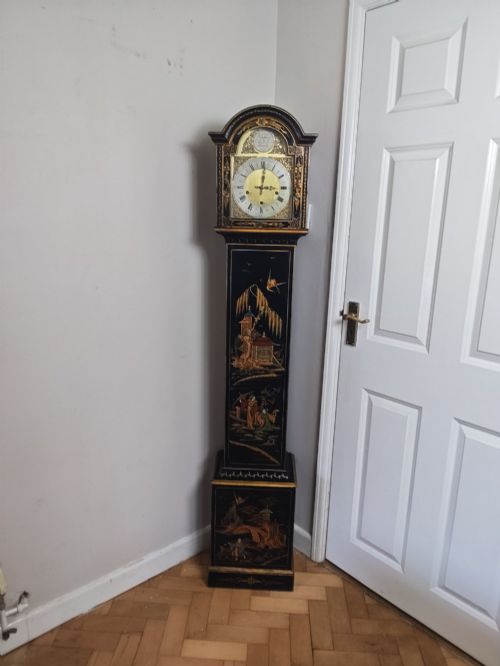
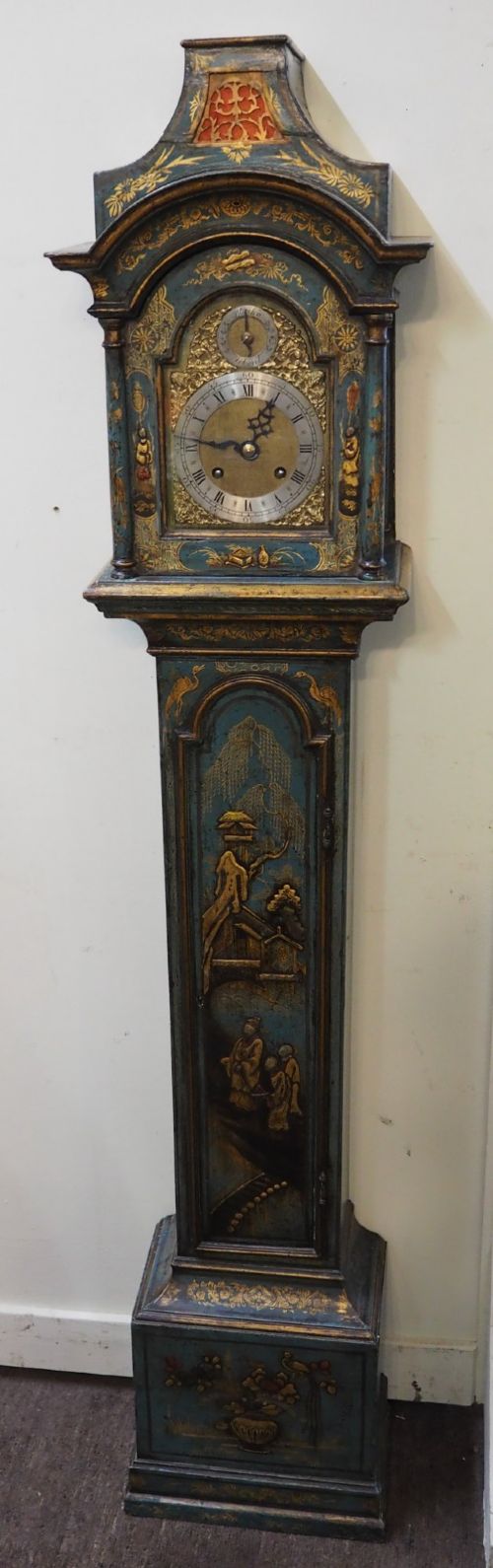
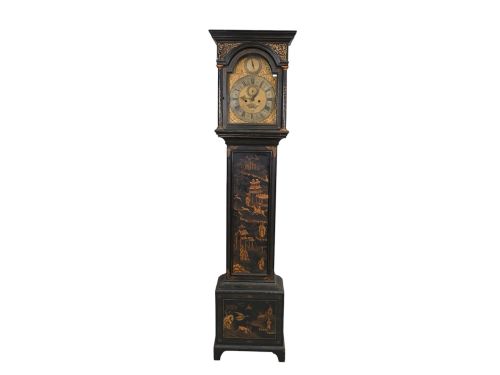
The forms on this page span grand eight-day grandfather clocks and smaller grandmother clocks, showing regional diversity from London makers to makers in Alton, Yarmouth, and Edinburgh. The dominant visual language relies on figures, pagodas, and landscapes painted or raised in gold and polychrome upon a coloured ground.
Buyers encounter surfaces in green lacquer, blue lacquer, and gilt lacquer, reflecting the varied tastes of eighteenth-century households. These tall clocks combine mechanical utility with ambitious decorative programmes that served as focal points in period interiors.
How they were made
Makers constructed the tall wooden cases using native timbers as a substrate before applying successive layers of varnish, gesso, and paint to achieve the characteristic japanned surface. Guilders and painters built up raised motifs using gold leaf and metallic powders to create the pictorial scenes associated with chinoiserie decoration.
The internal mechanics rely upon brass movements, which house the gear trains, escapements, and striking or musical mechanisms constructed by skilled horologists. Glass panels protect the dial face, allowing visibility of the chapter ring and hands while shielding the delicate brass work from dust.
Certain clocks include mechanical automata that bring painted scenes to life while the brass movement keeps time.
What varies in quality
The standard of an antique japanned tall clock rests upon the crispness and complexity of the painted or raised lacquer decoration across the tall case. Finer examples display intricate pictorial narratives with well-preserved gilding and depth, whereas simpler specimens feature repetitive or heavily restored surface detail.
Mechanical execution distinguishes the work of eminent makers from provincial production, seen in the finish of the brass movement and the inclusion of complications such as musical tunes or automata. The architectural proportion of the wooden case and the harmony between the dial signature and the housing further define the tier of the piece.
John fielder of Alton·William Kipling London·Thomas Utting of Yarmouth·Gardner of London
The Antique Japanned Tall Clock Glossary
- Japanned wood
- Wood finished with European lacquer techniques imitating Asian export screens and furniture. This surface treatment involves multiple layers of varnish and metallic dust.
- Chinoiserie
- European decorative style interpreting Chinese and East Asian artistic traditions. It appears prominently on eighteenth-century furniture and clock cases.
- Longcase clock
- A tall pendulum clock enclosed in a wooden case standing directly on the floor. These instruments are frequently termed grandfather or grandmother clocks depending on their height.
- Brass movement
- The mechanical interior of a clock constructed primarily from brass plates, wheels, and gears. This assembly regulates the passage of time and drives any striking trains.
- Automaton
- A mechanical device integrated into a clock that produces movement, such as figures interacting with the passage of time. These complications elevate the ambition of the piece.
Antique Japanned Tall Clock: Frequently Asked Questions
What is a japanned tall clock?
A japanned tall clock is an upright timekeeper housed in a wooden case decorated with European lacquerwork in the chinoiserie taste. These pieces combine mechanical clockwork with elaborate painted and gilt surface ornamentation.
They emerged as prominent furnishings during the Georgian era, serving both to measure time and to display fashionable taste in domestic interiors.
How do I care for lacquer?
Lacquer surfaces require stable environmental conditions away from direct sunlight and extreme temperature fluctuations to prevent the finish from cracking or fading. Gentle dusting with a dry, soft cloth is sufficient for routine maintenance.
Avoid using modern chemical polishes, water, or abrasive cleaners, which can permanently damage the delicate gold leaf and painted layers.
What is the difference between grandfather and grandmother clocks?
Grandfather clocks are standard full-sized longcase timekeepers, while grandmother clocks are scaled-down versions produced in smaller proportions. Both share similar mechanical and decorative characteristics but suit different spatial requirements.
Smaller grandmother clocks often date to later revival periods or specific twentieth-century interpretations of earlier eighteenth-century designs.
How do I identify eighteenth-century examples?
Eighteenth-century examples are identified through construction methods, movement characteristics, and the style of the japanned decoration typical of the Georgian period. Maker signatures inscribed on the brass dial face often provide specific chronological anchors.
The integration of early brass movements and traditional proportions further distinguishes pieces from this foundational era.