

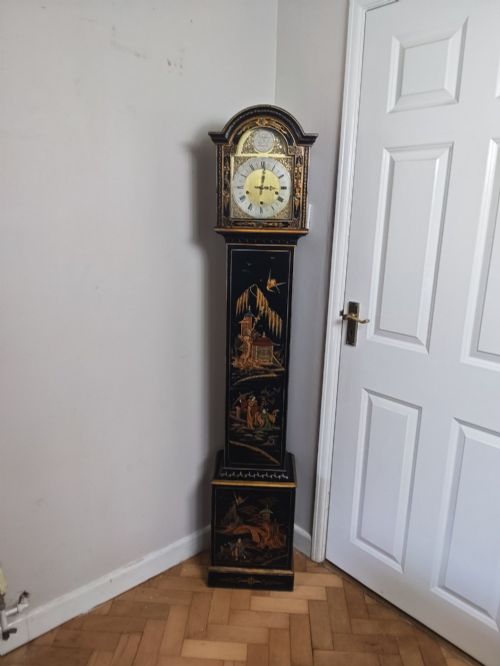


Antique Japanned Standing Clock
An antique japanned standing clock brings layered Chinoiserie ornament and a tall wooden case into a room.
Antique Japanned Standing Clock
An antique japanned standing clock is a tall timepiece housed in a wooden case decorated with lacquer and Chinoiserie ornament. These floor-standing pieces range from full-size longcase clocks to smaller grandmother clocks.
Buyers encounter versions spanning the 18th century and Georgian period alongside later 1930 revivals. The forms include green and cream lacquered longcase clocks originating from makers in places such as Alton, Edinburgh, London, and Yarmouth.
The aesthetic combines traditional cabinet-making with painted and gilt motifs on wood surfaces. Most examples rely on brass movements to track time within their decorated enclosures.
How they were made
The construction of an antique japanned standing clock involves shaping wood into a tall case and applying layers of lacquer. Artisans built these housings to protect the delicate internal mechanisms while serving as prominent interior furniture.
Decoration relied on japanning techniques, which simulated Asian lacquerwork using paint, gold leaf, and raised motifs. Makers added gilt details and brass for both the mechanical movements and structural mounts.
Antique Japanned Standing Clock Retail Price Guide 2026
Typical asking prices for japanned standing clock among the pieces listed under this phrase on Sellingantiques today, from the lower quarter to the upper quarter. They describe what is for sale here now, not the wider market.
Timekeeping relies on brass movements housed inside miniature painted worlds of pavilions and figures.
What varies in quality
The sophistication of the Chinoiserie decoration separates standard examples from finer works. The depth of the lacquer layers and the precision of the gilt and painted details dictate visual refinement.
Originality of the wooden case and the integrity of the brass movement determine the historical standing of each clock. Pieces retaining their early dark green finishes or documented maker signatures hold distinct character.
John fielder of Alton·Thomas Utting of Yarmouth·Gardner of London
The Antique Japanned Standing Clock Glossary
- Japanned wood
- Wood treated with European resin-based imitation lacquer finishes. This technique created glossy dark or pale surfaces decorated with raised motifs.
- Chinoiserie
- European artistic style reflecting Chinese and East Asian motifs. It appears on these clocks as painted figures, landscapes, and pavilions.
- Longcase clock
- A tall pendulum clock enclosed in a wooden case standing directly on the floor. These tall enclosures are also known colloquially as grandfather clocks.
- Grandmother clock
- A smaller, scaled-down version of the traditional longcase clock. They offer the same visual style in a reduced height.
- Brass movement
- The internal mechanical workings constructed primarily from brass to drive the gear train and timekeeping functions.
Antique Japanned Standing Clock: Frequently Asked Questions
What is an antique japanned standing clock?
An antique japanned standing clock is a tall floor-standing timepiece featuring a lacquered wooden case decorated in the Chinoiserie style. These pieces range from grand 18th-century longcase examples to later 1930 revivals.
They combine tall cabinet work with painted or gilt ornamentation and brass movements. Each clock serves as both a functional timepiece and a decorative focal point.
How do I date an antique japanned standing clock?
Dating relies on examining the construction of the wooden case, the style of the Chinoiserie decoration, and any recorded maker details. Pieces span the Georgian era, the 18th century, and the 1930 revival period.
Earlier examples from the 1700s often feature dark green lacquered surfaces and specific regional signatures. Later 1930 interpretations introduce cream finishes and alternative proportions while mirroring the traditional aesthetic.
Where were these clocks made?
These clocks originated in various British workshops and regional centres during the Georgian period and the 18th century. Recorded makers worked in locations such as London, Edinburgh, Alton, and Yarmouth.
Local cabinet-makers and clockmakers collaborated to build the tall wooden housings and fit the brass movements. Later revival pieces from 1930 continued this tradition of tall decorative timepieces.
How should I place one in a room?
A standing clock requires a stable floor and sufficient vertical clearance to accommodate its tall wooden case. Placing the piece away from direct sunlight protects the lacquered finish and gold leaf details.
Because these clocks feature prominent Chinoiserie artwork, they function well as standalone statement furniture in hallways or living spaces. The vertical proportions draw the eye upward while maintaining a steady mechanical rhythm.